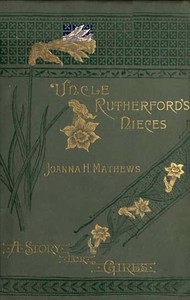
Uncle Rutherford's Nieces: A Story for Girls — Themes and Context
Edition facts
Uncle Rutherford's Nieces: A Story for Girls — Themes and Context can be approached with a clearer sense of reading commitment from its source measurements: 66,168 words, 4 hr 48 min estimated reading time, and 8 detected text sections.
The text analysis averages about 27.3 words per sentence, while the detected sections provide another way to judge how the source is divided.
Project Gutenberg metadata also associates the work with “Christian life -- Juvenile fiction,” connecting these edition facts with the source record’s subject description.
Calculated from edition completeness, EPUB availability, text structure and catalogue metadata. Not a user rating.
How this score is calculated
- Description quality20 pts
- Title & short description10 pts
- Source metadata20 pts
- Text length15 pts
- Chapters / structure15 pts
- EPUB file integrity20 pts
Total of 100 points, scaled to a 2.5-5.0 range. Editions with an empty description or a missing EPUB file are not scored.
Read the Text
CHAPTER I. AN ARITHMETICAL PUZZLE 7
CHAPTER II. A CABLEGRAM 27
CHAPTER III. AN ARRIVAL 47
CHAPTER IV. "FOOD FOR THE GODS" 71
CHAPTER V. THE "MORNING BUGLE" 89
CHAPTER VI. UNCLE RUTHERFORD'S PRIZE 107
CHAPTER VII. TWO PEANUT-VENDERS 129
CHAPTER VIII. NOT ON THE PROGRAMME 151
CHAPTER IX. MATTY 173
CHAPTER X. A COLD BATH 195
CHAPTER XI. FIVE DOLLARS 219
CHAPTER XII. CAUGHT IN THE ACT 241
CHAPTER XIII. MATTY IS PROVIDED FOR 261
CHAPTER XIV. JIM'S CONFESSION 285
UNCLE RUTHERFORD'S NIECES
AN ARITHMETICAL PUZZLE.
A sunny and a dark head, both bent over a much-befigured, much-besmeared slate, the small brows beneath the curls puckered,--the one in perplexity, the other with sympathy; opposite these two a third head whose carrotty hue betrayed it to be Jim's, although the face appertaining thereto was hidden from my view, as its owner, upon his hands and knees, also peered with interest at the slate. Wanderer, familiarly known as "Wand,"--the household dog, and the inseparable companion of my little sisters,--lay at their feet, as they sat upon a low rustic seat, manufactured for their special behoof by the devoted Jim; its chief characteristic being a tendency to upset, unless the occupant or occupants maintained the most exact balance, a seat not to be depended upon by the unwary or uninitiated, under penalty of a disagreeable surprise. To Allie and Daisy, however, it was a work of art, and left nothing to be desired, they having become accustomed to its vagaries.
Such was the picture which presented itself to my view as I came out on the piazza of our summer-home by the sea, and from that point of vantage looked down upon the little group on the lawn below.
But the problem upon which all three were intent had evidently proved too much for the juvenile arithmeticians; and, as I looked, Allie pushed the slate impatiently from her, saying,--
"I can't make it out, Jim: it's too hard. You are too mixed up."
"Now, Miss Allie! an' you with lessons every day," said Jim reproachfully. "Should think you might make it out."
"I'm not so very grown up, Jim," answered the little girl; "and I've not gone so very far in the 'rithmetic; and I'm sure this kind of a sum must be in the very back part of the book."
"Here comes Bill," said Jim, as a boy of his own age and social standing appeared around the corner of the house, a tin pail in one hand, a shrimp-net in the other. "Maybe he'll know. Mr. Edward's taught him lots of figgerin'. Come on, Bill, an' help me an' Miss Allie make out this sum. You ought to know it, bein' a Wall-street man."
Allie said nothing; but I saw a slight elevation of her little head and a pursing of her rosy lips, which told me that she did not altogether relish the idea that a servant-boy might possess superior knowledge to herself, although he might be nearly double her age. Allie's sense of class distinctions was strong.
Having faith in his own attainments, however, the "Wall-street man"--this was the liberal interpretation put by Jim upon his position as office-boy to brother Edward--deposited his pail and net upon the ground, and himself in a like humble position beside his fellow-servant and chum. He might be learned, but he was not proud by reason thereof.
"Now le's see, Miss Allie," he said; "what is it you're tryin' to figger out?"
"It's Jim's sum; and I can't see a bit of sense in it, even when it's down on the slate," answered Allie, still in a somewhat aggrieved tone. "He's as mixed up as a--as a--any thing," she concluded hastily, at a loss for a simile of sufficient force.
"As a Rhode-Island clam-bake when they puts fish an' clams an' sweet-potatoes an' corn all in to once," said Jim.
"_At_ once, not _to_ once; and they _put_, not they _puts_," corrected Allie, who, remarkably choice herself in the matter of language, never lost sight of a slip in grammar on the part of our _proteges_.
"Seems funny, Miss Allie, that you, that's so clever in the right ways of talkin', can't do a sum," said Jim.
Allie's self-complacency was somewhat restored by the compliment; but she still answered, rather resentfully,--
"Well, I can, a decent sum! I had five lines yesterday, and added it all right, too; but a sum like that--I b'lieve even brother Ned couldn't do it!"
That which brother Ned could not do was not to be compassed by man, in the opinion of the children. And, as if this settled the matter, Allie rose from her seat, forgetting for the moment the necessity for keeping an exact equilibrium, and that both its occupants must rise simultaneously, unless dire results were to follow to the one left behind. The usual catastrophe took place: the vacant end went up, and Daisy was thrown upon the ground, the seat fortunately being so low that her fall was from no great height; but the rickety contrivance turned over upon the child, and she received quite a severe blow upon her head. This called for soothing and ministration from an older source, and, for the time, put all thought of arithmetical puzzles to flight; but after I had quieted her, and she rested, with little arnica-bound head against my shoulder, Jim returned to the charge.
"Miss Amy," he said, a little doubtfully, as not being quite sure of my powers, "bein' almost growed up, you're good at doin' up sums, I s'pose."
Now, arithmetic was not altogether my strong point, nevertheless I believed myself quite equal to any problem of that nature which Jim was likely to propound; and I answered vain-gloriously, and with a view to divert the attention of the still-sobbing Daisy from her own woes,--
"Of course, Jim. What do you want to know? No," declining the soiled slate which he proffered for my use, "I'll just do it in my head."
"You're awful smart then, Miss Amy," said Bill, admiringly.
But the question set before me by Jim proved so inextricably involved, so hopelessly "mixed up," as poor little Allie had said, that, even with the aid of the rejected slate, it would, I believe, have lain beyond the powers of the most accomplished arithmetician to solve. No wonder that it had puzzled Allie's infantile brains. To recall and set it down here, at this length of time, would be quite impossible; nor would the reader care to have it inflicted upon him. Days, weeks, and years, peanuts, pence, and dollars, were involved in the statement he made, or attempted to make, for me to work out the solution thereof; but it was hopeless to try to tell what the boy would be at; and, indeed, his own ideas on the subject were more than hazy, and, to his great disappointment, I was obliged to own myself vanquished.
"What are you at, Jim?" I asked. "What object have you in all this"--rigmarole, I was about to say, but regard for his feelings changed it into "troublesome sum?"
"Now, Miss Amy," broke in Bill, "he's got peanuts on his mind; how much he could make on settin' up some one in the peanut-business, an' gettin' his own profits off it. But now, Miss, did you ever hear of a peanut-man gettin' to be President of the United States, an' settin' in the White House?"
"I believe I never heard of any peanut-man coming to that, Bill," I answered, laughing; "but I have heard of men whose early occupations were quite as lowly, becoming President in their later years."
"An' I ain't goin' to be any peanut-man," said Jim. "I'm just goin' to stick to this place, an' Miss Milly an' her folks, till I get eddication enough to be a lawyer. I find it's mostly lawyers or sojers that gets to be Presidents; lawyers like Mr. Edward. Miss Amy," with a sudden air of apprehension, "you don't think Mr. Edward would try to cut me out, do you? He might, you know; an', bein' older an' with more learnin', he would have the start of me."
"I do not think that Mr. Edward has any ambition to be President, Jim," I answered, reassuringly. "You need have no fear of him."
For to no less a height than this did Jim's ambition soar, and he had full faith that he should in time attain thereto. In his opinion, the day would surely come when,--
"The Father of his country's shoes No feet would fit but his'n."
And it was with a single eye to this that his rules of life were conformed. The reforms which he intended to institute, mostly in the interest of boys of his own age and social standing, when he should have attained to that dignity, were marvellous and startling. No autocrat of all the Russias, no sultan, was ever endowed with the irresponsible powers which Jim believed to appertain to the position he coveted; but, to his credit be it said, these were to be exercised by him more for the benefit of others than for himself.
But he repudiated, now, the idea that the peanut venture upon which his mind was dwelling had any thing to do with his future honors.
"Brother Edward would not be so mean to you, Jim," quoth Allie, who was standing by my knee. "You spoke first to be President, and he would never do such a thing as to take it from you."
"And Jim is not thinking about that when he tries to find out that sum," said Daisy, raising her little bandaged head from my shoulder; "he is quite nice and pious, sister Amy, and wants to do a very right thing."
"'Tain't for pious, neither, Miss Daisy," said Jim, who rather resented the imputation of being influenced by motives of that nature. "'Tain't none of your doin' good to folks, nor any of that kind of thing; it's on'y to animals, cause I'm sorry for 'em."
"O Jim, what grammar!" sighed Allie. For Jim, when excited or specially interested, was apt to lapse into the vernacular against which he and his friends were striving; Allie in particular setting her face against it, and constituting herself his instructress and monitress in grammar and style.
"Can't help it, Miss Allie," said Jim. "Can't keep grammar an' 'rithmetic into my head both to once; leastways, not when the 'rithmetic's such a hard one as this."
The excuse was accepted as valid; and Jim and the matter which was now agitating his mind, both being at present in high favor and held in great interest, any further lapses were suffered to pass without correction or remark.
Jim's love for and sympathy with all animals, especially such as were feeble or disabled in any way, was a well-known trait. A maimed or otherwise afflicted dog, horse, cat, or bird was sure to meet with more favor in his eyes than the most beautiful and perfect of its kind; and he had a horror of shooting birds or other game, which was quite remarkable in a boy of his antecedents. He even questioned the right and expediency of killing animals for food, although he never objected to partaking thereof when it was set before him. Fish, only, seemed to him legitimate prey in the way of sport; and for all noxious insects, snakes, or vermin of any description, he had a perfect hatred, setting at naught the principles of the Society for the Prevention of Cruelty, and really taking a most reprehensible delight in tormenting them, altogether at variance with his feeling for other creatures.
"Bill," I said, turning to that youth as the most practical and clear-headed of the group, "tell me if you know what it is that Jim desires to find out, and the rest of you keep silence, and do not interrupt."
"Well, Miss Amy," answered Bill, "it's just this. Jim was readin' in the newspaper about a' old lady, how she left all her money--an' she'd worked hard for it too, makin' a show of herself on account of bein' so fat--to keep a hospital for all sorts of hurt an' sick animals an' birds; an' Jim, he's just about as much took up with animals an' natur an' things of that kind as she must ha' been, even if he ain't so fat; an' he's got it on his mind to set up his own hospital, an' let Tony Blair an' his sister Matty keep it an' take care of the animals. Tony's lame, you know, and Matty's hunchbacked, an' can't work; so it's kind of beginnin' on the two-legged animals--at least, Tony's only one legged, but he has a right to be two, an' it's a help to them, too."
Poor Tony Blair, with his deformed sister, had formerly been associates and chums of Bill and Jim, in the days when these last had themselves been young vagabonds, waifs, and strays, buffetting with a hard world; and that sentiment in Jim, which was "took up with animals an' natur," had led him to befriend the helpless creatures, and to do them such kind turns as fell in his way. Overwhelming modesty, or a desire to hide his light under a bushel, were not distinguishing characteristics of Jim; but Bill also had borne ample testimony to the fact, that many a time in the old days Jim had deprived himself of a meal--Milly come by, it might be--to give it to the little cripples, poorly provided for by a drunken father and ill-tempered mother to whom they were naught but a burden. Many a faded and limp bouquet, discarded by some happier child of fortune, did Jim rescue from the ash-heap and bring to Matty, who had a passionate love for flowers; and not seldom during the spring and summer months would he take a long trudge into the suburbs, and gather wild blossoms to gratify the craving of the little hunchback. On one of these occasions he stole a little, fluffy chicken, which had wandered from its mother's guardianship beyond the garden palings of a small cottage, and, hastily buttoning it beneath his worn jacket, made off as fast as his feet would carry him to bestow his prize upon Matty, who had expressed a longing desire for a bird. But the stolen gift brought naught but distress to Matty's tender heart; for, when the ragged jacket was unbuttoned, the little yellow ball fell lifeless into Jim's hand.
"I'm sure I thought he'd got lots of air to breathe," said Jim, wofully gazing at his victim, while Matty's tears bedewed it; "there's holes enough in my jacket to make it as ventilatin' as a' ash-sifter, an' it was awful mean in him to up an' die on me that way. An', Matty, I wish I hadn't brought him, for him to go an' disappint you like this. Never mind, some day I'll buy you a parrot an' a monkey."
Tearful Matty declined the monkey, but the parrot had long since gladdened her weary hours; for a gorgeous specimen, given to much screaming, even more than is the usual manner of his kind, had been purchased by Jim for her behoof out of his little savings, soon after he and Bill had fallen into good hands, namely, those of my sister Millicent and brother Edward.
This occurred not long after the chicken episode. Milly had become interested in the boys, whom she had encountered at one of the Moody and Sankey meetings, whither they had come, not for purposes of edification to themselves or others, but drawn, partly by their love of music, and partly by the desire to make themselves obnoxious to more decently disposed worshippers. But Milly, by her gentle tact, had disarmed them,--they being our near neighbors at the service,--and, profiting by this love of sweet sounds, had brought them within her influence; nor ceased her missionary efforts on their behalf until, with the aid of brother Edward, and the consent and co-operation of our parents, she had established them both as servants in the family, where they had opportunity and encouragement to fit themselves for decent and useful lives.
But their rise in life had not caused Bill and Jim to forget their less fortunate little friends and _proteges_,--for Bill, too, had in his way been good to Tony and Matty, though he was not nearly so generous and self-sacrificing as Jim,--and they made them sharers in their improved circumstances so far as they were able. Jim had proposed that they also should be taken into our household, and nursed and cared for; but, as father and mother objected to having the house turned into a wholesale reformatory and hospital, his modest plan was not carried out. Some help, however, had been extended to the two cripples, who could have been provided with good homes in some beneficent institution, could the wretched mother have been induced to give them up; but, thinking probably that they excited sympathy by which she could profit, she refused to do so.
Ever since Jim had fallen upon happier times, it seemed that the boy's whole nature had expanded, and he was constantly on the lookout, to use his own language, "for a chance to do a make-up for all the good done to me an' Bill." A certain ambitious and not unpraiseworthy pride, too, and a strong sense of gratitude and obligation to those who were befriending and helping them, particularly strong in Jim, were causing both boys to make the most of the opportunities offered to them.
And now, it would seem, Jim was actuated by schemes of wholesale benevolence for one, two, and four legged animals.
He had proved himself quite a hero during the last summer; had, through the force of circumstances and appearances, fallen under unjust suspicion, but had been absolutely and triumphantly cleared (the story of which may be found in "Uncle Rutherford's Attic"); and had made himself an object of considerable interest, not only to the members of our own family, to whom he had shown great loyalty and fidelity under severe temptation and trial, but also to outsiders who had known of the story of his adventures. Hence, he had been made the recipient of various tokens of this interest and appreciation, mostly of a pecuniary nature, and he now felt himself to be quite a moneyed man.
With the generosity which was one of his characteristics,--perhaps the most distinguishing one,--he scouted the idea of retaining the whole of his small fortune for his own benefit, pressing a share of it upon Bill, presenting our children and his fellow-servants with tokens of his regard, mostly of a tawdry, seaside-bazaar nature, but beautiful in their eyes and his own; conveying, with an eye to the future, another portion to the care of brother Edward, to be used for "'lection expenses" when the time should come for him to run for that dignity to which he aspired; and now it appeared that he had other ends, of a philanthropic nature, in view.
Old Captain Yorke, a veteran sailor, now retired from active service, was our purveyor-general, going each morning in boat or wagon to the nearest town, whence he brought for us and other families such supplies as we ordered; the Point affording no facilities for marketing or daily household needs. He was a great friend and crony of our two young servant-lads, and to him as well as to Bill had Jim confided his plans; but the three heads had proved unequal to the settlement of the arithmetical difficulties which presented themselves, and Jim had applied to Allie, as being possessed of greater educational advantages. This had not proved equal to the situation, however, as has been seen; the knowledge of eight years not being able to cope with this mathematical problem.
Divested of Jim's complications, Bill's discursive remarks upon other subjects, and put into rather more choice English than that in which the latter delivered it, the plan amounted to this:--
The opening scene of Uncle Rutherford's Nieces presents a precise domestic tableau: two girls bent over a slate, a red-haired boy named Jim on hands and knees, and a dog called Wanderer at their feet. The narrator describes a rustic seat that tends to upset unless balance is maintained—a detail that signals the book's attention to small, concrete objects and their comic potential. The arithmetical puzzle that stumps Allie and Daisy is not merely a plot device but a window into the story's method: problems are solved through patience, sympathy, and the intervention of older characters. The narrator's voice is observant and slightly amused, framing the children's efforts with affectionate detachment.
Dialect and Social Observation
The excerpts showcase a range of spoken voices, from Jim's reproachful “Now, Miss Allie! an' you with lessons every day” to Captain Yorke's elaborate account of being asked to eat with a fork instead of a knife. The captain's dialect is rendered with phonetic spelling (“pernikity,” “spoon-victuals it”) and his commentary on city ways versus his own habits provides a running social contrast. His remark about the theatre—that it is “uncommon troublesome” to adjust one's eating habits—is both comic and revealing of class differences. The narrator does not mock the captain but presents his perspective as a valid, if unsophisticated, viewpoint. This attention to dialect and social nuance suggests that the book is as interested in the texture of everyday speech as in its moral lessons.
Moral Instruction Through Incidents
The catalog subject “Christian life” is not overtly preached in the excerpts; instead, moral lessons emerge from situations. When Allie gives up on the arithmetic problem, Jim's reproach implies a duty to persevere. Captain Yorke's willingness to change his eating habits to accommodate a boarder's nerves demonstrates consideration for others, even when it causes him personal difficulty. The theatre episode includes a quiet endorsement of uncle Rutherford's judgment: the boys assure the captain that “uncle Rutherford went quite often to the 'theayter,'” which calms his conscience. Right action is modeled by trusted adults rather than explained in abstract terms. The book's moral framework is embedded in character interactions, not in explicit homilies.
The Role of the Unseen Uncle
Despite the title, uncle Rutherford appears only as a reference point in the excerpts. He is the authority whose approval matters: Captain Yorke “pinned his faith on uncle Rutherford,” and the boys cite his theater attendance to justify their own outing. The narrator, who may be uncle Rutherford or another relative, observes the children but does not dominate the action. This indirect presence creates a structure where the uncle's influence is felt without his constant appearance. The catalog subject “Uncles -- Juvenile fiction” is thus fulfilled in an unusual way—through reputation and offstage guidance rather than direct mentorship. Readers must infer his character from how others speak of him.
Readers approaching Uncle Rutherford's Nieces should expect a leisurely, observation-driven narrative that rewards attention to dialogue and small details. The peanut industry, listed as a catalog subject, does not appear in the provided excerpts, and its role remains unclear. The book's humor and moral weight arise from everyday incidents—a tricky sum, a borrowed fork, a trip to the theatre—rather than dramatic plot turns. The narrator's voice, at once involved and detached, invites readers to watch the children learn through their own mistakes and the gentle correction of those around them.
That old story about the summer with Allie and Daisy—it stayed with me because the quiet, everyday moments felt more meaningful than any dramatic plot. Something similar happens in The Lily and the Cross: A Tale of Acadia — A Closer Reading, where the gentle threads of faith and daily life linger long after the final page. I keep thinking about how softly both books let those impressions settle.
Ella Carter
2 weeks agoMadison Campbell
1 week ago-
Anthony Shelly George - 3 weeks ago
A delightful story that captures the spirit of girlhood with charm and grace. The three sisters are wonderfully drawn, each with her own unique personality, and their adventures together are both heartwarming and thought-provoking. Uncle Rutherford's wisdom and the nostalgic setting make this a timeless classic. Perfect for young readers and anyone who appreciates wholesome, character-driven fiction. -
Richard Kemp - 1 week ago
While the story aims to be charming, it ultimately feels simplistic and overly sentimental. The plot meanders without much conflict, and the characters are too good to be true. The writing, though clear, lacks depth and fails to engage emotionally. It might appeal to very young readers, but for adults or more sophisticated children, it's likely to be a bore. -
Tiffany Justin Herring - 1 week ago
A sweet, old-fashioned tale that will appeal to fans of vintage children's literature. The characters are likable and the story has a warm moral core. However, modern readers might find the plot predictable and the social values somewhat dated. It's a pleasant read, but not particularly gripping.
What did you think of this book?
Answer a few questions and save a private reflection on this device.

Leo Mitchell
4 weeks ago