About 278 minutes
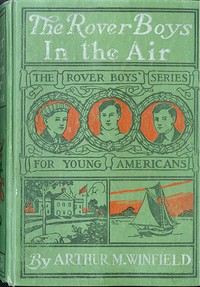
The Rover Boys in the Air; Or, From College Campus to the Clouds — Reading Companion
Childrens Adventures
63,760 recorded words. 1 minutes difference from this book's estimate.
View Gutenberg source #20053

Before opening Round the World in Seven Days — Story, Setting & Ideas, the edition data offers a quick orientation: 63,518 words, 4 hr 37 min estimated reading time, and 7 detected text sections.
The text analysis averages about 16.8 words per sentence, while the detected sections provide another way to judge how the source is divided.
Project Gutenberg metadata also associates the work with “Adventure stories,” connecting these edition facts with the source record’s subject description.
Explore this collection
These alternatives are selected using recorded categories and estimated reading time.
About 278 minutes
Childrens Adventures
63,760 recorded words. 1 minutes difference from this book's estimate.
View Gutenberg source #20053About 280 minutes
Childrens Adventures
64,342 recorded words. 3 minutes difference from this book's estimate.
View Gutenberg source #28418About 283 minutes
Childrens Adventures
64,956 recorded words. 6 minutes difference from this book's estimate.
View Gutenberg source #32606Search stored excerpts and compare books → Choose by your preferences →
Choices use stored catalog measurements. Estimates vary with reading speed. A shared category is a catalog label, not a claim that two books have the same argument or literary quality.
Search reads excerpt text stored with this catalog and links to its associated Gutenberg record. The connection is stored in the site database; this tool does not recheck that every excerpt is word-for-word identical to that external record. Excerpt search does not cover every chapter and does not verify historical publication dates.
Catalog snapshot checked: 2026-09-25. Coverage: 94 public books, 94 available source excerpts.
Read the complete public-domain text at its original source.
Read on Project GutenbergThe opening of Round the World in Seven Days does not begin with an aeroplane. Instead, it introduces Lieutenant George Underhill aboard H.M. surveying ship Albatross, anxiously watching a falling barometer near the Solomon Islands. The catalog subjects list 'Airplanes -- Piloting' and 'Aeronautics,' yet the first chapter is a tense maritime scene: a cyclone strikes, the ship shudders, and the crew crouch under bulwarks. This mismatch between subject tags and actual content is the first clue that the story may be more about survival than flight.
The catalog classifies this book under 'Airplanes -- Piloting' and 'Voyages around the world,' but the excerpts show that the initial peril is entirely nautical. Underhill's ship is caught in a cyclone while surveying 'imperfectly-charted waters.' The language is precise: the barometer reads 29.41', the wind increases to a 'roaring hurricane,' and the crew are 'half choked' by driving rain. No aircraft appears in the prelude. The table of contents lists chapters like 'Eastward Ho!' and 'Across Europe to the Bosphorus,' but the first excerpt dwells on reefs, squalls, and the risk of grounding. Readers expecting immediate aviation may be surprised by the extended sea voyage.
Later excerpts shift from the ship to a forest encampment, where the focus is on food. Tom, a character, scouts a savage camp and observes cooking pots and roasted flesh. The party is 'famishing,' and the men cry out 'To-night! to-night!' when food is mentioned. The narrative dwells on the logistics of foraging: Tom checks his watch, navigates by compass through dense forest, and worries about losing time before dawn. The catalog subject 'Adventure stories' fits, but the emphasis is not on aerial feats but on basic needs. The journey becomes a desperate march for sustenance, with Underhill 'sternly checking a cheer' from the sailors. This ground-level survival contrasts with the title's promise of a rapid global flight.
The list of illustrations provides a visual roadmap that diverges from the catalog's focus on aviation. Only one image directly references the aeroplane: 'The Aeroplane circled over the heads of the spectators.' Others depict maritime or terrestrial scenes: 'The Captain looked suspiciously from the two grimy travellers,' 'They suddenly darted forward with a wild whoop,' and 'The praus had already begun to paddle frantically away.' The map is titled 'Map of the First Aerial Voyage Round the World,' but the illustrations suggest a mix of shipboard, jungle, and sea encounters. A. C. Michael's artwork likely emphasizes action and danger, not just flight, reinforcing that the story spans multiple modes of travel and conflict.
Readers approaching this book through its catalog subjects should note that aviation is only one element of a broader adventure. The excerpts show a narrative that begins at sea, shifts to land-based survival, and only later incorporates flight. Pay attention to how the author balances the promised aerial voyage with older adventure tropes like shipwreck, exploration, and encounters with indigenous peoples. The title may promise speed, but the story lingers on the obstacles that slow the journey down.
That rainy afternoon, I kept thinking about how Strang’s airborne race kept circling back to water—the crew’s real battles were against waves, not wind. The same salty unease lingered in Harry Escombe: A Tale of Adventure in Peru — A Closer Reading, where the coast feels just as treacherous. One book simply led to the other, quietly, like a tide following a storm.
Your answers remain private and are stored only in this browser.