About 277 minutes
Round the World in Seven Days — Story, Setting & Ideas
Childrens Adventures
63,518 recorded words. 1 minutes difference from this book's estimate.
View Gutenberg source #15773
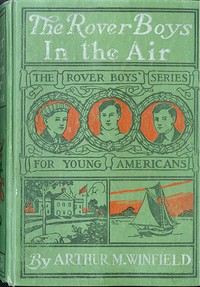
The Rover Boys in the Air; Or, From College Campus to the Clouds — Reading Companion can be approached with a clearer sense of reading commitment from its source measurements: 63,760 words, 4 hr 38 min estimated reading time, and 9 detected text sections.
The text analysis averages about 12.0 words per sentence, while the detected sections provide another way to judge how the source is divided.
Project Gutenberg metadata also associates the work with “Detective and mystery stories,” connecting these edition facts with the source record’s subject description.
Explore this collection
These alternatives are selected using recorded categories and estimated reading time.
About 277 minutes
Childrens Adventures
63,518 recorded words. 1 minutes difference from this book's estimate.
View Gutenberg source #15773About 280 minutes
Childrens Adventures
64,342 recorded words. 2 minutes difference from this book's estimate.
View Gutenberg source #28418About 283 minutes
Childrens Adventures
64,956 recorded words. 5 minutes difference from this book's estimate.
View Gutenberg source #32606Search stored excerpts and compare books → Choose by your preferences →
Choices use stored catalog measurements. Estimates vary with reading speed. A shared category is a catalog label, not a claim that two books have the same argument or literary quality.
Search reads excerpt text stored with this catalog and links to its associated Gutenberg record. The connection is stored in the site database; this tool does not recheck that every excerpt is word-for-word identical to that external record. Excerpt search does not cover every chapter and does not verify historical publication dates.
Catalog snapshot checked: 2026-09-25. Coverage: 94 public books, 94 available source excerpts.
Read the complete public-domain text at its original source.
Read on Project GutenbergFrom the opening chapter, The Rover Boys in the Air grounds its high-flying premise in the familiar rhythms of college life and family concern. The boys gather around a biplane not merely for sport, but as a means to track down the lingering threat of Josiah Crabtree and Tad Sobber—villains who have shadowed earlier installments. The narrative voice, brisk and direct, moves between technical descriptions of the flying machine and the emotional weight of Dick Rover’s private conversation with Dora Stanhope, where he proposes marriage. This juxtaposition of mechanical progress and personal commitment sets the tone for a story that balances adventure with domestic stakes.
The excerpt reveals a striking structural choice: the first major scene of aerial ambition is immediately paired with a marriage proposal. Dick Rover, the eldest brother, uses the quiet moment behind the biplane to ask Dora to marry him, linking the new technology of flight to a traditional life milestone. Their dialogue is measured and earnest, with Dick citing his education as sufficient and his desire to help Dora’s mother financially. The proposal is not impulsive; it is framed as a practical next step after leaving college. This intertwining of romance and aviation suggests that the flying machine is not just a plot device but a symbol of the boys’ transition into adulthood—a vehicle for both literal and figurative movement.
Even as the Rover boys discuss their biplane, the conversation turns to Crabtree and Sobber, who are reportedly near the family home. Dick mentions that his father has hired a detective to watch them, and the brothers express a wish that the villains “go where old Crabtree and Sobber can’t find them.” This recurring threat, drawn from earlier books, provides a continuous thread of tension. The excerpt does not reveal the villains’ current scheme, but their proximity creates an undercurrent of unease that contrasts with the celebratory tone of the proposal. The reader is left to wonder how the aerial capability of the biplane might be used to confront or evade these antagonists.
The prose is characterized by straightforward dialogue and minimal description. Characters speak in complete, unadorned sentences: “I can’t imagine. We are all awaiting developments.” The author uses repetition to emphasize emotional beats—Dick’s repeated “won’t you say yes?” and Dora’s murmured “yes” mirror the pattern of earlier Rover Boys proposals. The scene is structured around a clear dramatic arc: the group disperses, the couple converses privately, and the others return to interrupt. This efficient staging keeps the focus on character interaction rather than setting. The biplane itself is described only as a “big biplane,” with no technical detail, suggesting that the machine’s symbolic value outweighs its mechanical reality in this passage.
Readers familiar with the series will recognize the formula of college escapades and family loyalty, but this volume introduces a new dimension: the sky. The biplane is both a tool and a promise, offering the Rover boys a vantage point from which to survey their world—and its dangers. Pay attention to how the flying machine alters the geography of pursuit and escape, and whether the romantic subplot accelerates or complicates the brothers’ adventures.
Reading about the Rover boys and their airborne adventures over the campus, I was struck by how their youthful energy feels so far from quiet faith. That contrast reminded me of the more contemplative path in The Lily and the Cross: A Tale of Acadia — A Closer Reading, where a different kind of strength unfolds, one rooted in patience and quiet endurance rather than daring flight. A strange pairing, but both linger.
Capture what you thought, learned, and would like to remember.