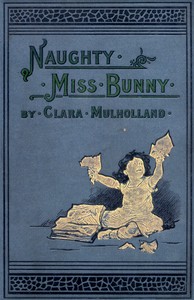
From the first page, Bunny Dashwood announces herself as a child who relishes freedom from adult oversight. 'Mama has sent for Miss Kerr, so I can do exactly as I like for a little while,' she declares, lying back on the grass in her white frock. The narrator immediately undercuts this confidence, noting that Bunny is 'one of the spoilt "chindrel"'—her own mispronunciation of 'children' becoming a signature verbal tic. The story opens with a clear moral framework: Bunny's parents have recently dismissed her indulgent nurse and hired a strict French maid, Sophie, signaling that reform is underway. Yet the early chapters show Bunny still testing limits, as when she insists she can ride her pony Frisk without a leading rein. The excerpts trace a pattern of small rebellions and gentle corrections, with Miss Kerr's influence gradually emerging as the central force for change.
Bunny's Voice and the Narrator's Frame
The opening chapter establishes a double perspective: Bunny's excited, self-justifying speech and the narrator's cooler assessment. Bunny's exclamation—'I think I should be jolly—yes, that's papa's word, jolly'—shows her mimicking adult language without fully understanding its implications. The narrator immediately steps in to explain that Bunny is six, an only child, and 'very hard to manage indeed.' This pattern recurs throughout the excerpts: Bunny speaks in exclamatory, impulsive sentences, while the narrator supplies context about her upbringing and the consequences of her actions. Readers are invited to enjoy Bunny's spirited dialogue while recognizing the need for correction. The mispronunciation 'chindrel' appears repeatedly, a small but consistent marker of her immaturity. Pay attention to how the narrator's voice interjects—often with gentle irony—to guide interpretation without moralizing heavily.
The Role of Adults: From Indulgence to Instruction
Bunny's world is populated by adults who either indulge or correct her. Her father, Mr. Dashwood, is affectionate but firm: when Bunny boasts she can ride Frisk alone, he laughs and says, 'I would rather not trust you.' The groom John represents a different adult voice—practical and uncurious, as when he explains place names by saying 'I never asks no questions.' In contrast, Miss Kerr (mentioned but not yet fully seen in the excerpts) is associated with the value of asking questions: Mervyn reports that 'Miss Kerr says no one should be ashamed to ask a question about a thing they don't understand.' This sets up a contrast between passive acceptance (John) and active learning (Miss Kerr's teaching). The excerpts also introduce Mr. Davis, a friendly older gentleman who whispers with Bunny's father—a hint of adult concerns beyond the child's understanding. Notice how each adult interaction either reinforces or challenges Bunny's self-centered worldview.
Setting and Social Detail in the Scarborough Scenes
The story is set in Scarborough, a seaside resort that provides a backdrop of gardens, cliffs, and drives. Bunny's opening speech mentions 'the distant sea that lay just beyond them, sparkling and dancing in the sunshine,' establishing a picturesque setting that contrasts with her inner turmoil. Later, the riding party enters 'Lady Edith's Drive,' a cool, shady avenue that Bunny calls 'the prettiest place about Scarborough.' The exchange about the drive's name reveals social hierarchies: John accepts names without question, while Mervyn insists on inquiry. This small episode encapsulates the book's interest in how children learn about the world through observation and conversation. The setting also includes domestic interiors—Bunny's home, the nursery—but the excerpts emphasize outdoor spaces where Bunny can test her independence. The pony Frisk and the groom John are recurring elements that ground the story in a specific, upper-middle-class Edwardian childhood.
Patterns of Naughtiness and Their Gentle Consequences
The excerpts show a clear pattern: Bunny declares her intention to do as she pleases, then encounters a situation that challenges her self-confidence. In the opening, she lies on the grass despite orders to keep her frock clean—a small act of defiance. Later, she insists she can ride without a leading rein, only to be gently warned by her father. The chapter titles hint at further incidents: 'Bunny gets a Fright,' 'Bunny forgets again,' 'Was it Cruel?' These suggest that naughtiness leads to mild scares or moral quandaries rather than severe punishment. The narrative does not dwell on dramatic consequences; instead, it accumulates small lessons. For instance, Bunny's boast about riding alone is met with a firm but affectionate refusal, not a scolding. The excerpts also introduce Mervyn, a cousin or friend, who serves as a foil—more curious and less impulsive. Readers can track how Bunny's behavior shifts in response to these encounters, noting that improvement is gradual and often interrupted by relapses.
As you read, watch for the recurring tension between Bunny's desire for autonomy and the adults' gentle guidance. The excerpts suggest that Miss Kerr's influence will be pivotal, but the full arc of Bunny's improvement remains to be seen. Pay attention to small details—mispronunciations, gestures, and the reactions of servants—that reveal the story's moral landscape without heavy-handed preaching. Mulholland's narrative voice balances sympathy for Bunny's energy with a clear sense that growth requires humility.
Reading about Bunny’s stubborn little world reminded me of sitting with my own mother’s old storybooks, feeling the weight of rules I didn’t yet understand. That same warmth came later with The Log House by the Lake: A Tale of Canada — Background and Themes, a quiet ache of childhood’s restraint and wildness folded together. Some lessons arrive gently, like light through a cabin window.