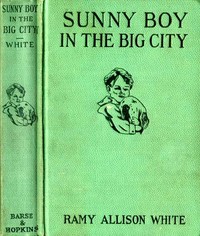
Sunny Boy in the Big City — Story, Setting & Ideas

(3 User reviews)   739
White, Ramy Allison, Wrenn, Charles L. (Charles Lewis), 1880-1952 [Illustrator] Project Gutenberg 2008 Not confirmed
Boys -- Juvenile fiction; New York (N.Y.) -- Juvenile fiction; Voyages and travels -- Juvenile fiction; City and town life -- Juvenile fiction Readers of public-domain and historical texts
Project Gutenberg digital edition en

Edition facts

Words 32,755
Reading time 143 min
Text sections 5

Sunny Boy in the Big City — Story, Setting & Ideas can be approached with a clearer sense of reading commitment from its source measurements: 32,755 words, 2 hr 23 min estimated reading time, and 5 detected text sections.

The text analysis averages about 12.9 words per sentence, while the detected sections provide another way to judge how the source is divided.

Project Gutenberg metadata also associates the work with “Boys -- Juvenile fiction,” connecting these edition facts with the source record’s subject description.

This editorial note examines Ramy Allison White's word choices, dialogue patterns, and descriptive strategies in a 1920 children's novel about a boy's first trip to New York City, using excerpts to trace how the author balances childish perspective with instructional clarity.
Share
Editorial Edition Score 4.7/5

Calculated from edition completeness, EPUB availability, text structure and catalogue metadata. Not a user rating.

How this score is calculated
  • Description quality20 pts
  • Title & short description10 pts
  • Source metadata20 pts
  • Text length15 pts
  • Chapters / structure15 pts
  • EPUB file integrity20 pts

Total of 100 points, scaled to a 2.5-5.0 range. Editions with an empty description or a missing EPUB file are not scored.

Edition quality

Read the Text

She looked a little wistfully at Sunny Boy. He didn't know it, but she was trying to say she was sorry she had been impatient and testy. Grown-ups frequently find it as difficult to say "I'm sorry" as boys and girls do.

"I wonder if your army would like some nice ice-cold lemonade?" said the woman abruptly. "Would your mothers mind, do you think?"

"Not lemonade," Sunny Boy assured her promptly. "'Sides, it is a long time to lunch, and Mother doesn't mind if you don't eat just before lunch."

"Well, all right, then. But how shall I give it to you?" asked their would-be hostess. "If I bring it out here all the neighborhood will come and want some. And I do hate to have so many children tramping in over my clean rugs."

Not without reason was Sunny Boy a general.

"I can march 'em in the basement door," he suggested. "They'll stay in a row and not muss anything."

So it was decided. The woman went in and closed the door, promising to open the iron basement gate for them, and Sunny Boy turned to his army.

"Forward march!" he ordered.

A little fearfully the army marched down the area steps and into a dark hall. They each had a feeling that the woman might change her mind after all, and scold them again. But she was smiling as they tramped into her old-fashioned kitchen.

"Halt!" commanded Sunny Boy, and the army ranged itself against the wall without further orders.

"I'll give each one a glass, and then I'll pour the lemonade," said the hostess pleasantly.

She went down the line, filling a tall crystal glass for each child. Then, after that, she brought out a plate of brown and white cookies and insisted that they must each take three.

"Sugar cookies don't hurt any one," she declared, patting Ruth on the head as she passed her. "Do they, General?"

"I guess not," agreed Sunny Boy contentedly, munching a cake.

When they had finished, they put the glasses carefully on the table, and said "Thank you" politely.

"My name is Miss Lyons, Miss Edith Lyons," announced their hostess, following them to the door. "I'm going to watch you march off, and I hope you'll come to see me again."

"We didn't muss anything, did we?" asked Sunny Boy anxiously. He felt responsible for all the rest.

Miss Lyons stooped down and kissed him.

"Bless your heart, for a thoughtful little boy," she said warmly. "You haven't hurt a thing. Good-bye, Soldier, and good luck!"

"Fall in!" Sunny Boy commanded as they reached the walk. "Forward, march!"

The drum sounding merrily, the army fell into step and marched down the street, Miss Lyons waving her handkerchief in good-bye.

"Those were good cookies," chuckled Harold Wallace, who marched beside Sunny Boy. "Gee, I wanted to run when she opened the door. Did you know her, Sunny?"

"My, no," Sunny Boy assured him. "I guess she was just glad to have somebody come and drink up all that lemonade."

When they reached Sunny's house, a familiar touring car was drawn up at the curb.

"Daddy's home!" cried Sunny Boy. "P'haps he'll give us a ride. Where's Bobbie?"

Bobbie was not in sight, but his shells lay scattered on the top step where he had left them.

"Well, well, who wants a little ride?" Mr. Horton came smiling down the steps. "Sunny Boy, Mother wants you to pick up this stuff and put it in the hall. Any one's likely to fall over it out here. And then I'll take you round the park and back."

"All of us?" asked Sunny Boy, beginning to pick up the shells and sea-weed. "Where's Bobbie, Daddy?"

"All of you," assented Mr. Horton. "Bobbie Henderson? Oh, his mother sent for him. Ready now, children?"

Mr. Horton put Ruth Baker in the front seat because she was the only girl, and the seven boys piled happily into the tonneau. They were all ready to start when Sunny Boy, turning around, saw a grinning little colored boy holding on at the back of the car. Mr. Horton saw him, too.

"Hey, get down from there!" Sunny Boy's father called crisply. "You'll be hurt, taking a chance like that. Get off now, before I start the car."

The woolly black head and grinning brown face disappeared, but Sunny Boy set up a loud wail.

"Daddy, he took my hat! See him! He's got it! Let me get out and chase him!"

"Stay where you are," commanded Mr. Horton. "You can't catch him now. Perhaps we can find him later. If not, Mother will have to get you another hat to-morrow."

"It was brand-new," Sunny Boy explained mournfully to David, as the car started. "Mother bought it for me to wear to New York. And now that colored boy went and stole it!"

"You going to New York?" Harold Wallace asked curiously. "When? My cousin lives there. He's coming to see me next summer."

Sunny Boy bounced around excitedly on the seat. That is, he bounced as much as he could in the rather crowded space.

"Yes, we're going to New York," he announced. "To-morrow--no, the next day--when is it, Daddy?"

"Soon," said Mr. Horton.

"Send me a post-card for my album," begged Ruth.

"Me, too," chimed in Nelson.

All the boys, it seemed, wanted post-cards from New York.

"Well, maybe, if Mother will write 'em," agreed Sunny Boy dubiously. "I can print A's and B's, but not a real letter writing. Are you going to get out, Daddy?"

The car had circled a large green that made attractive the center of the city, and Mr. Horton had parked before a busy grocery store.

"I'm going in here to do an errand for Mother," he said. "Now, youngsters, I won't be long, and every one of you stay in the car till I come back. I don't want to have to hunt up missing boys when it's time to go home."

Ruth Baker turned so she faced the back of the car.

"You never stay at home, Sunny Horton!" she declared accusingly. "I think it's mean. You were going to play Indian braves and sleep out in the tent, and pretty soon it will be so cold Mother won't let us."

"You have been away a lot, haven't you?" suggested David.

Sunny Boy considered.

"I had to go to see my Grandpa Horton," he urged. "And then I had to go to see my Aunt Bessie. And Daddy would be lonesome in New York without Mother and me. He said so."

You see, Sunny Boy had had a busy summer. First he and his mother had gone into the country to visit his grandfather who lived on a farm. Sunny Boy was named for this grandfather, "Arthur Bradford Horton," though Daddy and Mother called him Sunny Boy, and many people thought he had no other name. Grandfather Horton's farm was known as "Brookside," and Sunny Boy learned to love the place dearly in the month he spent there. You may have read what he did there and the friends he made in the first book about him, called "Sunny Boy in the Country."

After Sunny Boy and his mother came home from "Brookside," they went almost immediately to visit Mrs. Horton's sister, Sunny's Aunt Bessie, in her bungalow at Nestle Cove. Mr. Horton took them down to the seashore in the automobile, and Sunny Boy had a delightful time playing in the sand and learning to swim. He found a little lost dog, too, as you may remember if you have read the book about him called "Sunny Boy at the Seashore."

Now he was at home again in Centronia, the city where he and his daddy and mother lived, and they were getting ready to make a trip to the great city of New York.

"Where 'bouts does your cousin live?" Sunny Boy asked Harold Wallace, hoping his friends understood that all this traveling he was experiencing was truly necessary. "P'haps Mother and I'll see him."

"I don't know exactly where he lives," answered Harold cautiously. "But I know it is in a brick row. Aunt Lucy wrote my mother when they moved."

"I'll tell Daddy," promised Sunny Boy confidently. "He'll know what street. Don't get out, Oliver."

Oliver Dunlap, red-haired and blue-eyed, grinned provokingly.

"Wait till you see me," he retorted. "Can't I put just one foot out of the car?"

Of course, having one foot out, Oliver in another moment had both feet on the running board and from there jumped to the sidewalk.

"Daddy said to stay in the car," insisted Sunny Boy.

"He only meant not to go away," said Oliver. "Oh, look at the crowd coming!"

The children stood up in the car and stared in the direction Oliver was pointing. On the next block they could see a man running swiftly, followed by a crowd of people, and back of them two policemen.

"Come back, Oliver!" screamed Ruth, jumping up and down with excitement. "Make him come back, Sunny."

But before Oliver could run over to the car, if he had wanted to, the man, the crowd close upon his heels, had reached the spot where Oliver stood. He caught hold of him, whirled him about, and dropped something into his hands, all without stopping his headlong flight. The crowd immediately closed in around Oliver just as Mr. Horton, attracted by the noise and the shouting, came out of the store. One of the policemen continued to run after the man.

"Oh, Daddy, get Oliver," Sunny Boy almost sobbed, as his father came over to the car.

"Why, where is he?" asked Mr. Horton, surprised. "Aren't you all here?"

"Oliver isn't. He's in there." Sunny Boy pointed to the crowd which was growing larger every minute as more and more people pressed in, eager to know what the excitement was about. "Oh, gee!"

Sunny Boy's eyes grew wide with wonder and terror. The other boys in the car looked frightened. Ruth began to cry.

A policeman had come out from the center of the crowd, and he had Oliver by the arm. Oliver was crying, and looked very small and miserable.

"Why, Oliver Dunlap!" Mr. Horton walked up to him, and put his arm protectingly around the frightened child. "What is the matter, Officer?"

"Do you know him?" asked the policeman politely. "Maybe that's different then. That pickpocket stole a lady's purse, and here's the empty bag he left in the kid's hands. We thought they were together--using the boy to cover up his tracks, you see."

"I left him in my car ten minutes ago with these other children," said Mr. Horton calmly. "He's Henry Dunlap's son. Your chief knows his father."

"If you say it's all right, it is," pronounced the policeman. "Don't cry, kid, you're all right now. Sorry to make you any trouble, sir."

He turned to push back the crowd, which was surging about the automobile now, and Mr. Horton lifted in Oliver. Then slowly, so as not to injure any one, he steered the car out of the mass of people and turned it around.

"Guess you'll stay in the car the next time, Oliver," jeered Harold Wallace.

"That'll do, Harold," said Mr. Horton sharply. "I'm going to take you all around the park twice now and then we'll scoot home for lunch. It is twelve o'clock. I don't want to take home such solemn faces. See if you can't smile a bit."

By the time they had circled the park twice every one felt decidedly more cheerful. Even Oliver had managed a smile, though it would be some time before he could see a policeman and not want to run.

Sunny Boy had so much to tell Mother at lunch that he almost forgot to inform her of the loss of his hat. Seeing her trying on a new hat before the hall mirror after lunch reminded him.

"And how can I go to New York without a hat?" he finished sadly, when he had described to her how the colored boy had run off with his beautiful new, round, blue hat.

"You can't, of course," said Mother. "I'll have to take you down town again to-morrow and buy you another. Harriet, here's Sunny Boy losing his new hat before he's had it three days."

"Dear, dear! Do tell!" said Harriet, who was passing through the hall on her way upstairs. She sat down to listen.

"I might take Sunny down through the River Section," she suggested to Mrs. Horton. "We could go this afternoon. All the colored folks live there, you know, and Sunny might see the boy. I'd make him give the hat back, drat him!"

Mrs. Horton had little faith in their finding boy or hat, but she was willing they should go, and so Harriet and Sunny Boy set out half an hour later, bound for the River Section, which was over on the other side of the city from where the Hortons lived.

They decided to walk there and then ride home if they were tired, and Sunny Boy found much to interest him along the way. They passed a horse that had lost his nosebag before he had eaten all his oats and who was regarding it hungrily as it lay on the ground at his feet.

"Fix it, Harriet," implored Sunny. "He hasn't had all his dinner."

So Harriet stopped and picked up the nosebag and fixed it nicely on the horse's nose. He went right to eating the moment she had it in place, but Sunny Boy was sure his wise brown eyes thanked them gratefully.

"Look, Harriet!" they were crossing another street when Sunny Boy's quick eyes spied something else that interested him. "See, little desks."

A man was carrying desks into a brown stone house, and a large number of similar desks were propped up on the walk.

"'Miss May Ford's School for Boys and Girls.'" Harriet read the shining brass plate on the side of the house as they walked slowly past. "Why, Sunny, that must be the Miss May your mother talks about. I guess that's where you'll be going to school this winter."

Sunny Boy stared at the building with interest. He was very eager to learn what school was like, and he hoped that as soon as they came back from New York he would go to school every day as Nelson Baker did.

Two or three blocks further on Harriet turned suddenly down a side street.

"Now begin to look, Sunny," she admonished him. "See if you see a boy that looks like the one who took your hat this morning. How old would you say he was?"

"'Bout 'leven," returned Sunny Boy wisely. "He acted 'bout that, anyway. Isn't that a cunning baby, Harriet?"

Harriet wasn't interested in babies just then. She was determined to find that missing hat.

"That looks like him," Sunny pointed an accusing finger at a colored boy leaning against a rickety porch railing.

At the same moment the boy saw them and started to run.

"We can't chase him," said Harriet. "He'll run up some alley. You stay here on the sidewalk, and I'll ask if he lives in this house."

A little girl answered Harriet's knock. "Yes'm," she said, she knew the boy.

"He don't live here--don't live nowhere," she volunteered. "He just hangs around. His name is Pete."

"Well, there's no use in looking any further," announced Harriet, rejoining Sunny Boy on the pavement. "Pete, if that's his name, won't show up around here for several days now. And before that you'll be on your way to New York."

"Sunny Boy and I will go ahead and get the trunk checked," said Mr. Horton, picking up the two suitcases that stood in the hall. "Where's your hat? You haven't lost it again, have you?"

Sunny Boy dashed under the table and picked up his new hat.

"It's all right," he assured his father anxiously. "It just fell off when I wasn't looking. Mother bought it yesterday. Does it do for New York, Daddy?"

"I don't see why not," replied Mr. Horton, smiling. "All through, Olive? Sure you and Harriet can lock up all right?"

Mrs. Horton came into the hall, pencil and pad in hand. It was the day for leaving--Sunny Boy had been afraid that it would never come--and they were almost on the way to New York. The train would leave Centronia Union Station in an hour.

"I'm finishing the list of things I want Harriet to remember," explained Mrs. Horton. "Sunny, dear, did you say good-bye to her? All right then, run along with Daddy. And I'll meet you at the south entrance not later than a quarter of ten."

Sunny Boy and Daddy took the street car, and Sunny was so blissfully happy to be beginning the journey at last that a white-haired gentleman next to him asked him if he was thinking about Christmas.

Sunny Boy shook his head. He hadn't begun to think of Christmas. That was months and months away.

"I'm going to New York," he informed the white-haired gentleman proudly. "Daddy and Mother and me. And I can ride on top of the busses, Daddy said so."

"Dear me," said the gentleman, "that is a long trip for a chap of your age. I have a little grandson who lives in New York. He's counting the days now till he can come to see me."

This was a new idea to Sunny Boy.

"Do you s'pose folks who live in New York like to come to see Centronia?" he asked doubtfully.

"Just as much as you count on going to New York," said the white-haired gentleman promptly. "It's new to them, you see. Here's my corner now. Good-bye. I hope you will have all the good times you are looking forward to."

"Isn't it funny, Daddy?" said Sunny Boy, watching the gentleman go out the door. "Most everybody has relations living in New York. Harold Wallace's cousin lives there. Have we any 'lations to go to see?"

"Not in New York," answered Mr. Horton, pressing the button to tell the motor-man to let them off. "You and Mother will have to amuse each other, because you may find it lonesome at first with no friends to talk to."

They were opposite the station now, and the car stopped. Sunny Boy hopped off blithely, but his thoughts were busy with what Daddy had said. How could one be lonely in New York?

"'Member the time the baggage man thought the alarm clock was a 'fernal machine?" asked Sunny Boy, as he followed his father into the station and over to the baggage room.

"Indeed I do," Mr. Horton laughed.

You see, when Sunny Boy and his mother had been going to see Grandpa Horton, Sunny, as his part in the packing, tucked in the family alarm clock so that he would be sure to get up early in the country. And he forgot the clock might be set, as it was. The station people had held the trunk and it took a great deal of explaining, and the Hortons nearly missed their train before they were allowed to check the trunk.

The baggage man remembered Sunny Boy.

"How's the alarm clock?" he grinned cheerfully. "Any more infernal machines in your baggage this time?"

Sunny Boy smiled shyly.

"We didn't have a finger in packing this trunk," Daddy answered for him. "All right, Son, we're fixed. Now we'll see if we can get some parlor car seats."

But, it seemed, the parlor car seats were all sold.

"All the way through. Convention going to-day on your train," announced the man behind the brass-barred window. "Sorry, but you'll have to go in the day coach."

"You and I don't mind, Sunny," said Mr. Horton, as they walked over to the south entrance to wait for Mrs. Horton. "It is rather hard on Mother, but perhaps she won't mind. It isn't so warm to-day."

"And we can put the window up," suggested Sunny Boy helpfully. "Oh, there's Mother!"

He ran to meet her and brought her over triumphantly to the seat saved for her.

"Am I in time?" she asked a little anxiously. "Ten minutes yet? That's fine. There was a block on the cars."

"Get your breath, and then I think we'd better go through the gate," counseled Mr. Horton. "Couldn't get parlor car seats, so the earlier we get on, the better chance we have of getting a good seat. I'll take the grips, Sunny, you take care of Mother."

Ramy Allison White's Sunny Boy in the Big City (1920) opens not with a train or a skyline but with a neighborhood parade—a choice that establishes the author's method of grounding extraordinary experiences in familiar, domestic play. The first chapter's dialogue reveals a precise ear for childish speech: Sunny Boy's imperious "Fall in!" is immediately undercut by Bobbie's absorption in seashells, a small rebellion that White renders through naturalistic back-and-forth rather than authorial commentary. The narrator stays close to Sunny Boy's limited perspective, reporting his exasperation without explaining it, letting readers infer the social dynamics of the group.

Dialogue as Characterization

White uses dialogue not merely to advance plot but to define each child's temperament. Sunny Boy speaks in clipped commands and logical appeals ("I said 'Fall in'"), while Bobbie deflects with sensory distractions ("These shells made a noise"). Ruth's eager self-introduction—"I can mark time, an' everything!"—captures her age and enthusiasm through dropped consonants and run-on syntax. The author avoids tagging every line with adverbs; instead, the words themselves carry the tone. When Sunny Boy grudgingly accepts Ruth into the army, his concession ("I s'pose it's better than being one short") reveals both his pragmatism and his mild prejudice against girls, left for the reader to judge.

Descriptive Economy in Urban Scenes

White's descriptions of New York are filtered through what a child would notice: the moving stairway that "went further than one story," the elevated tracks that make Sunny Boy "just the least little bit afraid." The author does not pause for panoramic views; instead, details emerge through action. On the ferryboat, the focus stays on Sunny Boy's physical sensations—the vibration, the wind—rather than the skyline. This restraint keeps the prose brisk and aligned with a child's attention span. When the text does describe, it favors concrete nouns over adjectives: "a blue and white sailor suit," "an old soap box." The illustrations by Charles L. Wrenn, referenced in captions, reinforce this visual specificity.

Theatricality and Audience Participation

The Snow White episode in Chapter IX showcases White's handling of dramatic irony. Sunny Boy, knowing the fairy tale, cannot remain a passive spectator; he shouts a warning to the stage, standing up and waving his hands. The narrator reports this with deadpan precision—"at the top of his lungs" Harriet would have said—creating a gap between the boy's earnestness and the adults' amusement. White uses the theater scene to dramatize how children process fiction: they treat make-believe as real, and the author respects that impulse by not mocking Sunny Boy. The episode also serves as a structural hinge, moving from controlled play (the parade) to unpredictable public behavior.

Voice and Point of View

White employs a close third-person narration that occasionally dips into free indirect style, blending Sunny Boy's thoughts with the narrator's report. Phrases like "Not for nothing had Harriet read him his book of fairy tales!" carry the boy's self-satisfaction without quotation marks. The narrator also uses mild irony—"Sunny Boy decided swiftly" before a decision that is actually hesitant—but never condescends. This balance allows the book to function both as a story for children and as a document of early twentieth-century childhood, where adult authority (Mother's whispered corrections, the policeman's presence) frames but does not overwhelm the child's perspective.

Readers attentive to authorial craft will find in Sunny Boy in the Big City a careful study of how a child's mind organizes new experiences through play, warning, and wonder. White's dialogue-driven scenes and selective description reward close attention to what is said—and what is left unsaid. The excerpts suggest a work that trusts its young audience to infer character from speech and setting from action, making it a useful text for examining early twentieth-century children's literature's narrative strategies.

That rainy afternoon, I kept returning to how Sunny Boy’s guide explained the subway—patiently, without losing wonder. It made me think of other journeys told plainly, like the drifting quiet aboard a houseboat. Later, I stumbled onto Dorothy on a House Boat — Inside the Classic, and the same gentle pacing followed me there, like weather that moves from one window to another.

Alexander Nguyen
1 month ago

Wyatt Lee
1 month ago

Mila Clark
1 month ago

4
4 out of 5 (3 User reviews )

Add a Review

Your Rating *
There are no comments for this eBook.

Reader reflection

How will you remember this book?

Save your reaction, strongest insight, and memorable passage.

Your progress 0 / 10
1

Which reading stage best describes you?

2

Was reading this book enjoyable?

3

How likely are you to recommend this book?

4

How much effort did this book require?

Related eBooks