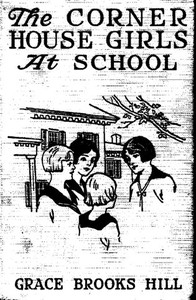
The Corner House Girls at School — Reading Companion

(0 User reviews)   94
In Category - School Stories
Hill, Grace Brooks, Owen, Robert Emmett, 1878-1957 [Illustrator] Project Gutenberg 2007 Not confirmed
Schools -- Juvenile fiction; Sisters -- Juvenile fiction; Children -- Juvenile fiction; Quakers -- Juvenile fiction Readers of public-domain and historical texts
Project Gutenberg digital edition en

Edition facts

Words 57,172
Reading time 249 min
Text sections 6

The Corner House Girls at School — Reading Companion can be approached with a clearer sense of reading commitment from its source measurements: 57,172 words, 4 hr 9 min estimated reading time, and 6 detected text sections.

The text analysis averages about 13.1 words per sentence, while the detected sections provide another way to judge how the source is divided.

Project Gutenberg metadata also associates the work with “Schools -- Juvenile fiction,” connecting these edition facts with the source record’s subject description.

The Corner House Girls face a new school year in Milton, navigating a goat named Billy Bumps, a blizzard, and a skating race. The opening chapters introduce the Kenway sisters' distinct voices and their Quaker-tinged community, while later excerpts show them in perilous winter adventures.
Share
Editorial Edition Score 4.7/5

Calculated from edition completeness, EPUB availability, text structure and catalogue metadata. Not a user rating.

How this score is calculated
  • Description quality20 pts
  • Title & short description10 pts
  • Source metadata20 pts
  • Text length15 pts
  • Chapters / structure15 pts
  • EPUB file integrity20 pts

Total of 100 points, scaled to a 2.5-5.0 range. Editions with an empty description or a missing EPUB file are not scored.

Edition quality

Read the Text

Tess had an idea and she was frank to express it. "Uncle Rufus, this goat is very strong. Can't you fashion a harness and some kind of a cart for him so that we can take turns riding--Dot and me? He used to draw Sam Pinkney."

"Glo-ree!" grumbled the colored man again. "I kin see where I got my han's full wid disher goat--I do!"

"But you _can_, Uncle Rufus?" said Tess.

"Oh, yes, chile. I s'pect so. But fust off let me git him shut up in de hen-yard, else he'll be eatin' up de hull ob Mis' MacCall's wash--ya'as'm!"

The poultry pens were fenced with strong woven wire, and one of them was not in use. Into this enclosure Mr. Billy Bumps was led. When the strap was taken off, he made a dive for Uncle Rufus, but the darky was nimble, despite his years.

"Yo' butt me, yo' horned scalawag!" gasped the old colored man, when once safe on the outside of the pen, "an' I won't gib yo' nottin' ter chew on but an old rubber boot fo' de nex' week--dat's what I'll do."

The old Corner House, as the Stower homestead was known to Milton folk, stood facing Main Street, its side yard running back a long way on Willow Street. It was a huge colonial mansion, with big pillars in front, and two wings thrown out behind. For years before the Kenway girls and Aunt Sarah Maltby had come here to live, the premises outside--if not within--had been sadly neglected.

But energetic Ruth Kenway had insisted upon trimming the lawn and hedges, planting a garden, repairing the summer-house, and otherwise making neat the appearance of the dilapidated old place.

On the Main Street side of the estate the property of Mr. Creamer joined the Corner House yard, but the Creamer property did not extend back as far as that of the Stower place. In the corner at the rear the tiny yard of Con Murphy touched the big place. Mr. Murphy was a cobbler, who held title to a small house and garden on a back street.

This man owned a pig--a very friendly pig. Of that pig, more later!

Perhaps it was the fruit that attracted the pig into the Stower yard. The Kenway girls had had plenty of cherries, peaches, apples, pears, and small fruit all through the season. There were still some late peaches ripening, and when Agnes Kenway happened to open her eyes early, the very next morning after the goat came to live with them, she saw the blushing beauty of these peaches through the open window of the ell room she shared with Ruth.

Never had peaches looked so tempting! The tree was a tall seedling, and the upper branches hung their burden near the open window.

All the lower limbs had been stripped by Uncle Rufus. But the old man could not reach these at the top of the tree.

"It will be a mean shame for them to get ripe and fall off," thought Agnes. "I believe I can reach them."

Up she hopped and slipped into her bathrobe. Just enough cool air entered the room to urge her to pull on her hose and slip her feet into slippers.

The window was at the back of the big house, away from the Willow Street side, and well protected from observation (so Agnes thought) by the shrubbery.

Below the window was a narrow ledge which ran around the house under the second story windows. It took the reckless girl but a moment to get out upon this ledge. To tell the truth she had tried this caper before--but never at such an early hour.

Clinging to the window frame, she leaned outward, and grasped with her other hand a laden, limb. The peaches were right before her; but she could not pluck them.

"Oh! if I only had a third hand," cried Agnes, aloud.

Then, recklessly determined to reach the fruit, she let go of the window frame and stretched her hand for the nearest blushing peach. To her horror she found her body swinging out from the side of the house!

Her weight bore against the limb, and pushed it farther and farther away from the house-wall; Agnes' peril was plain and imminent. Unable to seize the window frame again and draw herself back, she was about to fall between the peach tree and the side of the house!

"The Corner House Girls," as they had come to be known to Milton folk, and as they are known to the readers of the first volume of this series, had occupied the great mansion opposite the lower end of the Parade Ground, since the spring before.

They had come from Bloomingsburg, where their father and mother had died, leaving them without guardianship. But when Uncle Peter Stower died and left most of his property to his four nieces, Mr. Howbridge, the lawyer, had come for the Kenway sisters and established them in the old Corner House.

Here they had spent the summer getting acquainted with Milton folk (making themselves liked by most of the neighbors), and gradually getting used to their changed circumstances.

For in Bloomingsburg the Kenways had lived among very poor people, and were very poor themselves. Now they were very fortunately conditioned, having a beautiful home, plenty of money to spend (under the direction of Mr. Howbridge) and the opportunity of making many friends.

With them, to the old mansion, had come Aunt Sarah Maltby. Really, she was no relation at all to the Kenway girls, but she had lived with them ever since they could remember.

In her youth Aunt Sarah had lived in the old Corner House, so this seemed like home to her. Uncle Rufus had served the aforetime owner of the place for many years, too; so _he_ was at home here. And as for Mrs. MacCall, she had come to help Ruth and her sisters soon after their establishment in the old Corner House, and by this time had grown to be indispensable.

This was the household, saving Sandyface, the cat, and her four kittens--Spotty, Almira, Popocatepetl and Bungle. And now there was the goat, Mr. Billy Bumps.

Ruth was an intellectual looking girl--so people said. She had little color, and her black hair was "stringy"--which she hated! Now that she was no longer obliged to consider the expenditure of each dollar so carefully, the worried look about her big brown eyes, and the compression of her lips, had relaxed. For two years Ruth had been the head of the household and it had made her old before her time.

She was only a girl yet, however; her sixteenth birthday was not long behind her. She liked fun and was glad of the release from much of her former care. And when she laughed, her eyes were brilliant and her mouth surprisingly sweet.

The smaller girls--Tess (nobody ever called her Theresa) and Dorothy--were both pretty and lively. Dot was Ruth in miniature, a little, fairy-like brunette. Tess, who was ten, had a very kind heart and was tactful. She had some of Ruth's dignity and more of Agnes' good looks.

The twelve year old--the fly-away--the irrepressible--what shall we say about her? That she laughed easily, cried stormily, was always playing pranks, rather tomboyish, affectionate--utterly thoughtless----

Well, there is Agnes, out of the bedroom window in her bathrobe and slippers just at dawn, with the birds chirping their first chorus, and not a soul about (so she supposed) to either see or help her in her sudden predicament.

She really was in danger; there was no doubt of it. A scream for help would not bring Ruth in time; and it was doubtful if her older sister could do anything to help her.

"Oh--_oh_--OH!" gasped Agnes, in crescendo. "I--am--go--ing--to--fall!"

And on the instant--the very sweetest sound Agnes Kenway had ever heard (she admitted this fact afterward)--a boy's voice ejaculated:

"No you're not! Hang on for one minute!"

The side gate clicked. Feet scurried across the lawn, and under her as she glanced downward, Agnes saw a slim, white-faced youth appear. He had white hair, too; he was a regular tow-head. He was dressed in a shiny black suit that was at least two full sizes too small for him. The trousers hitched above his shoe-tops and the sleeves of his jacket were so short that they displayed at least four inches of wrist.

Agnes took in these points on the instant--before she could say another word. The boy was a stranger to her; she had never seen him before.

But he went to work just as though he had been introduced! He flung off his cap and stripped off the jacket, too, in a twinkling. It seemed to Agnes as though he climbed up the tree and reached the limb she clung to as quickly as any cat.

He flung up his legs, wound them about the butt of the limb like two black snakes, and seized Agnes' wrists. "Swing free--I've got you!" he commanded.

Agnes actually obeyed. There was something impelling in his voice; but likewise she felt that there was sufficient strength in those hands that grasped her wrists, to hold her.

Her feet slipped from the ledge and she shot down. The white-haired boy swung out, too, but they did not fall as Agnes agonizingly expected, after she had trusted herself to the unknown.

There was some little shock, but not much; their bodies swung clear of the tree--he with his head down, and she with her slippered feet almost touching the wet grass.

"All right?" demanded the white-head. "Let go!"

He dropped her. She stood upright, and unhurt, but swayed a little, weakly. The next instant he was down and stood, breathing quickly, before her.

"Why--why--why!" gasped Agnes. Just like that! "Why, you did that just like a circus."

Oddly enough the white-haired boy scowled and a dusky color came slowly into his naturally pale cheek.

"What do you say that for?" he asked, dropping his gaze, and picking up his cap and jacket. "What do you mean--circus?"

"Why," said Agnes, breathlessly, "just like one of those acrobats that fly over the heads of the people, and do all those curious things in the air----Why! you know."

"How do I know?" demanded the boy, quite fiercely.

It became impressed upon Agnes' mind that the stranger was angry. She did not know why, and she only felt gratitude--and curiosity--toward him.

"Didn't you ever go to a circus?" she asked, slowly.

The boy hesitated. Then he said, bluntly: "No!" and Agnes knew it was the truth, for he looked now unwaveringly into her eyes.

"My! you've missed a lot," she breathed. "So did we till this summer. Then Mr. Howbridge took us to one of those that came to Milton."

"What circus was it you went to?" the boy asked, quickly.

"Aaron Wall's Magnificent Double Show," repeated Agnes, carefully. "There was another came--Twomley & Sorter's Herculean Circus and Menagerie; but we didn't see that one."

The boy listened as though he considered the answer of some importance. At the end he sighed. "No; I never went to a circus," he repeated.

"But you're just wonderful," Agnes declared. "I never saw a boy like you."

"And I never saw a girl like you," returned the white-haired boy, and his quick grin made him look suddenly friendly. "What did you crawl out of that window for?"

"No. It was just out of reach, after all. And then I leaned too far."

The boy was looking up quizzically at the high-hung fruit. "If you want it awfully bad?" he suggested.

"There's more than one," said Agnes, giggling. "And you're welcome to all you can pick."

"Do you mean it?" he shot in, at once casting cap and jacket on the ground again.

"Yes. Help yourself. Only toss me down one."

"This isn't a joke, now?" the boy asked. "You've got a _right_ to tell me to take 'em?"

"Oh, mercy! Yes!" ejaculated Agnes. "Do you think I'd tell a story?"

"I don't know," he said, bluntly.

"Well! I like _that_!" cried Agnes, with some vexation.

"I don't know you and you don't know me," said the boy. "Everybody that I meet doesn't tell me the truth. So now!"

"Do _you_ always tell the truth?" demanded Agnes, shrewdly.

Again the boy flushed, but there was roguishness in his brown eyes. "I don't _dare_ tell it--sometimes," he said.

"Well, there's nobody to scare _me_ into story-telling," said Agnes, loftily, deciding that she did not like this boy so well, after all.

"Oh, I'll risk it--for the peaches," said the white-haired boy, coming back to the--to him--principal subject of discussion, and immediately he climbed up the tree.

Agnes gasped again. "My goodness!" she thought. "I know Sandyface couldn't go up that tree any quicker--not even with Sam Pinkney's bulldog after her."

He was a slim boy and the limbs scarcely bent under his weight--not even when he was in the top of the tree. He seemed to know just how to balance himself, while standing there, and fearlessly used both hands to pick the remaining fruit.

Two of the biggest, handsomest peaches he dropped, one after the other, into the lap of Agnes' thick bath-gown as she held it up before her. The remainder of the fruit he bestowed about his own person, dropping it through the neck of his shirt until the peaches quite swelled out its fullness all about his waist. His trousers were held in place by a stout strap, instead of by suspenders.

He came down from the tree as easily as he had climbed it--and with the peaches intact.

"They must have a fine gymnasium at the school where you go," said Agnes, admiringly.

"I never went to school," said the boy, and blushed again.

Agnes was very curious. She had already established herself on the porch step, wrapped the robe closely around her, shook her two plaits back over her shoulders, and now sunk her teeth into the first peach. With her other hand she beckoned the white-haired boy to sit down beside her.

"Come and eat them," she said. "Breakfast won't be ready for ever and ever so long yet."

The boy removed the peaches he had picked, and made a little pyramid of them on the step. Then he put on his jacket and cap before he accepted her invitation. Meanwhile Agnes was eating the peach and contemplating him gravely.

She had to admit, now that she more closely inspected them, that the white-haired boy's garments were extremely shabby. Jacket and trousers were too small for him, as she had previously observed. His shirt was faded, very clean, and the elbows were patched. His shoes were broken, but polished brightly.

When he bit into the first peach his eye brightened and he ate the fruit greedily. Agnes believed he must be very hungry, and for once the next-to-the-oldest Kenway girl showed some tact.

"Will you stay to breakfast with us?" she asked. "Mrs. MacCall always gets up at six o'clock. And Ruth will want to see you, too. Ruth's the oldest of us Kenways."

"Is this a boarding-house?" asked the boy, seriously.

"I 'spect it is," said Agnes. "There are lots of rooms we never use."

"Could--could a feller get to stay here?" queried the white-haired boy.

"Oh! I don't know," gasped Agnes. "You--you'd have to ask Ruth. And Mr. Howbridge, perhaps."

"Who's he?" asked the boy, suspiciously.

"Oh, no. There isn't any man here but Uncle Rufus. He's a colored man who lived with Uncle Peter who used to own this house. Uncle Peter gave it to us Kenway girls when he died."

"Oh! then you own it?" asked the boy.

"Mr. Howbridge is the executor of the estate; but we four Kenway girls--and Aunt Sarah--have the income from it. And we came to live in this old Corner House almost as soon as Uncle Peter Stower died."

"Then you could take boarders if you wanted to?" demanded the white-haired boy, sticking to his proposition like a leech.

"Why--maybe--I'd ask Ruth----"

"I'd pay my way," said the boy, sharply, and flushing again. She could see that he was a very proud boy, in spite of his evident poverty.

"I've got some money saved. I'd earn more--after school. I'm going to school across the Parade Ground there--when it opens. I've already seen the superintendent of schools. He says I belong in the highest grammar grade."

"Why!" cried Agnes, "that's the grade _I_ am going into."

"I'm older than you are," said the boy, with that quick, angry flush mounting into his cheeks. "I'm fifteen. But I never had a chance to go to school."

"That is too bad," said Agnes, sympathetically. She saw that he was eager to enter school and sympathized with him on that point, for she was eager herself.

"We'll have an awfully nice teacher," she told him. "Miss Shipman."

Just then Ruth appeared at the upper window and looked down upon them.

"My goodness! what are you doing down there, Aggie?" demanded Ruth. "And who's that with you!"

"I--I got up to get a peach, Ruthie," explained Agnes, rather stammeringly. "And I asked the boy to have one, too."

Ruth, looking out of the bedroom window, expressed her amazement at this statement by a long, blank stare at her sister and the white-haired boy. Agnes felt that there was further explanation due from her.

"You see," she said, "he--he just saved my life--perhaps."

"How is that?" gasped Ruth. "Were you going to eat _all_ those peaches by yourself! They might have killed you, that's a fact."

"No, no!" cried Agnes, while the boy's face flushed up darkly again. "He saved me from falling out of the tree."

"Out of the tree? _This_ tree!" demanded Ruth. "How did you get into it?"

"From--from the window."

"Goodness! you never! And with your bathrobe on!" ejaculated Ruth, her eyes opening wider.

As an "explainer," Agnes was deficient. But she tried to start the story all over again. "Hush!" commanded Ruth, suddenly. "Wait till I come down. We'll have everybody in the house awake, and it is too early."

She disappeared and the boy looked doubtfully at Agnes. "Is she the oldest sister you spoke of?"

"She's kind of bossy, isn't she?"

"Oh! but we like to be bossed by Ruthie. She's just like mother was to us," declared Agnes.

"I shouldn't think you'd like it," growled the white-haired boy. "I hate to be bossed--and I won't be, either!"

"You have to mind in school," said Agnes, slowly.

"That's another thing," said the boy. "But I wouldn't let another boy boss me."

In five minutes Ruth was down upon the back porch, too. She was neat and fresh and smiling. When Ruth smiled, dimples came at the corners of her mouth and the laughter jumped right out of her eyes at you in a most unexpected way. The white-haired boy evidently approved of her, now that he saw her close to.

"Tell me how it happened!" commanded Ruth of her sister, and Agnes did so. In the telling the boy lost nothing of courage and dexterity, you may be sure!

"Why, that's quite wonderful!" cried Ruth, smiling again at the boy. "It was awfully rash of you, Aggie, but it was providential this--this--You haven't told me his name?"

"Why! I don't know it myself," confessed Agnes.

"And after all he did for you!" exclaimed Ruth, in admonition.

"Aw--it wasn't anything," growled the boy, with all the sex's objection to being thought a hero.

"You must be very strong--a regular athlete," declared Ruth.

"Any other boy could do it."

"If he knew how," limited the white-haired boy.

"And how did you learn so much!" asked Ruth, curiously.

Again the red flushed into his pale face. "Practicin'. That's all," he said, rather doggedly.

"Won't you tell us who you are?" asked Ruth, feeling that the boy was keeping up a wall between them.

"Do you live in Milton?"

"But I never remember seeing you before," Ruth said, puzzled.

"I only came to stay yesterday," confessed the boy, and once more he grinned and his eyes were roguish.

"Oh! then your folks have just moved in?"

"I haven't any folks."

"No, ma'am," said Neale O'Neil, rather sullenly Ruth thought

"You are not all alone--a boy like you?"

"Why not?" demanded he, tartly. "I'm 'most as old as you are."

"But _I_ am not all alone," said Ruth, pleasantly. "I have the girls--my sisters; and I have Aunt Sarah--and Mr. Howbridge."

"Well, I haven't anybody," confessed Neale O'Neil, rather gloomily.

"You surely have some friends?" asked Ruth, not only curious, but sympathetic.

The Corner House Girls at School opens not with a classroom but with a goat. Sam Pinkney’s gift of Billy Bumps to Tess Kenway immediately tests the sisters’ judgment: twelve-year-old Agnes translates “Beware of the Greeks” while Tess corrects her with Yankee literalness. The scene establishes the Kenway household’s quick, affectionate banter and the girls’ distinct personalities—Ruth the eldest, Agnes impulsive, Tess earnest, and Dot the youngest. School itself is anticipated eagerly, but the narrative’s first crisis is domestic and comic.

A Goat, a Pig, and a Family Conclave

The first chapter, “A Goat, Four Girls, and a Pig,” sets a tone of brisk, humorous domesticity. When Sam Pinkney ties Billy Bumps to the woodshed, the Kenway sisters hold a “family conclave” in the dining room. Agnes’s classical allusion (“Beware of the Greeks”) is playfully undercut by Tess’s insistence that Sam is Yankee, not Greek. Dot, the youngest, confuses “allegorical” with a neighbor girl named Allie Neuman. The dialogue reveals the sisters’ ages and temperaments: Ruth, the eldest, speaks reflectively; Agnes seizes her and dances about the room at the thought of school. The goat’s name, Billy Bumps, is noted as “suggestive” by Ruth, hinting at mischief to come. The excerpt shows how the author uses everyday objects—a goat, a pig, a toothache—to generate plot and character friction.

Snow, Ice, and a Perilous Night Walk

Chapter XIV, “Uncle Rufus’ Story of the Christmas Goose,” shifts from schoolyard comedy to a winter survival episode. Ruth, Agnes, and Neale O’Neil are caught in a blizzard after Trix Severn’s taunt. The prose becomes sensory: “swish, swish, swish” of slanting snow, deadened sound, a brook hidden under ice. Neale breaks through thin ice, soaking his legs, and the girls must rouse Mrs. Kranz, a German grocer, at midnight. The scene is notable for its physical detail—Neale’s feet encased in ice, the iron-barred window, Mrs. Kranz’s threat to call the police. The trio’s dialogue mixes fear with bravado: Agnes calls Neale “the last boy on earth,” and he grins. The episode demonstrates how the author uses weather as both obstacle and bonding mechanism, and how the girls rely on neighbors like Mrs. Kranz and Maria Maroni.

Voices and Voices: Dialogue as Characterization

Throughout the excerpts, dialogue carries the weight of characterization. Agnes speaks in exclamations and literary references; Tess corrects with earnest precision; Ruth offers measured judgments. In the blizzard scene, Neale’s laconic “I’m game to go ahead” contrasts with Agnes’s theatrical “Have you gone under?” The author also uses dialect for minor characters: Mrs. Kranz’s “Go avay! Dere iss noddings for you here yedt!” and the Italian family’s presence in “miserable quarters below the street level” reflect early twentieth-century social strata. The girls’ speech is uniformly colloquial but differentiated—Dot’s childish confusion, Ruth’s “decidedly” tone. These vocal patterns allow readers to track the four sisters without constant physical description.

School, Skating, and the Threat of Trix

The catalog subjects list “Schools” and “Quakers,” but the excerpts show school as a backdrop rather than the main stage. Agnes mentions Miss Shipman as “the very nicest teacher,” and Ruth will enter Milton High after missing two years. Yet the most vivid school-related moment is the skating race hinted at in the table of contents: “Agnes stooped lower and shot up the course, passing Trix not three yards from the line.” Trix Severn, introduced as a rival, reappears in the blizzard chapter as the cause of the girls’ predicament (“Trix is going to stay all night with Carrie. If we go back she will only laugh at us”). The social dynamics of school—friendships, competition, and exclusion—are woven into outdoor adventures rather than classroom scenes.

Readers approaching The Corner House Girls at School for the first time will find a story that moves quickly from domestic comedy to outdoor peril. The Kenway sisters are distinguished by their speech and reactions, not by lengthy description. Pay attention to how minor characters—Sam Pinkney, Mrs. Kranz, Maria Maroni—reappear and affect the plot. The winter episodes in particular reward close reading for their sensory detail and the way they test the girls’ resourcefulness.

That rainy afternoon, I found myself lingering over the Kenway sisters’ blizzard, the way their bright voices carried through the cold. It made me think of other winters, quieter and wilder. Later, almost idly, I picked up Winter Adventures of Three Boys in the Great Lone Land — Text and Context, and felt the same hush of snow falling around someone else’s brave, small world.

There are no reviews for this eBook.

0
0 out of 5 (0 User reviews )

Add a Review

Your Rating *
  • ...
    Kevin Morgan - 2 weeks ago
    This charming tale of the Corner House girls navigating school life is a delightful nostalgic read. The characters are endearing and the adventures are wholesome, capturing the spirit of friendship and youthful mischief. It's a heartwarming story that transports you back to a simpler time, perfect for anyone who enjoys classic juvenile fiction. The writing is engaging and the plot, while simple, is full of warmth and gentle humor.

  • ...
    Daniel Jackson - 1 week ago
    The Corner House Girls At School is a pleasant enough read, offering a glimpse into early 20th-century school life. The characters are likable and the story is sweet, but it can be somewhat predictable and old-fashioned in its pacing. Still, it's a decent pick for those interested in vintage series books, even if it lacks the depth of more modern YA fiction.

  • ...
    Sarah Michael Roberts - 1 week ago
    This book feels extremely dated and lacks any real plot or character development. The 'adventures' are mundane and the writing is overly simplistic, even for its time. The characters are flat stereotypes, and the story meanders without purpose. It might appeal to very young readers, but for most, it’s a tedious read. I was disappointed by the lack of substance and the saccharine tone.


Reader reflection

Record your reading impressions

A brief reflection can help important ideas stay with you longer.

Your progress 0 / 10
1

What is your current status with this title?

2

Was reading this book enjoyable?

3

How likely are you to recommend this book?

4

What was the reading difficulty like?

Related eBooks