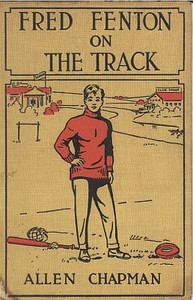
Fred Fenton on the Track; Or, The Athletes of Riverport School — A Reader’s Guide
Edition facts
For Fred Fenton on the Track; Or, The Athletes of Riverport School — A Reader’s Guide, the stored edition analysis reports 47,968 words, 3 hr 29 min estimated reading time, and 5 detected text sections.
The text analysis averages about 18.3 words per sentence, while the detected sections provide another way to judge how the source is divided.
Project Gutenberg metadata also associates the work with “Schools -- Fiction,” connecting these edition facts with the source record’s subject description.
Calculated from edition completeness, EPUB availability, text structure and catalogue metadata. Not a user rating.
How this score is calculated
- Description quality20 pts
- Title & short description10 pts
- Source metadata20 pts
- Text length15 pts
- Chapters / structure15 pts
- EPUB file integrity20 pts
Total of 100 points, scaled to a 2.5-5.0 range. Editions with an empty description or a missing EPUB file are not scored.
Read the Text
Fred had himself occasion to know what it meant to lie awake nights, and wonder if fortune would ever take a turn for the better. His father had been left a valuable property away up in Alaska, by a brother who had died; but there was a lot of red tape connected with the settlement; and a powerful syndicate of capitalists had an eye on the mine, which was really essential to their interests, as it rounded out property they already owned.
A certain man, Hiram Masterson by name, who had been in Alaska for years, and who had come back to the States to visit an uncle, Sparks Lemington, living in Riverport, had at first been inclined to side with the syndicate. Later on he changed his mind, and determined to give evidence for the Fentons which would, in all probability, cause the claim to be handed over to them.
How this change came about in the mind of Hiram Masterson, through an obligation which he found himself under to Fred Fenton, has already been told at length in the first volume of this series, called: "Fred Fenton, the Pitcher; Or, The Rivals of Riverport School."
Then it turned out that Hiram suddenly and mysteriously disappeared; and those who were so deeply interested in his remaining in Riverport learned that he had really been carried off by agents of the rich association of mine owners, of whom Sparks Lemington was one. How the search for the missing witness was carried on, as well as an account of interesting matters connected with the football struggles in the three towns bordering the Mohunk, will be found in the second book in the series, entitled "Fred Fenton in the Line; Or, The Football Boys of Riverport School."
Once again when hope ran high in the breasts of the Fentons they were doomed to disappointment, and long waiting. A brief letter was received from Hiram, written from Hong Kong, telling them that he was on the way home by slow stages, and would doubtless appear under another name, to avoid recognition by his uncle, Sparks Lemington. What new expectations this letter raised in the humble Fenton home; together with the story of the boat races on the Mohunk, has been related at length in the third volume, just preceding this, and issued under the name of "Fred Fenton on the Crew; Or, The Young Oarsman of Riverport School."
But now several months had passed, and as yet Hiram had not come. This was telling heavily on Fred, who counted the days as they dragged past, and kept wondering if, after all, the missing witness had died abroad, and they would never get the benefit of his evidence.
He knew his father was once more falling back into his old condition of mental distress, and he saw the lines gather on the usually smooth forehead of his mother. But Fred was by nature a light-hearted lad, who tried to look on the brighter side of things. He put these dismal thoughts resolutely aside as much as he could and took his part in the various pleasures that the young people of the town enjoyed.
Those who were at his side in all sorts of athletic rivalries never suspected that the boy often worried. And even pretty Flo Temple, the doctor's daughter, whom Fred always took to picnics, and on boat rides on moonlight nights, as well as to singing school and choir meetings, if she thought him a trifle more serious than seemed necessary, did not know what an effort it required for Fred to hide his anxieties.
Of course both Bristles and Fred were in running costume, in that they wore as scanty an outfit of clothes as possible. They were jogging along leisurely, and this allowed plenty of time for talk between them.
Bristles was one of Fred's best chums. Not a great while back he had fallen into what he called a "peck of trouble, with the pot boiling over," and Fred had been of great help to him. In fact, had it not been for him the mystery of who was taking some of Miss Muster's opals might never have been cleared up; and the elderly spinster, who was Bristles' mother's aunt, must have always believed that her grand-nephew was the guilty one.
But Fred had proved otherwise. He had even been smart enough to have the rich old maid on the spot when Gabe Larkins, the butcher's hired boy, was secreting his last bit of plunder. In her gratitude at finding that the culprit was not her own nephew, Miss Muster had even forgiven Gabe, who had promised to turn over a new leaf.
Somehow the thoughts of Bristles seemed to go back to several things which had happened to himself and Fred not a great while previous.
"That was a great time we had, Fred," he went on to say, as they fell into a walk, with a hill to climb; "I mean when we worked in double harness, and ran up against so many queer adventures last summer, in boat-racing time. Remember how we managed to rescue little Billy Lemington when he fell out of his brother's canoe; and how he begged us not to tell a single soul, because his father would whip him for disobeying?"
"Do you think Buck ever knew the truth of that canoe business?" remarked Fred. "I recollect your telling me he accused you of taking his canoe, and using it, because some fellow saw us putting it back in the place he kept it, and reported to Buck. And he was some mad, too, threatening all sorts of things if ever we touched his boat again."
"Say, d'ye know, between you and me and the henhouse, Fred, I don't believe he's ever heard the truth about that little affair to this day!" exclaimed Bristles, earnestly. "Want to know why I say that, do you? Well, just yesterday he threw it at me. We were with some fellows on the school campus, when the talk turned to canoes, and I happened to say I knew mighty little about the cranky things, as I'd had no experience in one."
"Oh! I can see how ready Buck would be to take advantage of that opening, and give you one of his sneering stabs with his tongue," observed Fred, quickly.
"Just what he did, Fred," asserted the other, frowning; "he turned on me like a flash, and remarked that he guessed I forgot a certain occasion when I had enjoyed _one_ canoe ride, anyhow, if it was in a stolen boat. I came mighty near telling the whole thing, how we had saved his little brother from drowning, or at least how you had, while I helped get you both ashore. But I stopped myself just in time, and let it pass by."
"Well," Fred went on to say, looking around at the dusty road they had just reached; "here's where we draw in close again to Riverport, to strike off again on the second leg of the run after we pass the Hitchen hotel at the crossroads. I suppose I ought not to keep on, with my toe hurting as it does; but you know I just hate to give up anything I start. Perhaps I'll be game enough to hold out to the end; and, besides, the pain seems to be passing off lately. I could even sprint a little, if I had to."
"Too late now to dream of heading off Colon, who has kept on the jump right along, while we took things easy. But I always like to be with you, Fred. You're a cheery sort of a feller, you know; and I feel better every time I chat with you."
Poor Fred,--who was secretly nursing deep anxiety to his heart, not willing to confide in even his best friends, lest in some way Squire Lemington get wind of the fact that they had heard from Hiram Masterson,--winced, and then smiled. Well, if he could put on a cheerful front, in spite of all that tried to weigh his spirits down, so much the better.
"We must turn at the crossroads, Bristles," he remarked. "The course heads into the northwest from there, up to Afton's pond; then due east two miles to Watch Hill; where we turn again and follow the turnpike home again."
"Oh! I guess I can stand for it, if you keep me company all the way, Fred; though I never was built for a runner, I reckon. But listen to all that shouting; would you? Some feller is excited, it sounds like. There, just what I expected was the matter; there's a horse taken the bit between his teeth, and is running away. I can see a boy sprinting after him, and that's his voice we get. Now, I wonder what it's up to us to do; step aside and let the runaway nag pass by; or try something to stop him? What say, Fred; can we block the road, and make him hold up, without taking too much risk?"
A STRANGE SOUND FROM A WELL
"Hi! there! Stop that horse! Head him off!"
The excited boy who was chasing wildly along in the rear of the runaway shouted these words as he waved his arms to the two lads coming so suddenly on the scene.
"Why, it's Gabe Larkins, as sure as you live!" ejaculated Bristles, recognizing the boy who drove the butcher's cart, and who had been concerned in the affair of Miss Muster's vanishing opals.
"Never mind who the boy is!" Fred called out; "if we want to head that runaway off we've got to be moving. Stand over there, wave your arms and shout 'Whoa!' as loud as you can. I'll try to cover this side of the road and do the same. The beast has just taken a notion to bolt home, that's all, and isn't badly frightened. We may be able to stop him right here."
"How far do we go, Fred?" cried Bristles, who was always ready and willing to do his share of any exciting business.
"Be careful, and keep ready to jump aside if he refuses to let up on his speed, Bristles."
"All right; I'm on, Fred!" And with that Bristles started to make as great and hostile a demonstration with arms and voice as he was capable of exhibiting.
His chum was doing likewise; so that between them they seemed to entirely block the road. The runaway horse was, as Fred had said, not worked up to the frantic stage where nothing would stay his progress. Indeed, seeing that these determined figures in running costume acted as though they meant to keep him from passing, the beast gradually slackened his pace.
The butcher's cart came to a standstill not twenty feet away from the boys; and the animal even started to back up into a fence corner, when the driver arrived on the scene, and took hold of the trailing lines. After that he soon gained the mastery over the horse.
"Got the slip on you that time, did he, Gabe?" remarked Fred, pleasantly; for he had been given to understand by Miss Muster, who was keeping track of the boy, that Gabe Larkins was doing what he could to make good; and Fred believed in extending a helping hand to every fellow who wanted to better his ways.
"Oh! he's a slick one, I tell you, fellers!" declared the panting and angered boy, as he reined in the animal that had given him such a scare and a race. "Nine times out of ten I tie him when I go to deliver meat. He knows when I forget, and this is the fourth time he's run away on me. Smashed a wheel once, and nigh 'bout scraped all the paint off'n one side of the pesky cart another time. Old Bangs says as how he means to fire me if it ever happens again."
"Well, we're right glad, then, Gabe, that we've been able to keep you from losing your job," Fred went on to say. "But that horse has a trick of going off if he isn't tied. I've heard about him before, and the trouble he gave the boy who was ahead of you. If I was driving him I'd never leave him unfastened."
"And I ain't a-goin' to no more, you just make sure of that!" Gabe declared, as no doubt he had done after every previous accident, only to grow careless again. "But it was nice in you fellers to shoo him that way. I sure thought he'd run right over you, but he didn't. Must 'a knowed from the way you talked to him you didn't mean to hurt him any."
"Well, we must be going on, Gabe, as we're in the cross-country run," said Bristles, who had been trying to study the face of the butcher's boy.
"Say, I'd like to be along with you, sure I would," remarked Gabe, wistfully. "Used to be some runner myself; but don't get no chanct nowadays. But I reckon it's all right, 'cause she says I'm a-doin' fine. Mebbe some day I can have a little fun like the rest of the fellers. I'm a heap 'bliged to both of you for holdin' up the hoss. G'lang, Rube!"
Swish! came the whip down on the withers of the late frisky runaway, and Gabe went helter-skelter down the road, headed for his next stopping place.
During the late summer the public spirited citizens of Riverport, led by Judge Colon, had started to raise funds in order to equip a much needed gymnasium with the latest appliances required by those who would train their muscles, and make themselves healthier by judicious exercise.
Mechanicsburg, up the river three miles, had done that for her school; and Riverport was trying to at least equal the generous spirit of the business men of the other town.
"Oh! the gym's just booming right along," declared Bristles, enthusiastically. "You know they've already got a long lease on the big rink where they used to have roller skating years ago. A cinder path has been laid around the whole of the circuit, equal to any outdoor track going. Great times we're going to have this winter, I tell you, Fred!"
"And, Bristles, how about the money for all the outfit--punching bags, parallel bars, boxing gloves, basketball stuff, and all the other things needed in an up-to-date gym?"
"Heard last night," said the other, joyfully, "that it had all been subscribed, and the order sent on. We'll soon be in the swim for keeps. But, while the good weather lasts let's keep outdoors. We can practice all sorts of stunts, so as to be ready to contest with those Mechanicsburg boys in an athletic meet. Great times ahead of us yet, old fellow! Hope we manage to snatch some of the prizes away from our old rivals; though they say it's just wonderful how clever they're sprinting and jumping up-river."
"We heard that sort of talk about football, and then when the boat race was planned didn't they say Mechanicsburg had a crew that was just a wonder?" Fred remarked, with a pleasant and cheery laugh.
"You're right, they did, Fred; and yet we licked the spots out of 'em both times. And we can do it some more, if we keep on practicing our stunts as Brad wants us to. Ten to one now they haven't got as fast a sprinter as our long legged Colon in their whole school. And when it comes to long-distance racing they'll have to look pretty far to find anybody who can hold out like Fred Fenton."
"Oh! let up on that kind of talk, Bristles; perhaps I might hold up my end of the log; and again there's a chance they've got a better man up there. I remember some of their fellows got around the bases like fun; and could carry the ball across the gridiron once they got hold of it. You never can tell what the best runner might be up against in a long race. Look at me to-day, stubbing my toe at the start; if this had been the big occasion that would have put me out of the procession in a hurry."
"Let's start on a little sprint again, now that we're getting close to the cross-road tavern. I can see it yonder through the trees. Old Adam will think we're handicap runners, catching up on the leaders. Here we go, Fred!"
Reaching the tavern at the spot where the roads crossed, they halted to get a cool drink, and ask a few questions. Somehow they saw nothing of any of the other runners, though the proprietor of the place told them several had come and gone. They found the names of Colon, Dave Hendricks and Corney Shays on the official pad that had been left at this important point, in order that each contestant might place his signature on it when he arrived, proving that he had fully covered the requirements of the run.
Once more the two lads started on their way at a good pace, since their short rest had refreshed them considerably.
"Look at the gray squirrel!" exclaimed Bristles, who was beginning to get winded after a mile of this jogging work, because he had not yet learned never to open his mouth while running, if it could be avoided.
"He's laying in his store of shagbark hickories for the winter," declared Fred; "and you better believe he picks only the good ones. I never yet found a bad nut in any store laid away by a squirrel. They know what's juicy and sweet, all right."
"Hold on!" said Bristles, coming to a stop.
"What's the matter now; hear any more runaways?" asked Fred, laughing; but at the same time coming to a walk in order to accommodate his panting chum.
"No, but there's an old farmhouse through the trees there, and I can see a fine well. Makes me feel dry again just to glimpse it. Come on, let's have a drink," and Bristles led the way between the trees toward the lonely looking place.
"A queer spot, Fred," he remarked. "Looks like it's deserted; and yet there's smoke coming out of the chimney; and I saw a pig run around the corner of that little stable. Here's our well; draw a bucket while I get my wind. Oh! did you hear that, Fred? It sounded just for all the world like a groan; and, as sure as anything, it came right out of this same well!"
The two boys turned to look at one another; and if they showed signs of alarm it was hardly to be wondered at.
"Oh! there it is again, Fred!" whispered Bristles, as a second sound, that was certainly very like a groan, came from the well.
Fred caught his breath. It was an unpleasant experience, to be sure; and might have tried the nerves of much older persons than two half-grown lads; but, after all, why should they be afraid?
"Somebody may have fallen down the well, and can't get out again," Fred remarked, with just the least tremor to his usually steady voice.
"Say, that's so," Bristles hastened to admit, as he cast a quick glance at the almost ropeless wooden windlass; "don't you see the bucket's away down? Whoever it is, Fred, they just can't climb up again. It takes you to get on the inside track of things, Fred."
"If that's so, it might account for the fact that nobody seems to be around the place," Fred went on to say.
"P'raps an old man lives here all alone, and he tripped over these stones when he went to lift the bucket of water out, and fell in himself. Gee! Fred, then it's up to us to get him out!"
The other stepped directly up to the edge of the old well. He saw that the coping was uneven, some of the stones being loose. It looked very much as if what Bristles had suggested might be the truth, and that some person, when striving to raise a heavy bucket, had lost his balance, slipped on the treacherous footing, and toppled into the well.
And, even as Fred Fenton bent down, he was thrilled to hear a third groan come out of the depths. Nevertheless, instead of starting back, he bent over further, as though hoping to look down and discover the truth.
"Can you see him?" asked Bristles, very white in the face, but bent on sticking it out as long as his chum did.
The opening chapter of Fred Fenton on the Track immediately establishes a pattern of strategic movement and hidden danger. Fred Fenton, limping from a stubbed toe, converses with Bristles about the race, revealing that the long-legged Colon is the favorite. The dialogue quickly shifts to a plan: Fred will drop out of the official cross-country run and secretly cover a separate five-mile course. This decision sets up a structure where the narrative alternates between the public race and Fred's private, more perilous route.
The Vanishing Act as Structural Device
The story hinges on Fred's deliberate disappearance from the starting line. With the pistol crack, he drops flat, crawls to the bushes, and slips away while the other runners surge forward. This vanishing act is not merely a trick; it becomes a recurring structural element. The reader follows Fred's solo journey through woodland, fields, and a dangerous limestone quarry, while the fate of the official race remains suspended. The narrative cuts between Fred's internal monologue—counting his pace, noting his time—and the unseen progress of his rivals. This dual-track structure creates suspense: will Fred's secret route prove faster, and what will happen when the other runners discover he never started?
The Quarry as a Recurring Image of Hazard
The limestone quarry is introduced with specific, sensory detail: pits partly concealed by bushes, the need to jump left and right to avoid suspicious spots. Fred recalls a previous near-fall, and the text repeats the word "deep holes" to emphasize the threat. This setting recurs as a physical and symbolic obstacle. The quarry is not just a place but a pattern of near-misses and careful navigation. Fred's internal warning—"I must sheer off more the other way"—echoes the caution that pervades his entire run. The image of hidden pits beneath friendly bushes suggests that danger in this story often lurks beneath a deceptively ordinary surface.
Movement Between Public and Private Spaces
The narrative constantly shifts between the crowded athletic field and Fred's solitary path. The field is described with collective energy: "the long line of young athletes surged forward," "loud cries from the crowd." In contrast, Fred's route is marked by isolation and self-reliance. He vaults stone fences, cuts across woodland, and follows a country road. This movement between public spectacle and private endeavor is a key structural pattern. The reader is placed inside Fred's head as he monitors his own performance, while the fate of the team depends on his hidden effort. The tension arises from the gap between what the crowd sees and what Fred is actually doing.
Voice and Dialogue as Character Markers
The dialogue between Fred and Bristles is brisk and idiomatic, filled with nicknames and friendly banter. Bristles' hair "stood up" oddly, and his speech is peppered with exclamations like "Huh!" and "Say." Fred's responses are measured, revealing a strategic mind. The exchange about Colon—"He can get over ground for a certain time like a deer"—uses animal imagery that recurs in the text. Later, Fred thinks of his own muscles responding "splendidly." This voice, with its blend of casual slang and athletic determination, defines the characters without lengthy description. The dialogue also advances the plot: the plan to vanish is hatched entirely through conversation, making speech a driver of action.
Readers attentive to the interplay between the public race and Fred's hidden route will find that the story's tension derives not from a simple contest of speed, but from the strategic choices made before the starting pistol fires. The quarry, the vanishing act, and the shift between crowd and solitude are not incidental details—they form the narrative's backbone. As you read, note how each chapter returns to these patterns, building a world where what is unseen often matters more than what is seen.
That rainy afternoon, Fred Fenton’s quarry detour lingered with me—how the race’s real hazard wasn’t the path but the vanishing act it demanded. Later, idly, I picked up The Corner House Girls at School — Reading Companion. Same era’s quiet wit, though softer. I hadn’t planned it. The rain just kept falling, and one book handed me to the other.
What did you think of this book?
Answer a few questions and save a private reflection on this device.

Charlotte Smith
1 month ago