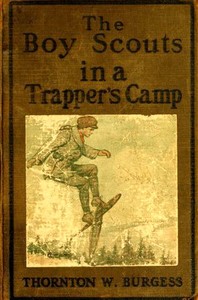
The Boy Scouts in A Trapper's Camp — Story, Setting & Ideas
Edition facts
For The Boy Scouts in A Trapper's Camp — Story, Setting & Ideas, the stored edition analysis reports 73,696 words, 5 hr 21 min estimated reading time, and 7 detected text sections.
The text analysis averages about 16.8 words per sentence, while the detected sections provide another way to judge how the source is divided.
Project Gutenberg metadata also associates the work with “Boys -- Juvenile fiction,” connecting these edition facts with the source record’s subject description.
Calculated from edition completeness, EPUB availability, text structure and catalogue metadata. Not a user rating.
How this score is calculated
- Description quality20 pts
- Title & short description10 pts
- Source metadata20 pts
- Text length15 pts
- Chapters / structure15 pts
- EPUB file integrity20 pts
Total of 100 points, scaled to a 2.5-5.0 range. Editions with an empty description or a missing EPUB file are not scored.
Read the Text
There were studies of deer and other wild animals, views of Woodcraft Camp, of scenes along Swift River, and of the various camps and points of interest on Lost Trail, the relocating of which by Walter and his four fellow Scouts of the Lone Wolf Patrol had won for them the distinction of a special letter of commendation from national headquarters of the Boy Scouts of America.
Above the door hung a hard-used set of boxing gloves. Crossed above one window were a pair of snow-shoes, while above the other window were a pair of fencing foils. In one corner, each in its case, were two fishing-rods, a rifle and a tennis racquet. In the opposite corner leaned a Scout staff and a couple of canoe paddles. A great horned owl stared unblinkingly down from the top of one of the plain oak bookcases. On the wall just back and above it was fastened a small banner having the head of a wolf worked in black against a white background, and bearing the one word "Persistence." It was the Lone Wolf banner which had been carried on that never-to-be-forgotten search for Lost Trail. By unanimous vote of the patrol, it had been presented to Upton at the conclusion of the trip in recognition of successful leadership.
Several small silver cups on the bookcases and half a dozen medals pinned to a little square of black velvet on one wall attested to well-won victories in various lines of sport. The books on the shelves were what one might expect in such surroundings, well selected stories of adventure and exploration, treatises on hunting, fishing and outdoor sports, a very complete nature library, handbooks on woodcraft, camping, first aid, forestry and surveying, a well-thumbed Scout manual and other books which attested to the owner's love of the great outdoor world. But these were not all. A whole shelf was devoted to history, and another to selections from standard American and English authors, including several of our best loved poets.
Altogether, it was a room such as a keen, red-blooded, broad-minded boy might well delight in. Upton did delight in it. Everything in it held some special significance or sentiment for him, and now as his eyes idly roved from one object to another one memory after another was stirred within him. At last his eyes rested on the snow-shoes and remained there.
"Wonder if I'll get a chance to use those things this winter," he muttered. "Little old New York doesn't know much about that kind of foot-gear. I suppose Pat has worn out two or three pairs since he gave me those, and here I haven't had 'em on but once in three years, and then there was hardly snow enough for an excuse. I guess I'd be some tenderfoot all right, all right, on those things up in the woods. Good old Pat! Wonder what he's doing. It's a long time since I've heard from him. Well, I ought not to kick over a little extra grind! He's trying to get an education and support himself and help his folks at the same time. Wish he could come down here for the vacation. What fun it would be to show him around and listen to his remarks on the big city. It would be almost as much fun as going into the big woods in the winter. Fact is, I envy him right now, and I'll bet he doesn't envy me a penny's worth."
Swiftly his thoughts reverted to his first meeting with Pat Malone, chore boy and bully of a sawmill village in the North Woods, and of the thrashing he had given the young woodsman in spite of the latter's advantage in weight and strength.
"It was all in the know how. Imagine me trying to do it now," he chuckled. "Why, Pat could take me across his knee just as he did the youngster who mistook him for a deer and put a bullet through his hat last fall. I've never seen anybody take to an idea as Pat did to scouting. He just soaked it up. It was the principle of the thing that got him right from the start, and not just the fun that goes with it. And just see what it's done for him! I don't know of any one it's done so much for, unless----"
Almost unconsciously Walter turned to stare through the gathering dusk at a photograph on the nearer of the two bookcases. A pair of frank eyes, kindly but keen, looked down at him from a face good to see, the face of a boy of about his own age. It was a handsome face and the beauty lay, not in regularity of features, but in the strength of character and purpose written in every line. It was the face of Hal Harrison, son of a multi-millionaire, and comrade and fellow Scout in the fun and adventures of the last three summers. It was the sudden remembrance of Hal that had caused the abrupt break in the trend of his thought. Not even for the poor, rough, tough young bully of the woods had scouting done more than it had for this other lad, brought up in the lap of luxury, his every whim gratified, toadied to, petted, spoiled. From opposite extremes of the social strata it had brought these two together on the common ground of true brotherhood--the brotherhood of democracy. It had discovered to the young savage, for Pat was little more than that, his own manhood. It had stripped from Hal, the cad, the veneer of false social rank based on wealth and found there also a man. And now these two--the one whom he had fought and the one whom he had despised--Upton regarded not only as comrades and brother Scouts, but almost as chums.
Some such thoughts as these were floating through his mind as he sat there in the soft dusk of winter twilight. It was just the hour for dreaming the dreams which every boy loves to dream, half thought, half idle fancy. He tried to picture what the future might hold for himself and for these two comrades. Hal would be a captain of industry. It could hardly be otherwise. He would inherit vast wealth. He would in time take charge of the great enterprises which his father had built up. Would he apply to their management the principles of which as a Scout he was now so earnest a champion? Pat dared to dream of some day becoming a naturalist. Would he succeed? Remembering what Pat had been and what he now was Walter somehow felt that he would. As for himself he could not see his own career with a like clearness. He would like--
Ting-aling-ling! It was the telephone in the hall. With a start Walter came back to earth and the present. He went to answer the call. Picking up the receiver he called, "Hello." For a moment there was no response, but he caught a sound as of voices and something that sounded like a laugh. Then over the wire came a rich brogue that caused Walter to nearly drop the 'phone.
"Hello, Misther Leader. I have to reporrt the discovery av the city av Noo Yor-r-k and the losing av mesilf entoirely."
"Pat! You big red headed son of Erin! Are you really in New York? When did you get in? Where are you? Are you----"
"Aisy, aisy now. Have ye not learned thot ye can make but wan bull's-eye at a shot? Shure I be in Noo Yor-r-k, an' 'tis proud the city ought to be av the honor I be doin' ut."
"Quit your kidding, Pat, and tell me where you are and when you came and all about it," interrupted Walter.
"Shure, wasn't I afther telling ye thot I be in Noo Yor-r-k?" protested Pat in a grieved tone. "'Tis at the illigant home av an illigant gintleman thot I be, but begorra I forgot entoirely to blaze the trail and I don't know how I got here at all, at all."
There was a sound of a scuffle and a smothered laugh, then another voice broke in:
There was no mistaking that voice, and Upton grinned more broadly than before as he replied:
"Hello, Hal. It sure does me good to hear your voice. I might have known whose illigant home Pat is honoring. Where did you find him, and why didn't you tell me? Didn't expect you home until the end of next week. Funny thing, but I was thinking of you two fellows when the 'phone rang. Same old Pat, isn't he? Gee, but it's good to hear the voices of you two fellows! Now when do I see you and where?"
"Right after dinner. We'll drive around and pick you up and then give Pat a glimpse of the Great White Way," replied Hal, answering the last questions first. "I've had this all planned for a month by way of a surprise. I have a week more vacation than you do, and I got in just in time to meet Pat's train. Had hard work to persuade him to come, but I got him at last. Say, got any plans made for your vacation?"
"Nary a plan. Been waiting to hear from you," replied Walter.
"Good! I've got the greatest little stunt you ever heard of to tell you about to-night. Pat suggested it, and I had to promise to try to put it through before he would agree to come down here. We've got to go clean up for dinner now, but we'll be around about eight o'clock. So long until then."
"So long," replied Walter, and hanging up the receiver he whooped joyously and proceeded to execute a war dance that ended with a crash as a rug slipped under his feet and he came down in a heap. It happened that at that very instant his father, just home from the office, opened the hall door briskly and a second later landed on Walter with a force that brought a grunt from each. He had tripped over one of the boy's sprawling legs. As quickly as he could disentangle himself Walter scrambled to his feet. Concern was written in every line of his face as he extended a helping hand to Mr. Upton.
"Oh, Dad, are you hurt?" he cried anxiously.
Mr. Upton's eyes twinkled good-humoredly as he replied: "Only in my dignity. But tell me, son, why all this hilarity that led to the utter downfall of the house of Upton? I heard you break loose, and was hurrying to share in it."
"It's a shame," declared Walter contritely as he brushed off his father's coat. "I ought to know better than to be acting like a wild Indian in the house. Fact is, I had just got some mighty good news over the 'phone. Guess what."
"Hal is coming home for the vacation," hazarded Mr. Upton promptly, for these two, father and son, were chums, and he knew just how eagerly Walter had hoped for Hal's homecoming.
"Right and wrong, both!" whooped Walter. "You're a good little guesser, Dad, but you didn't guess enough this time. He's home already, and Pat's with him!"
"Pat! Pat who?" A puzzled frown wrinkled Mr. Upton's forehead.
"Pat Malone, of course! As if there was more than one Pat! They got in half an hour ago, and they're coming around here after dinner to get me."
Mr. Upton's face lighted with a smile of pleasure. "That's splendid," he declared. "It's news worth getting upset for. How ever did Hal lure that young giant out of his beloved woods?"
"I don't know," replied Walter. "All I know is that he is here, and the rest we'll find out when they get here. Hope he's going to stay through vacation. It'll be no end of fun showing Pat around. Wish you could be with us."
"I wish I could," replied Mr. Upton, smiling. "Suppose we eat dinner now so that you will be ready for them when they arrive."
Promptly at eight o'clock a big touring car drew up in front of the house, and Walter was down the steps before the two figures in the tonneau could disentangle themselves from the robes. Three voices mingled in a joyous shout, there was a swift clasping of hands in the Scout grip, and then the three boys started up the steps to the open door, where Mr. Upton stood waiting with outstretched hand.
"Welcome to our city, Pat!" he cried heartily.
"Thank you, sir. If everybody receives such a welcome as I have had it is no wonder that we cannot keep people in the woods."
Walter actually gaped open mouthed at Pat. There was not a trace of accent. Pat caught the look and his blue eyes twinkled. Suddenly he whirled and hit Upton a resounding whack between the shoulders with his open palm. "Did I not tell ye thot whin I got the leaves out av me hair and the Irish out av me shpach I would come? And here I be. Tell me now, do ye want to foight? 'Twas the reception I was afther giving ye whin ye first came to the woods, and 'tis no more than roight thot ye should trate me the same whin I land in Noo Yor-r-k."
Walter ran a calculating eye over the brawny young woodsman, six feet in his stockings and broad in proportion, and backed away. "I waive the privilege--out of politeness," said he with a low bow.
"'Tis loike Noo Yor-r-k to be gentle with the helpless. Shure 'tis a foine settlemint and foine people in ut," retorted Pat.
"I am interested to learn how Hal induced you to come here, Pat," said Mr. Upton as he ushered them into the library.
Hal chuckled. "I trapped him," said he. "I set a trap and baited it and he walked right into it. Don't you think I'm some little trapper?"
"You certainly are," declared Mr. Upton, while Pat grinned. "Let's hear all about it."
"Well, first I made sure that I could get passes from Dad. You know he controls the railroad to Upper Chain. Dad was tickled to death with the idea. Even offered to send up his private car. You know he's a great admirer of Pat. Then for a bait I arranged through a friend to get an introduction for Pat to some of the head people out at Bronx Park and at the American Museum of Natural History. I knew that he just couldn't pass that chance up, but to make sure I wrote to Doctor Merriam at Woodcraft Camp, and of course he joined the conspiracy right away. For a clincher I promised Pat that Walt and I would spend Walt's vacation with him up in the woods."
Walter came out of his chair with a bound. "What's that?" he cried. "Say it again!"
"I said that to get Pat down here I promised him that we--you and I--would spend a week in the woods with him this winter. Is that perfectly clear?" Hal spoke slowly and with emphasis.
"It sounds clear, but it isn't," replied Walter, glancing at his father with a rueful smile. He was thinking of the expense and that as things then were he could not afford the trip.
Hal intercepted the glance and understood. "Oh, yes, it is," said he. "It is perfectly clear. We leave here next week Friday night and you and Pat are my guests until we reach Upper Chain the next morning. Then the three of us become the guests of Doctor Merriam at Woodcraft Camp for a day or two, and after that you and I will be the guests of--guess who?"
Walter shook his head. He was a trifle dazed by the way in which Hal took everything for granted.
"Pat and his partner!" cried Hal, while Pat grinned broadly. "Pat's trapping this winter instead of lumbering, and we're going to spend a week in a real trapper's camp, and snow-shoe and have no end of fun. Won't it be great? Walt may go, mayn't he, Mr. Upton?"
Mr. Upton laughed aloud. "I wouldn't dare say no in the face of such completely organized plans," he confessed. "Of course he may go. It's a splendid idea, and I suspect that when he comes back for the next term of the school year he will be feeling so fine that nothing can stop him from winning that scholarship he has set his heart on, and has been working so hard for."
"Then it's all settled!" cried Hal. "Pat is going to stay and go back with us, and while he is here it is up to us to show him what New York is like. We'll begin by showing him the Great White Way to-night. Get your coat and hat, Walt. The car is waiting. Won't you go with us, Mr. Upton?"
"Not this time, thank you, Hal," replied Mr. Upton. "I have an engagement for this evening, though I would much rather join you youngsters than keep it. I feel that I am to lose something really worth while--a rare pleasure."
"And the loss is equally ours, sir," said Pat as they rose to don their coats.
Once more Walter eyed Pat quizzically. It was clear that the young Irishman had been pursuing his studies under Doctor Merriam to good advantage. Without the rich brogue it was a new and wholly different Pat. But he forbore to make any comment, and in a few minutes they were off to show Pat one of the most wonderful scenes in the world, New York's famous Broadway by night.
Mindful of the lasting effect of first impressions Hal had contrived to give Pat no opportunity to get more than a fleeting glimpse of crowded streets and glaring lights. He had met Pat at the train, which had not arrived until the early winter evening had set in, hurried him to a big touring car with curtains drawn and then whirled him away to the palatial Harrison home on Riverside Drive without giving him a chance to sense more than a glare of lights and that confusion of sounds which constitutes the voice of a great city. The same car had brought them to Walter's modest home. While they had been making their brief call there the chauffeur, under Hal's orders, had put back the top of the machine, so that as they descended the steps Pat did not recognize the car at all. In fact, until that day Pat had never so much as seen a motor car, a buck-board being the most stylish equipage of which Upper Chain could boast.
"Arrah, 'tis black magic!" exclaimed Pat as he settled himself comfortably between Hal and Walter in the tonneau, convinced at last that he was really in the same car which had brought him there.
"And we're going to show you some white magic," cried Hal, as he leaned forward to give orders to the chauffeur.
A quick run through side streets, comparatively deserted at this hour, brought them to Broadway at the junction with Sixth Avenue. Turning north the dazzling splendor of the "Great White Way" burst upon the startled eyes of the young woodsman. His companions heard him catch his breath with a little gasp. Then he closed his eyes for the space of a few seconds, opening them slowly as if he suspected them of playing him tricks. An instant later he seized a leg of each of his companions just above the knee with a grip that brought both half-way to their feet with a little yell of surprised protest.
"'Tis true, then, and no drame," said he as he settled back with a little sigh of relief. "Sure and had I pinched mesilf I would not have believed me own sinse av feeling. White magic, did yez call ut? Sure 'tis the city av enchantment."
Thornton W. Burgess's The Boy Scouts in a Trapper's Camp (1915) is cataloged under subjects including Boy Scouts, trappers, and boys' adventure fiction. Yet the excerpts from the text reveal a work that leans heavily into technical instruction: the detailed description of setting a fox trap, the recipe for a scent lure made from skunk fat and rotted mice, and the step-by-step explanation of cased skinning all suggest that Burgess's primary interest here is in conveying the practical knowledge of a trapper's trade rather than in advancing a plot or developing character.
Instruction Over Incident
The excerpts contain almost no dialogue that advances a story. Instead, the characters—Alec, Pat, Hal, Upton, and Sparrer—serve as audience for extended monologues on trapping technique. Alec explains dry sets, the importance of leaving no scent, and the use of stretching boards with a wedge or tongue to accommodate different pelt sizes. The boys' reactions are limited to comic disgust at the scent lure: Hal howls, Sparrer yelps, and Upton exclaims. The narrative pauses for a full lecture on fleshing, curing, and the difference between cased and open skins. This suggests that Burgess, who wrote nature books for children, may have used the Boy Scouts framework as a vehicle for outdoor education rather than for storytelling.
The Wilderness as Classroom
The setting—a trapper's camp in winter—is described in the introduction as a place where the reader can gain a sense of "the mystery of the great life eternal" and the importance of standards when no one is watching. But the excerpts do not dramatize these themes. Instead, they show the boys learning concrete skills: how to boil traps in hemlock boughs, how to handle raw furs, and how to use fish oil as a scent. The catalog subject "Scouts (Youth organization members)" is present only in the title and dedication; the text itself focuses on the trapper's solitary craft, not on scout law or patrol activities. The Blue Tortoise Patrol is mentioned in the table of contents but does not appear in the provided excerpts.
Voice and Authenticity
Burgess gives the trapper Alec a dialect that marks him as an experienced woodsman: "He disna like to wet his feet," and "That's when ye get him." Pat, another trapper, uses similar Scots-inflected speech. This contrasts with the boys' more standard American English, creating a clear hierarchy of knowledge. The technical passages are precise and unglamorous—the description of skinning a muskrat includes cutting around the vent, stripping the skin wrong side out, and cutting off the ears close to the head. There is no romanticizing of the trapper's life; the work is presented as messy, smelly, and methodical. The excerpts suggest that Burgess valued accuracy over adventure, and that the book's primary appeal may be to readers interested in how things are done rather than in dramatic events.
What the Catalog Misses
The catalog subjects emphasize "Boy Scouts of America" and "Trappers," but the excerpts show that the book is less about scouting as an organization and more about the transfer of specialized knowledge from an older trapper to younger boys. The introduction states that the book aims to "demonstrate what a powerful factor in the development of character and true manhood are the oath and law of the Boy Scouts," yet the provided text contains no reference to the scout oath or law. The actual content is closer to a manual on trapping techniques, with the scout framework serving as a thin narrative wrapper. Readers expecting patrol meetings, merit badges, or scoutcraft may find instead a detailed guide to setting traps and curing pelts.
Readers approaching The Boy Scouts in a Trapper's Camp should be prepared for a text that prioritizes instruction over incident. The excerpts suggest that the book's value lies in its specific, hands-on descriptions of trapping methods—scent preparation, trap placement, and skin stretching—rather than in plot or character development. Those interested in early twentieth-century outdoor education or the technical details of fur trapping will find the most reward here. The Boy Scouts element is present in name and dedication, but the heart of the book is the craft of the trapper.
I keep thinking about that Burgess book, how the real heart of it wasn’t the adventure but the quiet, patient craft of making scents and handling pelts. It made me wonder about the boys in The Banner Boy Scouts on a Tour; or, The Mystery of Rattlesnake Mountain — Story, Setting & Ideas, and whether their mystery might hide the same kind of slow, hands-on learning beneath the surface. It lingers, somehow.
Your personal reading reflection
Build a private reading journal entry for this title.
Wyatt Davis
2 weeks ago