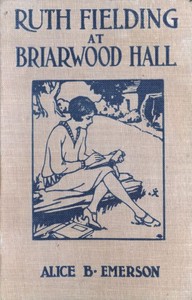
Ruth Fielding at Briarwood Hall; or, Solving the Campus Mystery — Context and Discussion
Edition facts
Ruth Fielding at Briarwood Hall; or, Solving the Campus Mystery — Context and Discussion can be approached with a clearer sense of reading commitment from its source measurements: 46,333 words, 3 hr 22 min estimated reading time, and 6 detected text sections.
The text analysis averages about 14.4 words per sentence, while the detected sections provide another way to judge how the source is divided.
Project Gutenberg metadata also associates the work with “Boarding schools -- Juvenile fiction,” connecting these edition facts with the source record’s subject description.
Calculated from edition completeness, EPUB availability, text structure and catalogue metadata. Not a user rating.
How this score is calculated
- Description quality20 pts
- Title & short description10 pts
- Source metadata20 pts
- Text length15 pts
- Chapters / structure15 pts
- EPUB file integrity20 pts
Total of 100 points, scaled to a 2.5-5.0 range. Editions with an empty description or a missing EPUB file are not scored.
Read the Text
I. THE EXODUS II. THE MAN WITH THE HARP III. APPROACHING THE PROMISED LAND IV. THE RIVALRY OF THE UPEDES AND THE FUSSY CURLS V. THE DUET VI. THE ENTERING WEDGE VII. THE UPEDES VIII. THE MARBLE HARP IX. THE GHOSTLY TRIBUNAL X. SOMETHING MORE THAN GHOSTS XI. THE VOICE OF THE HARP XII. THE MYSTERY DEEPENS XIII. BEGINNINGS XIV. THE SWEETBRIARS XV. THE NIGHT OF HARPOCRATES XVI. THE HAWK AMONG THE CHICKENS XVII. GOODY TWO-STICKS XVIII. THE MYSTERY AGAIN XIX. THE TRIUMVIRATE XX. AT TRITON LAKE XXI. ON THE ICE XXII. THE HARPIST ONCE MORE XXIII. THE SECRET XXIV. WHO IS THE "TATTLE-TALE?" XXV. GETTING ON
RUTH FIELDING AT BRIARWOOD HALL
The sun was a regular lie-abed on this Autumn morning, banked about by soft clouds and draperies of mist; but they glowed pink along the horizon--perhaps blushing for Old Sol's delinquency. The mist hung tenderly over the river, too--indeed, it masked the entire Valley of the Lumano--lying thick and dank upon the marshes and the low meadows, but wreathed more lightly about the farmhouses and their outbuildings, and the fodder and haystacks upon the higher ground.
But suddenly the sun flung off the bedclothes and leaped right into the sky. That long, low bank of cloud that had been masking him, melted away and the shreds of mist were burned up in a hurry as his warm rays spread abroad, taking the entire valley in their arms.
Farmhouses, where the kitchen chimney smoke had been rising straightly into the air, immediately put on a new bustle. Doors opened and shut. There was the stamping of horses in the stables as they crunched their corn; cows lowed as the milk-pails rattled; sheep baa-a-ed in their folds, and the swine, fearing that some other of the farm stock would get _their_ share of the breakfast, squealed in eager anticipation.
On a knoll by the river side stood the rambling buildings belonging to Jabez Potter, who kept the Red Mill. The great wheel beside the mill end of the main structure had not yet begun to turn, but there was plenty of bustle about the pleasant house.
The sun had scarcely popped up when a very pretty, bright-looking girl ran out upon the porch and gazed earnestly along the road that followed the Lumano toward Osago Lake. She looked out from under a shielding hand, for the sun was in her eyes. Around the corner of the house came a tall, dark-faced man whose long jaws were cleanly shaven and deeply lined. His clothing was full of milldust and it seemed to have been ground into his face for so many years that it was now a part of the grain and texture of his skin. He did not smile at the girl as he said:
"You ain't looking for them yet; air you, Ruth? It's much too early. Help your Aunt Alviry put breakfast on the table. She'll hev it all to do when you're gone."
The tone was stern, but the girl seemed to be used to it, for her face did not cloud over, and the smiles rippled about her mouth as she replied:
"I'm so full of happiness, Uncle Jabez, that you mustn't mind if I'm looking for Helen and Tom ahead of time. It doesn't seem possible that I am actually going with them."
"It seems real enough to me," grumbled Jabez Potter. "I hope you'll get enough out of it to pay us for all the trouble and cost of your going--that I do."
But even this seemingly unkind speech did not ruffle the girl's temper.
"You wait and see, Uncle Jabez--you just wait and see," she said, nodding to him. "I'll prove it the best investment you ever made."
He didn't smile--Jabez Potter was not one of the smiling kind; but his face relaxed and his eyes twinkled a little.
"I sha'n't look for cent. per cent. interest on my money, Niece Ruth," he said, and stumped into the house in his heavy boots.
Ruth Fielding, who had come to the Red Mill only a few months before, having lost all other relatives but her great-uncle, who owned the mill, ran into the kitchen, too, where a little old woman, with bent back and very bright eyes, was hovering over the stove. The breakfast was ready to be served and this little woman was pottering about, muttering to herself a continual complaining phrase:
"Oh, my back and oh, my bones!"
Aunt Alvirah Boggs (who was everybody's Aunt Alvirah, but no blood relation to either Ruth or her uncle) was not a morose person, however, despite her rheumatic troubles. She smiled on Ruth and patted her hand as the girl sat down beside her at the table.
"Seems like we'd be lost without our pretty leetle creetur about," said Aunt Alvirah. "I don't see what the old house will do without her."
"I'll be home at Thanksgiving--if Uncle will let me," said Ruth, quickly, and glancing at the old man; "and again at Christmas, and at Easter. Why, the intervals will go like _that_," and she snapped her fingers.
"All this junketing up and down the country will cost money, Niece Ruth," admonished Uncle Jabez.
He was, by nature, a very close and careful man with money--a reputed miser, in fact. And that he did hoard up money, and loved it for itself, must be confessed. When he had lost a cash-box he kept in the mill, containing money and other valuables, it had been a great trouble to Uncle Jabez. But through a fortuitous train of circumstances Ruth Fielding had recovered the cash-box for him, with its contents untouched. It was really because he considered himself in her debt for this act, and that he prided himself upon paying his debts, that Jabez Potter had come to agree that Ruth should go away to school.
He had not done the thing in a niggardly way, when once he gave his consent. Ruth's new trunk was at the Cheslow railroad station and in it was an adequate supply of such frocks and necessities as a girl of her age would need in the school to which she was bound. Her ticket was bought, too, and in her purse was a crisp ten-dollar note--both purse and money being a special present from Uncle Jabez.
Ruth had learned that the miller was by no means as grim as he looked, and she likewise knew that now he was kindly disposed toward her and really was doing a great deal for her. She was determined to never be ungrateful to Uncle Jabez for satisfying the greatest longing she had ever had--to go to Briarwood Hall, a boarding school.
Suddenly a young man put his head in at the kitchen door, grinned, and said:
"They're a-comin', Miss Ruthie. I see 'em up the road."
Ruth jumped up at once and ran for her coat and hat.
"There, child!" cried Aunt Alvirah, "ye haven't eaten enough breakfast to keep a fly alive. Lucky I've got a good basket of lunch put up for ye. It'll be a long journey--by train, boat, and stage coach. You'll be hungry enough before ye git there---- Oh, my back and oh, my bones!" she added, as she hobbled to the dresser for the luncheon box.
Ruth flashed back into the room and cried to the youth on the porch:
"Is the car really in sight, Ben?"
"It's almost here, Miss."
Indeed, they could hear the purring of a motor-car coming up the river road. Ruth flung her arms about Uncle Jabez's neck, although he did not rise from the table where he was methodically putting his breakfast away as though nothing unusual was happening.
"You've been a dear, good uncle to me," she whispered, "and I love you for it. I'll be careful of the money, and I'll get all the learning I can for the money you pay out--now just you see if I don't!"
"I ain't sure that it'll do either of us much good," grumbled Uncle Jabez, and he did not even follow her to the door as she ran out.
But Aunt Alvirah hobbled after her, and pressed her close before she would let the girl run down the walk.
"Blessin's on ye, ye pretty creetur," she crooned over Ruth. "I'll think of ye ev'ry moment ye air away. This is your home, Ruthie; ye ain't got nary 'nother--don't fergit that. And yer old A'nt Alviry'll be waitin' for ye here, an' jest longin' for the time when ye come home."
Ruth kissed her again and again. Two excited young voices called to her from the automobile.
"Come on! Come on, Ruth. Do come away!"
She kissed Aunt Alvirah once more, waved her hand to bashful Ben, who was Uncle Jabez's man-of-all-work, and ran down to the waiting car. In the seat beside the chauffeur was a bright-looking, black-haired boy in a military uniform of blue, who seized her lunch basket and handbag and put them both in a safe place. In the tonneau was a plainly dressed lady and a brilliantly pretty girl perhaps a year older than Ruth. This young lady received the girl from the Red Mill rapturously when she sprang into the tonneau, and hugged her tightly as the car started on. She was Ruth's dearest friend, Helen Cameron. It was her brother Tom in front, and the lady was Mrs. Murchiston, who had been the governess of the Cameron twins since their babyhood, and was now to remain in the great house--"Outlook"--Mr. Macy Cameron's home, as housekeeper, while his son and daughter were away at school.
For Tom was bound for Seven Oaks Military Academy, and that was only ten miles, or so, this side of Lumberton, near which was situated Briarwood Hall, the boarding school which was the girls' destination. Tom had attended Cheslow High School for a year; but Ruth and Helen were about equally advanced in their studies and expected to be both roommates and classmates at the Hall.
Ruth stood up in the car as it rolled up the hill toward Cheslow and looked back at the Red Mill. She fluttered her handkerchief as long as she could see the little figure of Aunt Alvirah on the porch. Uncle Jabez came out and strode down the path to the mill. Then the car shot around a curve in the road and the scene was blotted out.
How much was to happen to her before she saw the Red Mill again!
THE MAN WHO PLAYED THE HARP
In the first volume of this series, entitled, "Ruth Fielding of the Red Mill; Or, Jasper Parloe's Secret," is related how Ruth and Helen and Tom came to be such close friends. The Camerons had been with Ruth when the lost cash-box belonging to Uncle Jabez Potter was found, and out of which incident Ruth's presence in the Camerons' automobile on this beautiful September morning, and the fact that she was accompanying Helen to school, arose.
Mr. Macy Cameron, a wealthy dry-goods merchant, and a widower, had selected the best school for his daughter to attend of which he could learn. Briarwood Hall, of which the preceptress was Mrs. Grace Tellingham, was a large school (there being more than two hundred scholars in attendance for the coming term), but it remained "select" in the truest sense of the word. It was not an institution particularly for the daughters of wealthy people, nor a school to which disheartened parents could send either unruly girls, or dunces.
Without Mrs. Murchiston's recommendation Helen Cameron could not have gained entrance to Briarwood; without the attested examination papers of Miss Cramp, teacher of the district school, who had prepared Ruth for entering Cheslow High School before it was supposed that she could go to Briarwood, the girl from the Red Mill would not have been starting on this journey.
"My goodness me!" exclaimed Helen, when Ruth had sat down and Cheslow was coming into view before them. "I'm just as excited as I can be. Aren't you afraid of meeting Mrs. Tellingham? She's got an A. B. after her name. And her husband is a doctor of almost everything you can think!"
Mrs. Murchiston smiled, but said with some sternness; "I really hope, Helen, that Briarwood will quell your too exuberant spirits to a degree. But you need not be afraid of Dr. Tellingham. He is the mildest old gentleman one ever saw. He is doubtless engaged upon a history of the Mound Builders of Peoria County, Illinois; or upon a pamphlet suggested by the finding of a fossilized man in the caves of Arizona."
"Is he a great writer, Mrs. Murchiston?" asked Ruth, wonderingly.
"He has written a great many histories--if that constitutes being a great writer," replied the governess, with a quiet smile. "But if it was not for Mrs. Tellingham I fear that Briarwood Hall could not exist. However, the doctor is a perfectly harmless person."
From this Ruth drew the conclusion (for she was a thoughtful girl--thoughtful beyond her years, as well as imaginative) that Mrs. Grace Tellingham was a rather strong-minded lady and that the doctor would prove to be both mild and "hen-pecked."
The car sped along the beautifully shaded road leading into Cheslow; but there was still ample time for the travelers to catch the train. On the right hand, as they advanced, appeared a gloomy-looking house with huge pillars upholding the portico roof, which was set some distance back from the road. On two posts, one either side of the arched gateway, were set green lanterns. A tall, stoop-shouldered old gentleman, with a sweeping mustache and hair that touched his coat collar, and a pair of keen, dark eyes, came striding down the walk to the street as the motor-car drew near.
"Doctor Davison!" cried Helen and Ruth together.
The chauffeur slowed down and stopped as the doctor waved his hand.
"I must bid you girls good-bye here," he said, coming to the automobile to shake hands. "I have a call and cannot be at the station. And I expect all of you to do your best in your studies. But look out for your health, too. Take plenty of gym work, girls. Tom, you rascal! I want to hear of you standing just as well in athletics as you do in your books. Ah! if Mercy was going with you, I'd think the party quite complete."
"What do you hear from her, Doctor?" questioned Ruth, eagerly.
"My little Goody Two-sticks is hopping around pretty lively. She will come home in a few days. Too bad she cannot see you before you go. But then--perhaps you'll see her, after all."
"What do you mean?" demanded Helen, looking sharply at the physician. "You're hiding something. I can see it! You've got something up your sleeve, Doctor!"
"Quite so--my wrist!" declared the physician, and now, having shaken hands all around, he hurried away, looking vastly mysterious.
"Now, what do you suppose he meant by that?" demanded Helen. "I'm suspicious of him. He's always bringing unexpected things about. And poor Mercy Curtis----"
"If she could only go to Briarwood with us," sighed Ruth.
"She would make you and Helen hustle in your work, all right," declared Tom, looking over the back of his seat. "She's the smartest little thing that I ever saw."
"That's what Dr. Davison says," Ruth observed. "If the surgeons have enabled her to walk again, and dispense with the wheel chair, why couldn't she come to Briarwood?"
"I don't think Sam Curtis is any too well fixed," said Tom, shaking his head. "And Mercy's long illness has been a great expense to them. Hello! here we are at the station, with plenty of time to spare."
Mrs. Murchiston was not going with them; the trio of young folk were to travel alone, so Tom took the tickets, got the trunk checks, and otherwise played escort to the two girls. There were several friends at the station to bid the Camerons good-bye; but there was nobody but the stationmaster to say a word to Ruth Fielding. It was his lame daughter whom they had been discussing with Dr. Davison--an unfortunate girl who had taken a strong liking for Ruth, and for whom the girl from the Red Mill, with her cheerful spirit and pleasant face, had done a world of good.
The train was made up and they got aboard. Just below Cheslow was the Y where this train branched off the main line, and took its way by a single-track, winding branch, through the hills to the shore of Lake Osago. But the young folks did not have to trouble about their baggage after leaving Cheslow, for that was checked through--Tom's grip and box to Seven Oaks, and the girls' over another road, after crossing Lake Osago, to Lumberton, on Triton Lake.
Lake Osago was a beautiful body of water, some thirty miles long, and wide in proportion; island-dotted and bordered by a rolling country. There were several large towns upon its shores, and, in one place, a great summer camp of an educational society. Steamboats plied the lake, and up and down the rivers which either emptied into the Osago, or flowed out of it, as far as the dams.
The trio of school-bound young folk left the train very demurely and walked down the long wharf to the puffy little steamboat that was to take them the length of the lake to Portageton. Tom had been adjured by his father to take good care of his sister and Ruth, and he felt the burden of this responsibility. Helen declared, in a whisper to Ruth, that she had never known her twin brother to be so overpoweringly polite and thoughtful.
Nevertheless, the fact that they were for the very first time traveling alone (at least, the Camerons had never traveled alone before) did not spoil their enjoyment of the journey. The trip down the lake on the little side-wheel steamer was very interesting to all three. First the Camerons and Ruth Fielding went about to see if they could find any other girl or boy who appeared to be bound to school like themselves. But Tom said he was alone in that intention among the few boys aboard; and there were no girls upon the _Lanawaxa_, as the little steamboat was named, save Ruth and Helen.
Tom did not neglect the comfort of the girls, but he really could not keep away from the engine-room of the _Lanawaxa_. Tom was mightily interested in all things mechanical, and in engines especially. So the girls were left to themselves for a while upon the upper deck of the steamboat. They were very comfortable under the awning, and had books, and their luncheon, and a box of candy that Tom had bought and given to Ruth, and altogether they enjoyed the trip quite as much as anybody.
The breeze was quite fresh and there were not many passengers on the forward deck where the girls were seated. But one lady sitting near attracted their attention almost at first. She was such a little, doll-like lady; so very plainly and neatly dressed, yet with a style about her that carried the plain frock she wore, and the little hat, as though they were both of the richest materials. She was dark, had brilliant eyes, and her figure was youthful. Yet, when she chanced to raise her veil, Ruth noted that her face was marred by innumerable fine wrinkles--just like cracks in the face of a wax doll that had been exposed to frost.
"Isn't she a cunning little thing?" whispered Helen, seeing how much Ruth was attracted by the little lady.
"She's not a dwarf. There's nothing wrong with her," said Ruth. "She's just a lady in miniature; isn't she? Why, Helen, she's no taller than you are."
"She's dainty," repeated her chum. "But she looks odd."
Below, on the other deck, the music of a little orchestra had been tinkling pleasantly. Now a man with the harp, another with a violin, and a third with a huge guitar, came up the companionway and grouped themselves to play upon the upper deck. The three musicians were all foreigners--French or Italian. The man who played the harp was a huge, fleshy man, with a red waistcoat and long, black mustache. The waistcoat and mustache were the two most noticeable things about him. He sat on a little campstool while he played.
The first chapter of Ruth Fielding at Briarwood Hall opens with a leisurely, personified description of sunrise: the sun is a “regular lie-abed,” clouds “blush for Old Sol’s delinquency,” and mist “masked the entire Valley of the Lumano.” This elaborate, almost poetic voice slows the narrative to a pastoral crawl before abruptly shifting to a bustling farm scene. The contrast between the languid dawn and the immediate “stamping of horses” and “squealed” swine establishes a pattern of alternating pace that recurs throughout the excerpts.
Once Ruth and her friend Helen arrive at Briarwood Hall, the prose quickens. Dialogue and action dominate, especially during the staged greeting of new students. The narrator’s earlier descriptive richness gives way to a brisk, reportorial tone, punctuated by the girls’ improvised song. This shift in pace mirrors Ruth’s own transition from a contemplative observer to an active participant in school life.
From Pastoral to Playful: The Opening’s Dual Tempo
The novel’s opening paragraph devotes over a hundred words to a single sunrise, using metaphors of bedclothes and blushes. This unhurried, sensory description establishes a contemplative mood. Yet within the same chapter, the pace accelerates: doors open, animals stir, and Ruth appears “running out upon the porch.” The narrator’s voice remains consistent—omniscient and slightly formal—but the rhythm changes abruptly. The effect is a deliberate contrast between the timelessness of nature and the urgency of human activity. Later, when the stagecoach arrives, the prose becomes even more brisk, with short sentences and exclamations: “Here we be!” croaked Old Dolliver. The shift is not merely stylistic; it signals that the story’s center of gravity has moved from landscape to social interaction.
Song as Structural Beat: The Rhythmic Interlude
A notable change in pace occurs during the Infants’ reception. The Upedes sing a call-and-response song: “Uncle Noah, he drove an Ark— / One wide river to cross!” The lyrics are interspersed with narrative description, creating a rhythmic, almost theatrical interlude. The song’s repetition and meter impose a structured tempo on the scene, breaking the naturalistic flow of dialogue. Mary Cox “lined out the doggerel, inventing some telling hits as she went along,” while the chorus “came in strongly on the refrain.” This device slows the action momentarily, drawing attention to the ritualized hazing. After the song ends, the pace resumes its quicker, conversational rhythm. The contrast highlights how the author uses embedded verse to mark transitions between exposition and performance.
Dialogue-Driven Acceleration in the Schoolyard
Once Ruth and Helen join the Infants’ march, the narrative voice becomes almost entirely dialogue and brief action. Ruth’s line—“Come! we are Infants, too”—is followed by a rapid sequence of introductions and movements. The narrator steps back, offering only minimal stage directions: “She drew her chum away with her.” This compression of description accelerates the reading pace, mimicking the confusion and energy of a crowd. The earlier elaborate sentences give way to short, declarative ones: “My name’s Jennie Stone, and you’re very welcome to Briarwood.” The effect is a cinematic immediacy, contrasting with the novel’s opening. Readers familiar with series fiction will recognize this pattern: a slow, scene-setting start followed by a cascade of events. Here, the shift is particularly sharp, underscoring Ruth’s active role in shaping her own experience.
Readers may find it useful to note how the author varies sentence length and descriptive density across chapters. The opening’s elaborate style is not sustained; later sections rely more on dialogue and action. Observing these shifts can illuminate how the narrative voice adapts to different settings—from the Red Mill’s pastoral calm to Briarwood’s social whirl. The excerpts suggest that Emerson uses pace as a tool to distinguish between reflective moments and scenes of communal activity, a technique worth tracking throughout the full text.
Reading about Ruth’s slow, song-filled arrival at Briarwood brought back my own first boarding-school autumn, that hush before friendship took shape. The same quiet ache surfaced years later in The Search for the Silver City: A Tale of Adventure in Yucatan — Background and Themes, where the jungle’s rhythms felt like a breathing pause before the plot quickened. Both let me sit in a place’s mood before its story found me.
Oliver Jackson
2 weeks agoJames Jackson
4 weeks agoLeo Ramirez
1 month agoCarter Carter
4 weeks agoHow will you remember this book?
Save your reaction, strongest insight, and memorable passage.

Michael Jones
2 weeks ago