About 260 minutes
The Launch Boys' Adventures in Northern Waters — Reading Companion
Childrens Adventures
59,723 recorded words. 7 minutes difference from this book's estimate.
View Gutenberg source #25849
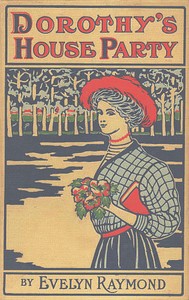
The source record for Dorothy's House Party — Reading Notes measures this digital text at 61,214 words, 4 hr 27 min estimated reading time, and 7 detected text sections.
The text analysis averages about 16.5 words per sentence, while the detected sections provide another way to judge how the source is divided.
Project Gutenberg metadata also associates the work with “Orphans -- Juvenile fiction,” connecting these edition facts with the source record’s subject description.
Explore this collection
These alternatives are selected using recorded categories and estimated reading time.
About 260 minutes
Childrens Adventures
59,723 recorded words. 7 minutes difference from this book's estimate.
View Gutenberg source #25849About 259 minutes
Childrens Adventures
59,494 recorded words. 8 minutes difference from this book's estimate.
View Gutenberg source #13859About 277 minutes
Childrens Adventures
63,518 recorded words. 10 minutes difference from this book's estimate.
View Gutenberg source #15773Search stored excerpts and compare books → Choose by your preferences →
Choices use stored catalog measurements. Estimates vary with reading speed. A shared category is a catalog label, not a claim that two books have the same argument or literary quality.
Search reads excerpt text stored with this catalog and links to its associated Gutenberg record. The connection is stored in the site database; this tool does not recheck that every excerpt is word-for-word identical to that external record. Excerpt search does not cover every chapter and does not verify historical publication dates.
Catalog snapshot checked: 2026-09-25. Coverage: 94 public books, 94 available source excerpts.
Read the complete public-domain text at its original source.
Read on Project GutenbergEvelyn Raymond opens Dorothy's House Party with Dorothy waking in a strange, charming room, her disorientation quickly replaced by delight at the white-tiled bathroom and soft towels—details that signal a shift from her earlier life. The narrative voice blends colloquial dialogue (“Alfy! Alfy Babcock!”) with descriptive passages that linger on sensory specifics, such as “yeller artemisias” in a yellow bowl. This attention to domestic objects and affectionate nicknames establishes a world where material comfort and friendship intertwine.
Raymond’s word choices ground the story in a particular, tangible world. Characters use regional or informal speech: Alfy calls Dorothy “Dolly Doodles,” and the narrative describes a “yeller bowl” and “yeller artemisias,” preserving the sound of spoken language. Objects are named with precision—a “white-tiled bathroom,” “great soft towels,” a “lovely bath-robe”—creating a catalogue of comforts that Dorothy notices with wonder. This specificity extends to actions: Dorothy “skips from point to point” examining the room, and later, the violin’s “low undercurrent of melody” is said to “wail and sob.” The diction consistently favors concrete nouns and active verbs, avoiding abstract summary.
Dialogue in the excerpts reveals personality through rhythm and vocabulary. Alfy’s singing of “Old Noah of old he built an ark” and her immediate response to Dorothy’s call show her cheerful, direct nature. Dorothy’s own speech is imperative and affectionate: “Come right up here this very, very minute!” Later, the guests’ reactions to the violin are rendered through internal monologue: Melvin pictures “a far-away Yarmouth garden,” Helena sighs over her deserted parents, and James Barlow reflects on “the apparent hopelessness of ever crossing far beyond its boundaries.” Each character’s thoughts are distinct, shaped by their background—Melvin’s homesickness, Helena’s guilt, James’s ambition. Raymond uses dialogue and interior voice to differentiate the party without heavy exposition.
A central excerpt depicts Dorothy playing a violin medley that shifts from “jumble” to a “minor, moving melody.” The effect on the silent guest Luna is described in physical, almost mechanical terms: she “began to creep toward the player, inch by inch, almost imperceptibly advancing as if drawn forward by some invisible force.” Raymond avoids explaining Luna’s inner state, instead showing her through movement and the reactions of others. The farrier thinks, “Music! Who knows but that was the key to unlock her closed intelligence?” but the narrative does not confirm this. The scene relies on gesture and observation—Luna’s “vacant smile,” her cuddling with the twins—to convey her character, leaving interpretation open.
The chapter titles hint at a pattern of intrusion: “The First and Uninvited Guest” and the presence of three “uninvited” characters—the twins and Luna—who form a silent subgroup. In the excerpts, Luna is described as a “Silent Partner,” and the twins are “mischievous” yet protected by her proximity. Raymond uses this structural device to create tension between the planned house party and the unpredictable elements that enter it. The narrative voice notes that Luna “paid scant attention to them, no more than she did to anything, except gay colors and music,” establishing a limited but consistent set of responses. This economy of detail allows the reader to infer Luna’s condition without explicit diagnosis.
Readers attentive to Raymond’s craft will notice how she builds character through small, repeated details—the yellow flowers, the bath-robe, the violin’s effect—rather than through authorial commentary. The excerpts offer a compact demonstration of her method: dialogue that sounds spoken, description that selects telling objects, and a plot that advances through the interaction of planned and unplanned guests. These choices reward close reading of the full novel.
There’s a moment in Dorothy’s House Party when music reaches someone who hasn’t spoken in years—old Luna, silent as furniture, suddenly listening. I thought of that quiet opening when reading The Search for the Silver City: A Tale of Adventure in Yucatan — Background and Themes, where the wildness outside eventually finds its way inside a person, too. Some stories just wait that way.
Your answers remain private and are stored only in this browser.