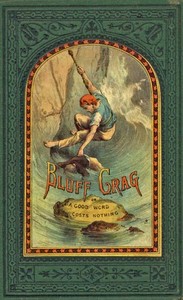
Bluff Crag; or, A Good Word Costs Nothing — Context and Discussion

(5 User reviews)   1391
Cupples, George, Mrs., 1839-1898 Project Gutenberg 2007 Not confirmed
Conduct of life -- Juvenile fiction; Brothers -- Juvenile fiction; Children and death -- Juvenile fiction; Uncles -- Juvenile fiction; Truthfulness and falsehood -- Juvenile fiction; Seashore -- Juvenile fiction Readers of public-domain and historical texts
Project Gutenberg digital edition en

Edition facts

Words 14,720
Reading time 64 min
Text sections 2

Before opening Bluff Crag; or, A Good Word Costs Nothing — Context and Discussion, the edition data offers a quick orientation: 14,720 words, 1 hr 4 min estimated reading time, and 2 detected text sections.

The text analysis averages about 21.2 words per sentence, while the detected sections provide another way to judge how the source is divided.

Project Gutenberg metadata also associates the work with “Conduct of life -- Juvenile fiction,” connecting these edition facts with the source record’s subject description.

Mrs. George Cupples frames a moral tale within a family storytelling session, using embedded narratives and coastal settings to explore truthfulness, kindness, and the gap between reputation and action.
Share
Editorial Edition Score 4.5/5

Calculated from edition completeness, EPUB availability, text structure and catalogue metadata. Not a user rating.

How this score is calculated
  • Description quality20 pts
  • Title & short description10 pts
  • Source metadata20 pts
  • Text length15 pts
  • Chapters / structure15 pts
  • EPUB file integrity20 pts

Total of 100 points, scaled to a 2.5-5.0 range. Editions with an empty description or a missing EPUB file are not scored.

Edition quality

Read the Text

Berkley said we might go and meet you, but we thought you would come by the highway.'

"'Yes; but this little niece of mine had never seen the sea, and I wanted to let her have her first view from the Bluff Crag.'

"'Then you have never been down to the beach?' said the little girl. 'We must get aunt to allow us to go there after dinner. It is such a delightful walk;--isn't it, sir? And you needn't be afraid to trust her with us, for we take Natilie when we go, and she is so careful.'

"'And who is Natilie?' inquired Uncle John, lifting the little girl from the donkey at her request.

"'Oh, Natilie is our French maid, and she is so nice; even the boys like Natilie.--But what is your name, please?' she continued, turning to me. 'Mine is Vivian Berkley, but the boys and all my friends call me Vea.'

"'My name is Lilian, but I am called Lily at home--Lily Ashton,' I replied.

"'Then I shall call you Lily too, may I not?' she said, looking up into my face with a kindly smile, and taking my hand, while her beautiful blue eyes sparkled. 'I am so glad you have come, dear Lily,' she continued. 'I do want a companion like you so much!'

"'Do you find the boys unsocial, then, Miss Vea?' inquired Uncle John.

"'Oh no, sir,' she replied; 'but they are boys, and you know girls are not allowed to do exactly what they do, so I am often alone.'

"'And what do you do when you are alone?' said Uncle John, evidently amused with the precise though sweet tone of voice of little Vea.

"'I play with my doll Edith, and I read my story-books, and I talk to Natilie. Do you know, sir,' she said, letting my hand loose and taking my uncle's as we mounted up the steep slope to the road above, while the donkey was led round by another way, followed by the boys, 'poor Natilie, when she came to stay with us, could not speak a word of English, and she was so sad. And the boys used to laugh at her, and so did I sometimes, till Aunt Mary, in whose house we were living, told us that if we only knew poor Natilie's sad story we would be so sorry for her, that, instead of laughing, we would be apt to cry.'

"'And what was the story?' inquired the rector.

"'Oh,' said Vea, laughing, 'Aunt Mary was so cunning about it, she wouldn't tell us a word, but said we must learn our French very fast, and that then Natilie would tell it for herself; and as Aunt Mary said it was far more interesting than any we could read in our story-books, we did try to understand what she said to us very hard indeed. But we haven't heard the story yet; only we never laugh at Natilie now, for we have made out little bits of it, and we know the chief reason why she is sad is this: her husband is a very bad man, and he ran away and left her, and carried off her two little children, and she cannot find them.--But will you please walk into the garden, sir?' she continued, opening a side gate. 'Aunt said we might show you the new rustic table as we came along.'

"Patrick, the eldest boy, who had run on before, joined us just as we came up to the arbour, where a neat round table stood, having curious feet made out of the rough branches of a tree; the top had been polished, and painted with varnish, and looked very splendid indeed. But the quick eyes of Vea soon detected an ugly scar on the bright surface, as if some boy had been attempting to cut out a letter upon it.

"'Oh dear, who has done this?' cried little Vea, while Patrick turned away with blushing face. 'Patrick, this is a wicked action; do you know anything about it? Now be careful; think well before you answer.'

"Uncle John could scarcely keep from smiling at the way Vea spoke, and the anxious manner shown towards her brother. 'O Patrick,' she exclaimed, 'if you did this, it is very wicked; you must go and tell aunt about it at once.'

"Instead of answering, however, Patrick set off at a gallop, and disappeared behind some bushes, leaving Vea standing looking after him with glistening eyes. 'What is to be done now?' she said, as if to herself; 'it is so difficult to get Patrick to own a fault, and I fear he will lead Alfred into more mischief. O mamma, mamma, I wish you had never left us! I do try to keep the boys right, but they are so wild sometimes.'

"'You cannot do more than your best, my child,' said my uncle, laying his hand tenderly on her bowed head. 'Would you like me to speak to your aunt for Patrick?'

"'Oh no, sir, thank you very kindly,' she said, drying her eyes hastily; 'Patrick must confess the fault himself, if he has done it. Aunt Berkley is so good-natured, that I am sure she would excuse him if you asked; but that would not be safe for Patrick,--he forgets so soon, and will be at some other mischief directly. Aunt Mary warned me about this very sort of thing.'

"'Well, I am sure he ought to be a good boy, having such a kind, good little sister to look after him.'

"'Please, sir, don't say that,' said Vea, the tears coming to her eyes again; 'I don't deserve such praise; for the reason why Aunt Mary told me of Patrick's faults was, she wished to point out my own, and she knows I am so lazy, and don't like to check the boys, lest they should call me "Goody;" but Aunt Mary said I ought to look after them,--that a good word costs nothing; at anyrate, if I had only to bear being called a harmless name, it was but a very small cross, compared to the evil I might cause by allowing the boys to play mischievous tricks.'

"'That is right, my dear child,' said Uncle John; 'we must do our duty, however hard it may be; and though a good word in one sense costs nothing, still we all know it sometimes costs a good deal, and is a difficult matter, to a great many people.'

"To Vea's astonishment, instead of her Aunt Berkley letting her brother off easily, when she found out about the mischief done to the table, she was so very angry that she would not allow him to join the party that afternoon in the excursion in the steamer. While she pointed out the various objects of interest to Vea and myself, seeing that poor Vea was depressed in spirits--her kind heart suffering extremely when her brothers fell into error--Aunt Berkley whispered, 'You are not vexed with me, dear child, for punishing Patrick? If he had owned the fault, I would have forgiven him; but he was so stubborn, and would not even speak when spoken to. Alfred is so different.'

"'Oh no,' said Vea quickly; 'I am only sorry that he was so naughty and required the punishment;' but, as if afraid she was condemning her brother, she added, 'Patrick has a warm, affectionate nature, aunt; if he could only get over his love of mischief he would be a dear, good boy.'

"'Well, my dear, we must try to help him to be good. Boys will be boys, however; though it is necessary to punish them sometimes, else they might get into serious disgrace. We must have another excursion soon, and perhaps the thought of it will keep Patrick from being naughty.'

"On reaching home that afternoon they found the school-room empty; and though Patrick had been told he was to remain in the house till his aunt returned, he was nowhere to be found. Alfred sought for him in all their favourite haunts about the out-houses and garden, but without success. 'I'll tell you where he will be, Vea,' said Alfred, on his return to the school-room from a last hunt in the orchard,--'he has gone to the cave at the Bluff Crag.'

"'Oh, surely not,' said Vea in distress. 'Aunt told us distinctly we were never to go there without leave from her, and then only with some person who knows the coast well. What makes you fancy such a thing, Alfred?'

"'Because, I remember now, he muttered to himself about giving aunt something to be angry for; and he has often been wanting me to go there.'

"'I hope this is not the case, Alfred,' said Vea. 'But perhaps aunt would allow us to go down to the beach with Natilie, to look for him.'

"'I daresay she will,' said Alfred; 'but if you do ask her, don't mention Patrick's name; you needn't be getting him always into a scrape by your tale-telling.'

"'O Alfred, how cruel you are,' said Vea, 'when you know I am always trying to get you boys out of scrapes!' and the tears rose to her eyes.

"'Very well, then, I won't,' said Alfred; 'you are a dear, good little sister, and we do bother you tremendously sometimes. Stay you here, and I will ask aunt to let us go to the beach.'

"Alfred soon returned, stating that his aunt had said Yes at once to his request; 'But,' he added, laughing, 'I think she did not know very well what she was saying, she was so busy talking to the rector.'

"Natilie was quite willing to accompany us, and very soon we were down on the beach; but whichever way we looked we could not see any trace of the missing Patrick. All of a sudden Alfred gave a shout, and pointed in the direction of some great high rocks upon which stood a light-house.

"'See, Vea, there is Wild Dick running upon the rocks!' cried Alfred excitedly.

"'Where?' said Vea, standing on tip-toe, and straining her head forward towards the place Alfred was pointing out.

"'I see von boy,' said Natilie, in her strange broken English. 'Him not be Master Patrick. I know him now for that same wicked boy Mrs. Berkley forbid you speak to.'

"'But I tell you Patrick is with him,' said Alfred, showing he knew more about his brother's movements than he had owned at first. 'Dick offered to help him to find some sea-birds' eggs, and they have gone off to get them now.'

"At this moment the boy called Dick observed us, and as soon as he did so he began to make signs in a most excited manner to us to hasten.

"'There has been some accident to Master Patrick, I much fear,' said Natilie, beginning to run. 'Oh, when will that boy be good?'

"On coming closer to Dick, it soon became evident that an accident had really happened; and in a few moments more they learned that the unfortunate Patrick, in climbing the rocks, had lost his footing, and had fallen down from a considerable height.

"'I think he's broken his leg, miss,' said Dick to Vea. 'And how he is to be taken out of that 'ere hole he has fallen into, is what I'd like very much to know.'

"'Do show us where he is, Dick,' said Vea. 'Oh, be quick; he may die if his leg is not attended to at once!'

"It was no easy matter to scramble over the stony beach to the place where Patrick was lying; and rather a pitiable sight it was to see him with his leg doubled under him, and with a face so very pale that it was no wonder Vea cried out with pure horror, for she evidently thought he was going to faint, or die altogether, perhaps.

"'Oh, what shall we do?' cried Vea. 'How are we to get him up? and how are we to get him carried home?'

"'I would not have you distress yourself so, Miss Vea,' said Natilie. 'I think I can get him out of this difficulty, with very little patience, if we could get him carried home.'

"'If you get him out of the hole he has fallen into,' said Dick, 'I will manage the rest.'

"'But how can you carry him over such a rough beach?' asked Alfred.

"'I will get the boat from my grandfather,' replied Dick, 'and we can row him round to the harbour, where the men can help us up to the house with him.'

"'Oh yes, that will be the plan,' said Vea. 'Do run, like a good boy, and get the boat; I am sure your grandfather will be very glad to lend it to us, for Patrick was always a favourite with him.'

"'And I know somebody who is a greater favourite than even Master Patrick,' replied Dick, smiling, before he hurried away towards his grandfather's house.

"Very soon, though it seemed a long time to Vea, Dick was plainly seen shoving out the boat from the shore, with the assistance of two boys, who then jumped in and rowed it round as close to where Patrick lay as they possibly could.

"Natilie had by this time managed to get Patrick up out of the sort of hole he had fallen into, and by our united efforts we at last succeeded in getting him into the boat, where we all helped to support him, as he had fainted away again. It was considered advisable to row to Dick's grandfather's house for the present; and accordingly the boat was steered for a cove, up which the tide carried us.

"The hut where Dick's grandfather lived was a very poor one, built mostly of turf, and thatched with rough bent or sea-grass. The chimney-can was made with an old barrel, which stood the blast and served better than an ordinary one would have done at such a stormy part of the coast. One or two fishing-boats lay at the rough pier or jetty old Dick had constructed, the men belonging to which were earnestly engaged preparing their nets for going to sea that evening; while a number of boys were busy sailing miniature boats in a small pool left by the last tide. No sooner, however, did they hear the shouts of their companions in our boat, than they left their sport, and hurried down to lend a hand in pulling in the boat to a place of security.

"'Has grandfather come back from the town, Jack?' cried Dick to a rough-looking boy, the tallest of them all, and who had carried his model boat in his arms, instead of leaving it as the others had done theirs.

"'No, he ha'n't,' replied Jack; 'and, what's more, it's likely he won't be for some time either; for I hears Tom Brown saying to Tim that my father would be late to-night, and I knows your grandfather is to keep him company.'

"'Then what's to be done now, miss?' said Dick. 'I had been thinking grandfather, who knows all about sores, seeing as he was boatswain's mate aboard a man-o'-war, might have been able to put young master's leg to rights.'

"'Oh no, Dick, that would never do,' said Vea; 'we must get him ashore and laid in your grandfather's bed, and somebody had better run up to tell aunt of the accident, and get her to send for the doctor at once.'

"While Natilie prepared the bed in the old fisherman's hut, Patrick was being carried by the men who had been summoned from the boats. The poor boy was still in a fainting state, and it was not till after he had been laid on the bed that he opened his eyes and showed signs of consciousness. 'Oh, where am I?' he uttered; but even this exertion was too much for him, and he became insensible once more.

"'It's a bad break, this,' said one of the men to his fellow; 'I shouldn't wonder, now, if he had to lose his leg altogether!'

"'Oh, please don't speak of it,' said Vea, her face becoming ghastly pale. 'Do look out again, Lily dear, and see if Alfred is coming with the doctor.'

"Yes; there he was at last, running at a break-neck speed down the steep and rocky bank to the beach, while the doctor was distinctly seen high overhead on the regular path, coming very quickly too. Indeed, though he had taken the longest road, and did not seem to hasten like Alfred, he was only a few minutes behind him, and showed no signs of heat and over-exertion.

"'Heyday, this is a pretty business,' said Dr. Blyth cheerily. 'What's this you've been about, Miss Vea? breaking your brother's leg, eh?' All this time he had been unrolling a case of formidable-looking instruments, taking off his coat, and getting fresh water brought, and bandages prepared with the help of Natilie. When these were ready, he turned to look at his patient, and bidding every one leave the hut but the two fishermen and Natilie, he shut the door against them himself, and secured it firmly.

"'Oh, please, doctor, let me stay,' Vea had said pitifully. 'I'm sure Patrick would like me to stay.'

"'I'm sure of that too,' said the doctor kindly; 'but you shall have plenty of nursing by-and-by: don't be afraid, I mean to engage you as my chief assistant. Meanwhile, my dear, trust me for knowing what is best for you and for your brother, and take yourself off to the beach there. Come, Miss Lily,' he continued, turning to me, 'you take your friend down to the beach, and keep her there till I call you. Remember, you are not to leave the rock there till I call you, Miss Vea.'

"'Oh dear, dear, it does seem hard,' said Vea, when we were seated under the rook, 'to leave Patrick in the hands of strangers. And yet, Dr. Blyth is such a good, kind man, I'm sure he won't give him unnecessary pain.'

"'Would you like me to read a story to you, dear Vea?' I inquired, opening a book I had brought out with me. 'It might help to pass the time away.'

"'Thank you, Lily,' said Vea; 'but I feel as if I couldn't listen to anything; and yet, if I sit here I shall go mad with the suspense.'

"'Come, then, take a walk along the beach,' I replied; 'we will be within reach of the doctor's voice quite as well. I know he will take some time to set the leg; for when our stable-boy, Reuben, got his leg broken, the doctor took a long time to set it.'

"'And did Reuben's leg get well again--quite well, I mean?' inquired Vea earnestly; 'was he able to walk with it as he did before?'

"'Oh yes; he could use it quite as well as before,' I replied. 'Indeed, papa used to say Reuben was quicker at going a message after the accident than before.'

"'Oh, I am so glad to hear that,' said Vea, sighing. 'I do hope it will be the same with Patrick. Poor Patrick! Aunt Mary has so often said he would need to get some severe lessons to make him think. She was always telling him that he would find out the path of transgressors is hard, instead of pleasant, as he seemed to fancy. I don't think there is such a miserable girl as I am in the world?' And here Vea began to cry.

Mrs. George Cupples opens Bluff Crag with a domestic scene that immediately establishes storytelling as the book’s central device. Robert and Lily coax their father into telling a story, and his half-dreamed tale becomes the frame for the main narrative. This layered structure—a story within a story—allows Cupples to embed moral lessons without direct preaching. The children’s eager interruptions and their father’s playful reluctance create a natural, conversational tone that carries through the book.

The excerpts reveal a careful attention to dialogue: characters speak in distinct voices, from Lily’s earnest pleading (“you can make an end to it as you go along”) to the stepmother’s harsh commands. Cupples uses these vocal contrasts to signal character without explicit judgment.

A Framed Narrative and Its Effects

The book’s opening is not merely a prelude but a deliberate structural choice. Mr. Lincoln’s claim that he was “just in the middle of such a nice one” when woken suggests that the story we read is itself a recovered dream—a fiction within a fiction. This frame distances the moral content, allowing Cupples to present lessons about truthfulness and kindness as something overheard rather than imposed.

The children’s responses also model reader engagement. Lily says she likes dreams “better than the real stories,” hinting at the book’s own blend of realism and fancy. The frame also introduces the theme of patience: Robert’s impatience “knocked off the end” of the dream, a small detail that echoes the book’s concern with hasty judgments.

Dialogue as Character Revelation

Cupples distinguishes characters primarily through what they say and how they say it. Polly’s account of Patrick’s kindness is delivered in plain, earnest speech: “he just laughed, and said there were lots of people would be glad to know Patrick Berkley was so usefully employed.” The stepmother’s dialogue is clipped and imperious (“bade me take the ropes”), while Vea’s responses are warm and inquisitive.

Patrick himself is described through others’ words rather than his own—a technique that preserves his mystery. The cut on his eye from “wild Joe throwing a stone” is reported matter-of-factly, without melodrama. This restraint in dialogue keeps the moral weight on actions rather than declarations.

The Seashore as a Stage for Small Dramas

The coastal setting is not just backdrop but an active element in the story’s conflicts. The beach is where Polly gathers driftwood under her stepmother’s orders, where Patrick secretly helps her, and where a crab seizes the narrator’s toe—a moment of comic relief that also underscores the physical reality of this world.

Cupples uses specific details—the anchor left for a new boat, the ladder against a moored vessel, the “clear blue water” with darting fish—to create a tangible sense of place. These details ground the moral lessons in a recognizable, sensory environment. The sea also provides natural barriers and opportunities: the cove where boats are moored becomes a private space for Vea’s quiet actions.

Reputation Versus Hidden Goodness

A recurring tension in the excerpts is the gap between how Patrick is perceived and what he actually does. Vea notes that “Aunt Mary always says there is a great deal of good in Patrick, only his love of mischief sometimes chokes the good seed. It is very strange he never lets us see him doing a kind or a generous action.” This observation, placed just after Polly’s grateful account, creates dramatic irony: the reader knows what the family does not.

Cupples does not resolve this tension in the excerpts. Patrick remains “very quiet and still on the bed,” injured and unable to speak for himself. The book’s title phrase, “A Good Word Costs Nothing,” may point toward the power of verbal testimony—Polly’s words, Vea’s listening—to bridge the gap between hidden virtue and public knowledge.

Readers attentive to dialogue and descriptive detail will find that Cupples rewards careful observation. The frame story invites us to consider how stories themselves shape moral understanding. As you read, note who speaks, who is silent, and what actions are witnessed versus reported—the book’s ethical weight often lies in these contrasts.

Reading about the Cupples family by the fireside, I remembered my own father’s low voice spinning yarns on stormy nights, where truth hid inside adventure. The same warmth surfaced, oddly, in Fred Markham in Russia; Or, The Boy Travellers in the Land of the Czar — Context and Discussion, the way a foreign landscape made character plain. Kindness costs nothing, but remembering it costs a little of ourselves.

Ella Anderson
2 weeks ago

Anthony Hill
2 weeks ago

Carter Harris
3 weeks ago

Theodore Walker
3 weeks ago

Amelia Wright
1 month ago

4
4 out of 5 (5 User reviews )

Add a Review

Your Rating *
There are no comments for this eBook.

Reader reflection

How will you remember this book?

Save your reaction, strongest insight, and memorable passage.

Your progress 0 / 10
1

Have you finished this book?

2

Did this book hold your interest?

3

Would you encourage someone else to read it?

4

Did the language feel accessible?

Related eBooks