
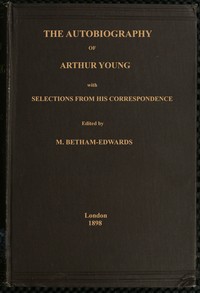
The autobiography of Arthur Young : with selections from his correspondence
Arthur Young's life reads like two different books stitched together. For decades, he was England's most famous agricultural writer, traveling the countryside in a bumpy carriage, inspecting farms, and preaching the gospel of scientific improvement to anyone who would listen. His early journals are full of soil samples, sheep breeds, and frustration with old-fashioned farmers.
The Story
The story takes a sharp turn in 1787. Young crosses the Channel to study French farming, but he arrives as the country is boiling over. His travelogue transforms into a real-time diary of a society collapsing. He dines with aristocrats one week and interviews starving peasants the next. He gets caught in riots, watches the Bastille fall, and records the chaos with the exact same meticulous detail he once used for wheat yields. The book weaves together his early struggles to reform English farming with these explosive later years, using his own letters and notes to show how his worldview was shattered and remade by the violence he witnessed.
Why You Should Read It
What makes this book special is Young's voice. He's not a philosopher or a politician; he's a hands-on, slightly cranky pragmatist. You feel his genuine excitement for a new kind of plow and his mounting terror as the French Revolution spirals out of control. His writing bridges two worlds. We see the quiet, stubborn rhythms of 18th-century rural life, and then we're thrown into the screaming crowds of Paris. It's this jarring contrast that gives the book its power. You're not just learning about history; you're seeing it through the eyes of a wonderfully ordinary, yet extraordinarily observant, man who happened to be in the wrong (or right) place at a pivotal time.
Final Verdict
Perfect for history buffs who want to get out of the palace and into the muddy fields and chaotic streets, and for anyone who loves a good first-person account. If you enjoyed the eyewitness feel of something like Samuel Pepys' Diary but want a story that stretches from English farmyards to French barricades, this is your next read. It’s a long, dense book, but open it to any page and you’ll find a man talking directly to you from the heart of the 18th century. Just be prepared—his journey is far more thrilling and unsettling than any book about crop rotation has a right to be.
There are no legal restrictions on this material. You are welcome to share this with anyone.
Karen Garcia
7 months agoI've been looking for a reliable source on this topic, and the author manages to bridge the gap between theory and practice effectively. It cleared up a lot of the confusion I had previously.
Barbara Martinez
1 year agoVery helpful, thanks.
Jackson Smith
2 months agoFive stars!
George Thompson
5 months agoThis book was worth my time since the emotional weight of the story is balanced perfectly. Exceeded all my expectations.



Robert White
10 months agoThe author provides a very nuanced critique of current methodologies.