H
Harvey Kubernik
Guest
- Thread Author
- #1
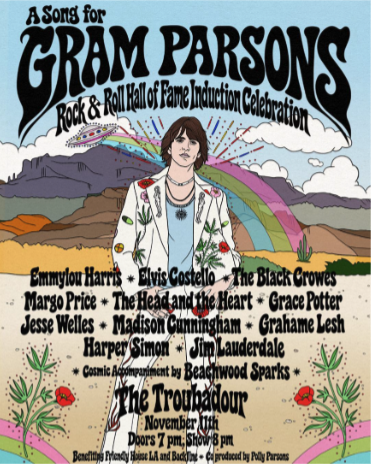
A news release from 2pmsharp.com described the forthcoming event.
“The evening will feature performances by Emmylou Harris, Elvis Costello, The Black Crowes, Margo Price, The Head and the Heart, Grace Potter, Jesse Welles, Madison Cunningham, Grahame Lesh, Harper Simon, and Jim Lauderdale, with cosmic accompaniment by Beachwood Sparks, bringing together generations of musicians whose work reflects Parsons' profound and lasting influence on American music.
“The concert will benefit the Friendly House Foundation and Backline, two organizations supporting addiction and mental health needs in Los Angeles. Tickets will go on sale at 10AM PT, this Thursday, Oct 22nd via AXS.
“Born Ingram Cecil Connor III on November 5, 1946, in Winter Haven, Florida, Parsons emerged as one of the most influential architects of what he famously termed 'Cosmic American Music' — a seamless blend of country, rock, folk and soul traditions. Though his life was tragically cut short at age 26 in 1973, his artistic vision helped redefine the possibilities of American popular music.
“Parsons first gained recognition with the International Submarine Band before joining The Byrds, where his influence steered the band toward a country-infused sound on the landmark 1968 album Sweetheart of the Rodeo, widely regarded as a cornerstone of country rock. He later co-founded the Flying Burrito Brothers, whose albums The Gilded Palace of Sin and Burrito Deluxe further cemented the genre's foundation and expanded its cultural reach.
“Parsons released two solo albums, including his 1973 debut GP, which featured members of Elvis Presley's TCB band and introduced his celebrated duet partnership with Emmylou Harris. Grievous Angel, released posthumously, continued the sound he had created with the TCB band and Harris and entered the Billboard Top 200.
“Despite a relatively brief career and modest commercial success during his lifetime, Parsons' impact has proven immeasurable. He was among the first to integrate traditional country instrumentation — such as pedal steel guitar — and vocal harmonies into a rock framework, effectively bridging two previously distinct musical worlds. Critics and historians now widely recognize him as a central pioneer, often referred to as a 'father' of country rock, whose influence extended far beyond his recorded output.
“Parsons' influence can be traced through a remarkable lineage of artists across genres. His close collaborator Emmylou Harris carried forward his musical vision, achieving widespread acclaim while preserving the emotional depth and hybrid style he championed. His work also left a lasting imprint on bands such as the Eagles — whose song 'My Man' pays tribute to him — as well as Poco and countless others who helped define the sound of 1970s country rock.
“In subsequent decades, Parsons' legacy has continued to inspire generations of musicians, from alternative country pioneers like Wilco, Son Volt and Ryan Adams to artists including Lucinda Williams, Elvis Costello and Beck, many of whom contributed to the acclaimed tribute album Return of the Grievous Angel. His genre-blurring approach also influenced rock icons such as Keith Richards, who noted the 'enormous' effect Parsons had on the evolution of country music.
“Though he never achieved mainstream stardom in his lifetime, Parsons' artistic philosophy — melding authenticity with experimentation — helped open the door for the Americana movement that thrives today.
“As the music world celebrates what would have been his 80th birthday, A Song for Gram will bring that extraordinary legacy to life, uniting some of music's most revered names and compelling contemporary voices for an evening honoring one of the most important and transformative figures in rock and American roots music history.
A Song for Gram is co-produced by Polly Parsons, and Vector Management and Shirley Halperin, in partnership with the Gram Parsons Estate.”
I saw Gram Parsons in the Flying Burrito Brothers at the 1969 Palm Springs Pop Festival with a music journalist/photographer, Heather Harris.
Over the last half century, I’ve discussed Parsons with several musicians.
In my March 24, 1976 interview with Emmylou Harris for the now- defunct Melody Maker, we discussed the popularity of country music in England and Europe.
"I was nervous I looked forward to playing overseas because I had this feeling there was an audience for my kind of music, especially since Gram's albums did so well there. He had been recognized critically in Europe and England far more than in the States. I don't think people here realize the magnitude of how he affected music," offered Emmylou Harris during a rehearsal break at Alley Sound in North Hollywood.
Emmylou was delighted by her reception in Britain. "There seems to be more respect toward country music, and I have this feeling that the audiences over there who like country music have not been exposed to the prejudices that exist here. They can appreciate a straight country performer like George Jones for being almost a folk hero. It seems that the audience in London doesn’t have any reservations, because of musicians like the Burritos and Gram. They were really hip to Gram's two albums. We tried to go back and do those old country songs, not to re-create an old song but pay respect to the old and add the new."
In 1976, I asked Harris about George Jones. The last time Jones was in town, Emmylou played a few numbers with him at the Palomino club in North Hollywood and, on her Elite Hotel album, she does two songs associated with him.
"'Feelin' Single, Seein' Double' we've been doing on stage for a long time and it's a super tune. 'Together Again' is a Buck Owens song I've always liked. The other George Jones song on the album is 'One Of These Days', written by Earl Montgomery.
"Earl has been author or co-author of many songs that I've liked. We wanted something completely new to record and we never did this song on stage. For a long time I've been singing it in my dressing room to warm up and it's my favourite on the album.
'Sin City' is a favourite that is very meaningful to a lot of people and in our repertoire since the Hot Band began last April.”
In 2026, songwriter and singer Walter Egan emailed me about Gram Parsons.
“I was fortunate to be at Clyde’s on M Street in Georgetown, Washington D.C., the night that Chris Hillman approached my friend Emmylou Harris about singing with Gram Parsons.
“Emmylou didn’t know who Gram was, but I had a small obsession with G. Parsons (as he was listed on Sweetheart of the Rodeo), the Byrds album which blindsided us Byrds fans who saw and heard them as a leading band in psychedelic music from their recent song “Eight Miles High”.
“That was when my obsession began.
“That night at Clyde’s I brought Emmylou back to the Sageworth House (where our band Sageworth all lived) and played Sweetheart and Gilded Palace of Sin for her. I was also in attendance when Gram came to town and to Clyde’s shortly thereafter.
“He sang Hank Williams’ “I Saw the Light” with her that night, but they needed a place the next day where they could try their voices together in a more focused way. I offered the Sageworth House, not far on Wisconsin Avenue.
“When Gram and Emmy arrived the following afternoon to our slightly funky band house, he had on his Nudie jacket and to someone who had been a fan now for around three years, he oozed a charisma of Southern California blended with Southern charm; and Emmylou looked pretty as well.
“They settled in the kitchen, and Gram broke out his Gibson. I was their only audience as they ran through “Sweet Dreams” and “That’s All It Took”, and I knew that they were destined to be right up there with George Jones and Tammy Wynette.
“As I was just opening my ears to real country music, I asked Gram to whom should I listen to for the real country experience. He thought for a minute, then said: Harlan Howard, Merle Haggard, Charlie Pride, and George Jones.
“Gram was my last idol in the music business. It was a moment of transcendent happiness when he and Emmylou recorded the song that I wrote with my friend Tom Guidera, “Hearts On Fire”.
“And perhaps a greater thrill when he sent me a set of lyrics to which he wanted me to put music, a song I consider the last Gram Parsons’ song, “Carolina Calypso”. I have made recordings of that song with The Brooklyn Cowboys as well as the Burritos.
“The last time I saw Gram was when I was his “chauffeur”, when he and Emmylou were on tour in Boston playing a few nights at a club called Oliver in 1973. I ferried him to the club, “in the shadow of Fenway Park’s Green Monster, in our beat-up Ford Econoline van. It was a thrill when they played “Hearts On Fire” live. But it was notable that his upbeat demeanor on the way to the gig was in strong contrast to his almost bipolar depression, which was evident on the ride back to the hotel.
“Gram deserves all the accolades and this Hall of Fame acclaim, but his greatest appeal to me was his very vulnerable humanity. It was a highlight of my life that I got to know him, just the little bit that I did.”
In 1999, I interviewed Chrissie Hynde and asked her about my “She,” my favorite cover version of a Parsons’ tune. Hynde did it on a Gram tribute compilation LP, The Return of the Grievous Angel.
“I knew Gram Parsons' Grievous Angel album when it came out in 1973 and loved it. And meeting Emmylou Harris has been such a fantastic thing for me, 'cause I think she has one of the greatest voices of all time. I've crossed paths with her a couple of times.
“Her long-time road manager (and Parsons’ pal) Phil Kaufman was a biker who had a Harley-Davidson in a garage where I used to have a squat in London, and I used to walk by there and read his Easy Rider magazines - this is way before I was in The Pretenders. I met Emmylou, we both did something for the Neil Young Bridge Concert one year. And I was enthralled being on the same bill with her. Then we met and had a few conversations on the phone and she said she was putting together this album. I told her, 'You ask me to do something and I'll do it. I don't even have to know what it is.' So, she came up with the idea to do "She". That was the first song actually that she recorded for this tribute album.”
On November 18, 1977, I attended the debut of Elvis Costello at the Whisky A Go-Go in West Hollywood. Afterwards, I did a brief interview with him at a local radio station. I gifted him with my copy of the rare International Submarine Band LP on LHI Records. It was a country rock band that Gram Parsons formed in 1965.
Elvis was startled. He was actively looking for a copy of this LP and very thankful for the item. Later, when he returned to play The Palomino Club, he put me on the guest list. Shortly afterwards, I got a phone call and learned Elvis penned the liner notes for a Reprise Records 1982 reissue of Parsons’ first two solo LPs, GP, and Grievous Angel.”
I’ve also interviewed multi-instrumentalist Chris Darrow, along with Chris Hillman, and Roger McGuinn of the Byrds, who all provided an honest assessment of Parsons’ influence on country rock.
In 2007, I asked Chris Hillman about the foundation work the Byrds did in exposing us to country rock in 1965 before Gram arrived in town.
“The Byrds on Turn! Turn! Turn! album with ‘Satisfied Mind,’ which really was a Porter Wagner hit, and I think we had heard Hamilton Camp do it, but it’s such a great song. And then, I still think ‘Time Between’ was our country rock song of the time. That’s when we started doing that stuff.
“When we had Clarence White come in and play on Younger Than Yesterday. I’m not taking credit for any of that. Rick Nelson deserves credit in the country rock thing, too. Big credit. Way beyond anybody else. But you know how this business works.
“The original concept in 1969 of the Flying Burrito Brothers was as plain as day. Here we are. We wanted to do country stuff. And the first two years with Gram was very good, very productive and on the same page. I think if I was to look back and say, ‘Well, I’d only…’ and I don’t go there, but if I did, and it was a question presented to me. He was far more confident. He was a charismatic figure. He was an interesting man at the time. I’m not saying he was a great singer. He wasn’t. He was a good singer on a couple of tracks, probably on the first album.
“I knew Gram and I will always cherish a couple of years when we really worked together. We were sloppy. The Flying Burrito Brothers with Gram. I just had come out of a band that recorded ‘Eight Miles High’ that went from doing Bob Dylan songs to being able to do a song like that, to doing something that musical, and to be on a par with the Who or the Beatles. The point is we became a really tight, good band. And I’m in the Burritos, and I’m looking at it not from a sterile place of it should be perfectly tight, but it wasn’t.
“We didn’t put any time into it. And I must say, and I’m not padding myself on the back, when Gram left and Bernie (Leadon) and I took that band, and we tightened it up and we made it a good band. And when Bernie left, we lasted another six or eight months. It became a musical band then. Did it have the magic that Gram offered? Not really. I still was learning how to sing. Yes, he did some good songs. He had a bunch of good songs. Two songs, ‘Hot Burrito #1’ and ‘Hot Burrito #2’ are Chris Etheridge songs. Chris brought those in, and Gram helped finish them. ‘She.’ Great song. Etheridge. And with all due respect to Gram, he was a good collaborator.”
A key player and architect in the emergence of the country rock genre, now the Americana genre, is Chris Darrow, a founding member of the pan-global world beat collective the Kaleidoscope in 1966-1968.
Darrow recorded during 1968-1974 with the Nitty Gritty Dirt Band, Hoyt Axton, James Taylor, Linda Ronstadt, and John Stewart.
“I got to know Gram Parsons a little bit. He and Bernie Leadon would come out to my house and visit. The Flying Burrito Brothers even did a concert right across the street from my house; I designed the poster for the gig. Gram had a mentor from the East Coast who was teaching in Claremont at Pomona College. His name was Jett Thomas.
“I think that country rock was a West Coast phenomenon and that the bands were the originators, not the individuals. The East Coast solo artist was a different breed from the West Coast collaborative unit. Most of the situations that arose on the West Coast were band situations, and whether there was strife or not, the element of the band usually prevailed. Guys like Gram Parsons were much more self-directed and solo- oriented than most of the West Coast personalities that worked with him. Chris Hillman has always been a good team player. Bluegrass training!
“What I’m saying is that country rock did not sprout out of the head of Gram Parsons and everybody else followed. He was a talented guy, but I am one who refuses to put a single name to the father of this genre.
“The fomenting of this music started early in all our heads, and each opportunity to express it was taken. A steel guitar is not the only criterion for country rock music. Clarence White invented a device to play the electric guitar like a steel guitar. He and Gene Parsons developed the Parsons/White Pull-String, eventually called the StringBender, and then renamed the B-Bender, which bends the second string in the same manner as a steel guitar.
“It is a hard style to play and only a handful of musicians have mastered this technique. I had a chance to play in his band at the Ash Grove a month before his untimely death.”
Last decade I interviewed Roger McGuinn, and told him that I thoughtguitarist Clarence White, who played on the Byrds’ Sweetheart of the Rodeo, was an overlooked hero in the birth and development of country rock.
I told Roger the Byrds had a bluegrass touch coupled with a rock ‘n’ roll beat on “Time Between Us” from the 1966 Younger Than Yesterday LP. He also played on The Notorious Byrd Brothers LP. And, going back to 1965 folkish/country Byrds’ offerings of “Oh! Susannah” and “Satisfied Mind,” a Porter Wagoner song, and the beat and country feel of your own playing and song structure of “Mr. Spaceman.” So, Roger and Chris Hillman certainly didn’t need to be introduced, let alone steered to country music by Gram Parsons.
A: I agree with you. I was a fan of country music and we were dabbling in country rock before Gram came in. And even ‘Mr. Spaceman’ has a country beat to it. I mean, it’s a silly sci-fi song but it’s got a country, Buck Owens approach kind of song. We were dabbling in that and something we did for fun, and the only difference when Gram came along is that we decided to do an entire album of it and do nothing but that so. That was the difference. And I think it was because Chris had an ally. That’s what he feels. He found an ally in Gram. And the two of them kind of swung it over to that at the time.
Absolutely. There was unity. We used to play poker every day. I mean we were buddies who would sit around, drink beer and play poker. And when we were off in L.A., we’d ride motorcycles together. I mean, we were having a good time. It wasn’t like there was this weird animosity. There was very little of that going on. It was a friendly band. Maybe too much fun. We enjoyed it. ‘Lazy Days’ is a cool song Gram wrote. They’re all good songs and we have to give Gram credit for bringing a lot of them to the sessions. Gram brought in a batch of songs. “Hickory Wind,” William Bell’s “You Don’t Miss Your Water,” and The Louvin Brothers’ “The Christian Life.”
We all got along great with the musicians in Nashville and stayed at this Ramada Inn and played poker all day until the sessions at night and had a ball. We were country boys. We got into it. I mean, we had cowboy hats and boots. I loved it. A very enjoyable experience. We were just role- playing. Even Gram. He wasn’t that kind of kid. He was a folkie, he was a preppie, basically. Gram got turned on Elvis when he was 10 years old, and that changed his life and he wanted to be a rock star, which he eventually became. He then got into country, he got into Buck Owens and he got into Waylon and Willie. I think what he really wanted to do was get rid of me and get a steel guitar player.
Q: Roger, before the Sweetheart Of The Rodeo album began, you were planning, or toying with a sprawling double LP concept collection of roots, bluegrass, folk, country, experimental, Appalachian, Elizabethan, and space age music, that you suggested to the band.
A: It was a very ambitious idea. It was actually bigger than Americana it was world music, it was going to be the origins and the history of music, if you will, from the beginning: Dawn of man up to the present day, incorporating Elizabethan music and how that came over to the Appalachians and got distilled and became folk music and country music and rock ‘n’ roll and the African blend. It was to cover everything, including Jazz, and finally go off into space music and synthesizers and go off the top and just into the future.
But I couldn’t get anybody to go along with me and got outvoted. I really thought that would be fun. ‘Cause I was interested in all those types and all those forms of music. I thought it would be a nice thing to put in one package and have it all there. It would have been interesting, but in retrospect all the albums the Byrds made you’ve kind of got that. Sci-fi, early stuff, “Renaissance Fair”
Q: But you went along with the eventual record you made.
A: I really loved Sweetheart Of The Rodeo. I wasn’t upset about it. It wasn’t a band meeting and there wasn’t a vote taken it was simply that I couldn’t get anyone else to go along with me on this bigger idea.
Q: And, contrary to some reports, there seemed to be unity and cohesion in the band on the project, and not big power struggles about musical direction in this version of the Byrds.
A: It was perfectly fun. It was just really fun until the end, and then it just fell apart.
Q: Chris Hillman met Gram Parsons in a bank and when Chris invited Gram over to your rehearsal, on Robertson or Melrose, a little office space you rented. I know initially you might have thought piano player Gram was McCoy Tyner, not a Hank Williams character after he started to harmonize at a rehearsal with you and Chris. And, even when the Byrds gigged with Gram in the outfit, shows at the Whisky A Go Go, Gram would play piano when the group played “Eight Miles High.”
A: We were rehearsing and Gram came in, and there was a keyboard of some kind, and I asked Gram if he could play any ‘McCoy Tyner’ because I wanted to continue in the vein of ‘Eight Miles High’ jazz fusion with a (John) Coltrane kind of thing. And he sat down and played a little ‘Floyd Cramer’ style piano, and I thought ‘this guy’s got talent. We can work with him.’
That was my original thought. Not knowing that he had another agenda, and that Chris and he were kinda in cahoots and going to sway the whole thing into country music. But I really liked country music, having come up in folk, I always considered country music, especially the Hank Williams and the traditional country music that Gram was into, a part of folk music, so it wasn’t alien to me.
Q: And you were impressed when you saw and heard Gram and Chris harmonize on Buck Owens’ “Under Your Spell Again.”
A: Exactly, and I started harmonizing with Gram, and he and I had a good blend. I was getting into it. It was fun. He and I had a lot of fun for a long time up until he left. I didn’t have any relationship to the International Submarine Band and knew nothing about them or the record.
Q: I always heard that just before you met Gram, let alone started the Sweetheart album, that you and Chris had just re-signed for seven years re-defining the original deal with Columbia Records, and re-worked your Byrds personal agreement deal, that the band was you two guys, and no more partners or equal share members. You weren’t sitting around waiting for three new and equal members to fill out the Byrds’ lineup. Just a rhythm section or sideman.
A: Absolutely. Chris and I made a pact that we would never have any more partners and that he and I would be the only partners. And that everyone else would be workmen for hire. That was our understanding.
Q: As a teenager in Los Angeles, when Sweetheart Of The Rodeo was first released, I was a bit unhappy by the KLAC (Los Angeles country music) AM station sound of the album, not KMET (progressive FM rock station) at the time.
A: As far as radio airplay locally, we went to KLAC to visit and I was encouraged. ‘Oh cool.’ I first saw our album cover tacked up to the bulletin board in the lobby, and I went up to it closer, and there was a sign that said. ‘Do not play this. This is not country music.’ That was cruel…It was a shock. I was hurt. It was like they were boycotting it because it was a bunch of hippies trying to infiltrate their scene.
Q: When Sweetheart was first issued, it sounded like a record that DJ Tennessee Ernie Ford would have spun in the late fifties on Southern California country radio station KMPC-AM. Many Byrds loyalists missed the jangle of your Rickenbacker guitar, not appreciating the wholesome beauty of a Martin D-45.
A: Some people were heartbroken. There wasn’t a sense of despair, some were disappointed because they didn’t hear the Rickenbacker but those people didn’t show up to the gigs. The people we got were into it, and they were liking it. There was a fan base that was gonna go along with us no mater what we did.
Well, you know, it’s satisfying, and what we did is that we went against the commercial grain and we upset a lot of people. The rock people thought we’d sold out to the conservative element. Country music was synonymous with right-wing politics and rock was synonymous with left-wing politics, and so I think we alienated both sides (laughs). But the people making this music were all buddies and kids hanging out, having fun. Playing music.
Q: What about the dealings with the record label at the time? I know you visited some radio stations to plug product.
A: We didn’t have any resistance from the record company when we did Sweetheart. The radio station visits were in the old business model. I don’t think we were very welcome to bring Sweetheart to radio stations. ‘Cause DJ’s like B. Mitchel Reed at KMET-FM in Los Angeles, who we knew couldn’t play Sweetheart on their shows. They had radio restrictions, even if it was their own personal taste, they weren’t going to play it. And we included a radio spot on the new re-release.
I remember meeting Peter Buck later saying, “Well it’s country, but it’s good country!” There were people who liked the album right off, and some people were put off by it but they liked it later. After, how long has it been now? It takes faith and perseverance. I’m a happy guy. It’s only recently over the last decade that I realized the impact this record has had on people, especially after meeting Jeff Tweedy and Jay Farrar.
What is amazing to me is the whole sub culture that formed out of the basically Sweetheart Of The Rodeo. There was nothing like it before and they took it and ran with it, they improved on it and embellished it and it finally came out into another area where it’s sorta new rock.
There was unity. We used to play poker everyday. I mean we were buddies who would sit around, drink beer and play poker. And when we were off in L.A., we’d ride motorcycles together. I mean, we were having a good time. It wasn’t like there was this weird animosity. There was very little of that going on. It was a friendly band. Maybe too much fun. We enjoyed it. ‘Lazy Days’ is a cool song Gram wrote. They’re all good songs and we have to give Gram credit for bringing a lot of them to the sessions. Gram brought in a batch of songs. “Hickory Wind,” William Bell’s “You Don’t Miss Your Water,” and The Louvin Brothers’ “The Christian Life.” Also “Reputation” is in the new version, a Tim Hardin song.
Q: What about the impact of the record over the years? How do you view the album now? Would you change anything now?
A: All I can tell you is that it has taken on a life of its own. It’s far exceeded my expectations for it. At the time we were just having fun and we wanted to do it.
In Nashville when we recorded, we had party tools…It’s probably the hottest album the Byrds ever did, and it’s ironic to me. It made the difference by doing it in Nashville and the authenticity it would not have had if it had been done the whole thing in L.A.
Q: In the liner notes to the new edition of Sweetheart you mention that “We did Sweetheart Of The Rodeo with a lot of heart and integrity. We were trying to make country music, as purely as we could. But we were so young-and we were a rock band.”
A: We all got along great with the musicians in Nashville and stayed at this Ramada Inn and played poker all day until the sessions at night and had a ball. We were country boys. We got into it. I mean, we had cowboy hats and boots. I loved it. A very enjoyable experience. We were just role- playing.
Even Gram. He wasn’t that kind of kid. He was a folkie. He was a preppie, basically, Gram was, and he got turned on Elvis when he was 10 years old, and that changed his life, and he wanted to be a rock star, which he eventually became, and then he got into country, he got into Buck Owens, and he got into Waylon and Willie. I think what he really wanted to do was get rid of me and get a steel guitar player.
Q: It seemed the game plan was to toss you out the door and replace you with pedal steel player Sneaky Pete Kleinow.
A: Yeah. Yeah. [laughs]. Let’s form the Burrito Brothers and call it the Byrds basically. I didn’t want that to happen. I had put too much into the Byrds.
Q: Do you remember your two-song set on the live-radio Grand Ole Opry broadcast from the Ryman Auditorium, a booking Columbia Records booked for you just after you finished the Nashville recording sessions. You had Lloyd Green added on pedal steel and your drummer Kevin had a really small kit. You were scheduled to do another Haggard song, “Life In Prison,” which was on Sweetheart, but Gram inserted another Sweetheart recording, his “Hickory Wind,” and dedicated it to his grandmother.
A: I remember it. It was a funny night in retrospect. We were a little nervous. Because we were out of our league. Our hair was pretty short. It was not shoulder length anymore and I think I had bangs, but if you saw me in that haircut today you would consider it fairly conservative haircut. There are pictures of our hair in the booklet.
So, we get there, and there is this kind of cold shoulder feeling going on. We get up to do our songs. The audience is polite but not really into it. And then Gram hijacks the whole thing. We were supposed to do a Merle song, and he took it over and wanted to sing a song for his grandma because he knew she would be listening. It was a surprise.
Anyway, so that’s what happened and they all got mad at us at the Grand Ole Opry for straying from the set list that we agreed on because I guess it was radio and they have rigid times, publishing details and licensing issues and all that stuff to deal with, and we didn’t care much about it. I thought it was funny Gram did that. I wasn’t upset at all. We weren’t booed, but we didn’t get a rousing round of applause. Skeeter Davis was friendly and supportive and told us we were great and not to listen to these people.
Even in Nashville when we visited country music DJ Ralph Emery with the album at WSM where Ralph was a DJ, he had an all-night show and mostly truckers were his audience, and cued it on a little turntable for a couple of seconds and said ‘I’m not gonna play this.’ I mentioned a couple of Dylan tracks included, check it out, he blasted us over the airwaves, called us hippies and said something like ‘if Dylan wore green socks everyone else would.’
Q: How do you now view Sweetheart Of The Rodeo?
A: What we did was very country. If you listen to country today it was certainly more country than anything that’s on country radio. Like country radio to me is like rock ‘n’ roll. (laughs). I’m very happy with the new expanded version. I’m involved with my own catalogue reissues and the effort Sony/Legacy has put into it. They’ve always done a good job with these things and it’s amazing to me they can find the tracks and the things. I think the quality has improved and sounds better than the original recording. I don’t think it takes away from the original pressing with the bonus tracks, working demos, outtakes. People who are purists can go back and find the original vinyl and play it.
Q Gary Usher who produced the Sweetheart album. You had a relationship with Younger Than Yesterday who was involved earlier in some surf music and beach soundtrack albums and he came out of surf music, and collaborating with Brian Wilson.
A: There were only a few producers around at that time. Like Phil Spector and the Brill Building people on the West Coast, along with the Beach Boys and The Wrecking Crew. Gary Usher was amazing when he was doing this. He was a ‘tech head’ for the time. Very innovative. We had done this phase-shifting he had done with two tape machines. And he took that idea, which was moving the machines closer together, after recording them spread out, and then one would phase shift, and move them and make a 16-track out of 2 right tracks. I was loving it. He was great. Gary and I were kindred spirits and very creative. Gary was the shining light in that whole thing.”
Q: The musicianship, influence, and impact of multi-instrumentalist and guitarist Clarence White, who joined a later edition of the Byrds. His B-string bender instrument was ahead of everybody. He gets constantly overlooked historically.
A: Oh, man, yeah. Incredible. Unfortunately, it’s so true, ya know. I don’t know how… Maybe it’s the tragedy that surrounded Gram although Clarence’s death was tragic as well, but it wasn’t self-induced. (White was killed by a drunk driver as he loaded equipment into a van in the Southern California area).
I don’t know, it’s hard to say. Clarence was a brilliant musician. I mean, it was like working with (Jimi) Hendrix. He was just a triple A plus musician and over the line every time. I see this imagery line, and some musicians come up to it, and they just hit it, and everything is fine. It’s in tune, and it’s in time. But Clarence was way over. He’d just fly over the line.”
“My involvement with Gram Parsons, besides loving his music, was impersonal but twofold,” Heather Harris emailed me in 2026.
“I simultaneously photographed the Flying Burrito Brothers at the 1969 Palm Springs Pop Festival while starting its riot (I tore down the barrier in front of the stage to get better photos closer up and suddenly was followed by 10,000 people, who kept going). I art directed the Sid Griffin book Gram Parsons, a Music Biography published by John Delgatto's Sierra Records in 1985.
“That book's Dominic Tarlè photographs of Gram with the Rolling Stones during their 1972 sojourn at the Villa Nellcôte, France to make Exile on Main Street have significance for me. Little known at the time, these shots and their French originator were uncovered by Sid when I told this capable sleuth of their existence. The now-famed photos subsequently made one of their first published appearances in our book.
“Gram and wife Gretchen had been Keith Richards' guests at Nellcôte, and Gram's encyclopedic knowledge of C&W purportedly added much to Exile on Main St country rock ambience.
“Furthermore, Tarlè's low-light, pushed-fast film, after-hours portraits of Keith and Gram creating indisputably passionate music under suspected chemical influences proved an unusually intimate window into these elusive souls.
“Since the photos had taken some effort to procure, I was pleased to read a review specifically praising the book's Tarlè shots for ‘...speaking volumes of decadence.’"
Photo © 1969 Heather Harris
Flying Burrito Brothers at the Palm Springs Pop Festival
The post ALL-STAR LINEUP TO CELEBRATE GRAM PARSONS’ HALL OF FAME INDUCTION first appeared on Music Connection Magazine.
“The evening will feature performances by Emmylou Harris, Elvis Costello, The Black Crowes, Margo Price, The Head and the Heart, Grace Potter, Jesse Welles, Madison Cunningham, Grahame Lesh, Harper Simon, and Jim Lauderdale, with cosmic accompaniment by Beachwood Sparks, bringing together generations of musicians whose work reflects Parsons' profound and lasting influence on American music.
“The concert will benefit the Friendly House Foundation and Backline, two organizations supporting addiction and mental health needs in Los Angeles. Tickets will go on sale at 10AM PT, this Thursday, Oct 22nd via AXS.
“Born Ingram Cecil Connor III on November 5, 1946, in Winter Haven, Florida, Parsons emerged as one of the most influential architects of what he famously termed 'Cosmic American Music' — a seamless blend of country, rock, folk and soul traditions. Though his life was tragically cut short at age 26 in 1973, his artistic vision helped redefine the possibilities of American popular music.
“Parsons first gained recognition with the International Submarine Band before joining The Byrds, where his influence steered the band toward a country-infused sound on the landmark 1968 album Sweetheart of the Rodeo, widely regarded as a cornerstone of country rock. He later co-founded the Flying Burrito Brothers, whose albums The Gilded Palace of Sin and Burrito Deluxe further cemented the genre's foundation and expanded its cultural reach.
“Parsons released two solo albums, including his 1973 debut GP, which featured members of Elvis Presley's TCB band and introduced his celebrated duet partnership with Emmylou Harris. Grievous Angel, released posthumously, continued the sound he had created with the TCB band and Harris and entered the Billboard Top 200.
“Despite a relatively brief career and modest commercial success during his lifetime, Parsons' impact has proven immeasurable. He was among the first to integrate traditional country instrumentation — such as pedal steel guitar — and vocal harmonies into a rock framework, effectively bridging two previously distinct musical worlds. Critics and historians now widely recognize him as a central pioneer, often referred to as a 'father' of country rock, whose influence extended far beyond his recorded output.
“Parsons' influence can be traced through a remarkable lineage of artists across genres. His close collaborator Emmylou Harris carried forward his musical vision, achieving widespread acclaim while preserving the emotional depth and hybrid style he championed. His work also left a lasting imprint on bands such as the Eagles — whose song 'My Man' pays tribute to him — as well as Poco and countless others who helped define the sound of 1970s country rock.
“In subsequent decades, Parsons' legacy has continued to inspire generations of musicians, from alternative country pioneers like Wilco, Son Volt and Ryan Adams to artists including Lucinda Williams, Elvis Costello and Beck, many of whom contributed to the acclaimed tribute album Return of the Grievous Angel. His genre-blurring approach also influenced rock icons such as Keith Richards, who noted the 'enormous' effect Parsons had on the evolution of country music.
“Though he never achieved mainstream stardom in his lifetime, Parsons' artistic philosophy — melding authenticity with experimentation — helped open the door for the Americana movement that thrives today.
“As the music world celebrates what would have been his 80th birthday, A Song for Gram will bring that extraordinary legacy to life, uniting some of music's most revered names and compelling contemporary voices for an evening honoring one of the most important and transformative figures in rock and American roots music history.
A Song for Gram is co-produced by Polly Parsons, and Vector Management and Shirley Halperin, in partnership with the Gram Parsons Estate.”
I saw Gram Parsons in the Flying Burrito Brothers at the 1969 Palm Springs Pop Festival with a music journalist/photographer, Heather Harris.
Over the last half century, I’ve discussed Parsons with several musicians.
In my March 24, 1976 interview with Emmylou Harris for the now- defunct Melody Maker, we discussed the popularity of country music in England and Europe.
"I was nervous I looked forward to playing overseas because I had this feeling there was an audience for my kind of music, especially since Gram's albums did so well there. He had been recognized critically in Europe and England far more than in the States. I don't think people here realize the magnitude of how he affected music," offered Emmylou Harris during a rehearsal break at Alley Sound in North Hollywood.
Emmylou was delighted by her reception in Britain. "There seems to be more respect toward country music, and I have this feeling that the audiences over there who like country music have not been exposed to the prejudices that exist here. They can appreciate a straight country performer like George Jones for being almost a folk hero. It seems that the audience in London doesn’t have any reservations, because of musicians like the Burritos and Gram. They were really hip to Gram's two albums. We tried to go back and do those old country songs, not to re-create an old song but pay respect to the old and add the new."
In 1976, I asked Harris about George Jones. The last time Jones was in town, Emmylou played a few numbers with him at the Palomino club in North Hollywood and, on her Elite Hotel album, she does two songs associated with him.
"'Feelin' Single, Seein' Double' we've been doing on stage for a long time and it's a super tune. 'Together Again' is a Buck Owens song I've always liked. The other George Jones song on the album is 'One Of These Days', written by Earl Montgomery.
"Earl has been author or co-author of many songs that I've liked. We wanted something completely new to record and we never did this song on stage. For a long time I've been singing it in my dressing room to warm up and it's my favourite on the album.
'Sin City' is a favourite that is very meaningful to a lot of people and in our repertoire since the Hot Band began last April.”
In 2026, songwriter and singer Walter Egan emailed me about Gram Parsons.
“I was fortunate to be at Clyde’s on M Street in Georgetown, Washington D.C., the night that Chris Hillman approached my friend Emmylou Harris about singing with Gram Parsons.
“Emmylou didn’t know who Gram was, but I had a small obsession with G. Parsons (as he was listed on Sweetheart of the Rodeo), the Byrds album which blindsided us Byrds fans who saw and heard them as a leading band in psychedelic music from their recent song “Eight Miles High”.
“That was when my obsession began.
“That night at Clyde’s I brought Emmylou back to the Sageworth House (where our band Sageworth all lived) and played Sweetheart and Gilded Palace of Sin for her. I was also in attendance when Gram came to town and to Clyde’s shortly thereafter.
“He sang Hank Williams’ “I Saw the Light” with her that night, but they needed a place the next day where they could try their voices together in a more focused way. I offered the Sageworth House, not far on Wisconsin Avenue.
“When Gram and Emmy arrived the following afternoon to our slightly funky band house, he had on his Nudie jacket and to someone who had been a fan now for around three years, he oozed a charisma of Southern California blended with Southern charm; and Emmylou looked pretty as well.
“They settled in the kitchen, and Gram broke out his Gibson. I was their only audience as they ran through “Sweet Dreams” and “That’s All It Took”, and I knew that they were destined to be right up there with George Jones and Tammy Wynette.
“As I was just opening my ears to real country music, I asked Gram to whom should I listen to for the real country experience. He thought for a minute, then said: Harlan Howard, Merle Haggard, Charlie Pride, and George Jones.
“Gram was my last idol in the music business. It was a moment of transcendent happiness when he and Emmylou recorded the song that I wrote with my friend Tom Guidera, “Hearts On Fire”.
“And perhaps a greater thrill when he sent me a set of lyrics to which he wanted me to put music, a song I consider the last Gram Parsons’ song, “Carolina Calypso”. I have made recordings of that song with The Brooklyn Cowboys as well as the Burritos.
“The last time I saw Gram was when I was his “chauffeur”, when he and Emmylou were on tour in Boston playing a few nights at a club called Oliver in 1973. I ferried him to the club, “in the shadow of Fenway Park’s Green Monster, in our beat-up Ford Econoline van. It was a thrill when they played “Hearts On Fire” live. But it was notable that his upbeat demeanor on the way to the gig was in strong contrast to his almost bipolar depression, which was evident on the ride back to the hotel.
“Gram deserves all the accolades and this Hall of Fame acclaim, but his greatest appeal to me was his very vulnerable humanity. It was a highlight of my life that I got to know him, just the little bit that I did.”
In 1999, I interviewed Chrissie Hynde and asked her about my “She,” my favorite cover version of a Parsons’ tune. Hynde did it on a Gram tribute compilation LP, The Return of the Grievous Angel.
“I knew Gram Parsons' Grievous Angel album when it came out in 1973 and loved it. And meeting Emmylou Harris has been such a fantastic thing for me, 'cause I think she has one of the greatest voices of all time. I've crossed paths with her a couple of times.
“Her long-time road manager (and Parsons’ pal) Phil Kaufman was a biker who had a Harley-Davidson in a garage where I used to have a squat in London, and I used to walk by there and read his Easy Rider magazines - this is way before I was in The Pretenders. I met Emmylou, we both did something for the Neil Young Bridge Concert one year. And I was enthralled being on the same bill with her. Then we met and had a few conversations on the phone and she said she was putting together this album. I told her, 'You ask me to do something and I'll do it. I don't even have to know what it is.' So, she came up with the idea to do "She". That was the first song actually that she recorded for this tribute album.”
On November 18, 1977, I attended the debut of Elvis Costello at the Whisky A Go-Go in West Hollywood. Afterwards, I did a brief interview with him at a local radio station. I gifted him with my copy of the rare International Submarine Band LP on LHI Records. It was a country rock band that Gram Parsons formed in 1965.
Elvis was startled. He was actively looking for a copy of this LP and very thankful for the item. Later, when he returned to play The Palomino Club, he put me on the guest list. Shortly afterwards, I got a phone call and learned Elvis penned the liner notes for a Reprise Records 1982 reissue of Parsons’ first two solo LPs, GP, and Grievous Angel.”
I’ve also interviewed multi-instrumentalist Chris Darrow, along with Chris Hillman, and Roger McGuinn of the Byrds, who all provided an honest assessment of Parsons’ influence on country rock.
In 2007, I asked Chris Hillman about the foundation work the Byrds did in exposing us to country rock in 1965 before Gram arrived in town.
“The Byrds on Turn! Turn! Turn! album with ‘Satisfied Mind,’ which really was a Porter Wagner hit, and I think we had heard Hamilton Camp do it, but it’s such a great song. And then, I still think ‘Time Between’ was our country rock song of the time. That’s when we started doing that stuff.
“When we had Clarence White come in and play on Younger Than Yesterday. I’m not taking credit for any of that. Rick Nelson deserves credit in the country rock thing, too. Big credit. Way beyond anybody else. But you know how this business works.
“The original concept in 1969 of the Flying Burrito Brothers was as plain as day. Here we are. We wanted to do country stuff. And the first two years with Gram was very good, very productive and on the same page. I think if I was to look back and say, ‘Well, I’d only…’ and I don’t go there, but if I did, and it was a question presented to me. He was far more confident. He was a charismatic figure. He was an interesting man at the time. I’m not saying he was a great singer. He wasn’t. He was a good singer on a couple of tracks, probably on the first album.
“I knew Gram and I will always cherish a couple of years when we really worked together. We were sloppy. The Flying Burrito Brothers with Gram. I just had come out of a band that recorded ‘Eight Miles High’ that went from doing Bob Dylan songs to being able to do a song like that, to doing something that musical, and to be on a par with the Who or the Beatles. The point is we became a really tight, good band. And I’m in the Burritos, and I’m looking at it not from a sterile place of it should be perfectly tight, but it wasn’t.
“We didn’t put any time into it. And I must say, and I’m not padding myself on the back, when Gram left and Bernie (Leadon) and I took that band, and we tightened it up and we made it a good band. And when Bernie left, we lasted another six or eight months. It became a musical band then. Did it have the magic that Gram offered? Not really. I still was learning how to sing. Yes, he did some good songs. He had a bunch of good songs. Two songs, ‘Hot Burrito #1’ and ‘Hot Burrito #2’ are Chris Etheridge songs. Chris brought those in, and Gram helped finish them. ‘She.’ Great song. Etheridge. And with all due respect to Gram, he was a good collaborator.”
A key player and architect in the emergence of the country rock genre, now the Americana genre, is Chris Darrow, a founding member of the pan-global world beat collective the Kaleidoscope in 1966-1968.
Darrow recorded during 1968-1974 with the Nitty Gritty Dirt Band, Hoyt Axton, James Taylor, Linda Ronstadt, and John Stewart.
“I got to know Gram Parsons a little bit. He and Bernie Leadon would come out to my house and visit. The Flying Burrito Brothers even did a concert right across the street from my house; I designed the poster for the gig. Gram had a mentor from the East Coast who was teaching in Claremont at Pomona College. His name was Jett Thomas.
“I think that country rock was a West Coast phenomenon and that the bands were the originators, not the individuals. The East Coast solo artist was a different breed from the West Coast collaborative unit. Most of the situations that arose on the West Coast were band situations, and whether there was strife or not, the element of the band usually prevailed. Guys like Gram Parsons were much more self-directed and solo- oriented than most of the West Coast personalities that worked with him. Chris Hillman has always been a good team player. Bluegrass training!
“What I’m saying is that country rock did not sprout out of the head of Gram Parsons and everybody else followed. He was a talented guy, but I am one who refuses to put a single name to the father of this genre.
“The fomenting of this music started early in all our heads, and each opportunity to express it was taken. A steel guitar is not the only criterion for country rock music. Clarence White invented a device to play the electric guitar like a steel guitar. He and Gene Parsons developed the Parsons/White Pull-String, eventually called the StringBender, and then renamed the B-Bender, which bends the second string in the same manner as a steel guitar.
“It is a hard style to play and only a handful of musicians have mastered this technique. I had a chance to play in his band at the Ash Grove a month before his untimely death.”
Last decade I interviewed Roger McGuinn, and told him that I thoughtguitarist Clarence White, who played on the Byrds’ Sweetheart of the Rodeo, was an overlooked hero in the birth and development of country rock.
I told Roger the Byrds had a bluegrass touch coupled with a rock ‘n’ roll beat on “Time Between Us” from the 1966 Younger Than Yesterday LP. He also played on The Notorious Byrd Brothers LP. And, going back to 1965 folkish/country Byrds’ offerings of “Oh! Susannah” and “Satisfied Mind,” a Porter Wagoner song, and the beat and country feel of your own playing and song structure of “Mr. Spaceman.” So, Roger and Chris Hillman certainly didn’t need to be introduced, let alone steered to country music by Gram Parsons.
A: I agree with you. I was a fan of country music and we were dabbling in country rock before Gram came in. And even ‘Mr. Spaceman’ has a country beat to it. I mean, it’s a silly sci-fi song but it’s got a country, Buck Owens approach kind of song. We were dabbling in that and something we did for fun, and the only difference when Gram came along is that we decided to do an entire album of it and do nothing but that so. That was the difference. And I think it was because Chris had an ally. That’s what he feels. He found an ally in Gram. And the two of them kind of swung it over to that at the time.
Absolutely. There was unity. We used to play poker every day. I mean we were buddies who would sit around, drink beer and play poker. And when we were off in L.A., we’d ride motorcycles together. I mean, we were having a good time. It wasn’t like there was this weird animosity. There was very little of that going on. It was a friendly band. Maybe too much fun. We enjoyed it. ‘Lazy Days’ is a cool song Gram wrote. They’re all good songs and we have to give Gram credit for bringing a lot of them to the sessions. Gram brought in a batch of songs. “Hickory Wind,” William Bell’s “You Don’t Miss Your Water,” and The Louvin Brothers’ “The Christian Life.”
We all got along great with the musicians in Nashville and stayed at this Ramada Inn and played poker all day until the sessions at night and had a ball. We were country boys. We got into it. I mean, we had cowboy hats and boots. I loved it. A very enjoyable experience. We were just role- playing. Even Gram. He wasn’t that kind of kid. He was a folkie, he was a preppie, basically. Gram got turned on Elvis when he was 10 years old, and that changed his life and he wanted to be a rock star, which he eventually became. He then got into country, he got into Buck Owens and he got into Waylon and Willie. I think what he really wanted to do was get rid of me and get a steel guitar player.
Q: Roger, before the Sweetheart Of The Rodeo album began, you were planning, or toying with a sprawling double LP concept collection of roots, bluegrass, folk, country, experimental, Appalachian, Elizabethan, and space age music, that you suggested to the band.
A: It was a very ambitious idea. It was actually bigger than Americana it was world music, it was going to be the origins and the history of music, if you will, from the beginning: Dawn of man up to the present day, incorporating Elizabethan music and how that came over to the Appalachians and got distilled and became folk music and country music and rock ‘n’ roll and the African blend. It was to cover everything, including Jazz, and finally go off into space music and synthesizers and go off the top and just into the future.
But I couldn’t get anybody to go along with me and got outvoted. I really thought that would be fun. ‘Cause I was interested in all those types and all those forms of music. I thought it would be a nice thing to put in one package and have it all there. It would have been interesting, but in retrospect all the albums the Byrds made you’ve kind of got that. Sci-fi, early stuff, “Renaissance Fair”
Q: But you went along with the eventual record you made.
A: I really loved Sweetheart Of The Rodeo. I wasn’t upset about it. It wasn’t a band meeting and there wasn’t a vote taken it was simply that I couldn’t get anyone else to go along with me on this bigger idea.
Q: And, contrary to some reports, there seemed to be unity and cohesion in the band on the project, and not big power struggles about musical direction in this version of the Byrds.
A: It was perfectly fun. It was just really fun until the end, and then it just fell apart.
Q: Chris Hillman met Gram Parsons in a bank and when Chris invited Gram over to your rehearsal, on Robertson or Melrose, a little office space you rented. I know initially you might have thought piano player Gram was McCoy Tyner, not a Hank Williams character after he started to harmonize at a rehearsal with you and Chris. And, even when the Byrds gigged with Gram in the outfit, shows at the Whisky A Go Go, Gram would play piano when the group played “Eight Miles High.”
A: We were rehearsing and Gram came in, and there was a keyboard of some kind, and I asked Gram if he could play any ‘McCoy Tyner’ because I wanted to continue in the vein of ‘Eight Miles High’ jazz fusion with a (John) Coltrane kind of thing. And he sat down and played a little ‘Floyd Cramer’ style piano, and I thought ‘this guy’s got talent. We can work with him.’
That was my original thought. Not knowing that he had another agenda, and that Chris and he were kinda in cahoots and going to sway the whole thing into country music. But I really liked country music, having come up in folk, I always considered country music, especially the Hank Williams and the traditional country music that Gram was into, a part of folk music, so it wasn’t alien to me.
Q: And you were impressed when you saw and heard Gram and Chris harmonize on Buck Owens’ “Under Your Spell Again.”
A: Exactly, and I started harmonizing with Gram, and he and I had a good blend. I was getting into it. It was fun. He and I had a lot of fun for a long time up until he left. I didn’t have any relationship to the International Submarine Band and knew nothing about them or the record.
Q: I always heard that just before you met Gram, let alone started the Sweetheart album, that you and Chris had just re-signed for seven years re-defining the original deal with Columbia Records, and re-worked your Byrds personal agreement deal, that the band was you two guys, and no more partners or equal share members. You weren’t sitting around waiting for three new and equal members to fill out the Byrds’ lineup. Just a rhythm section or sideman.
A: Absolutely. Chris and I made a pact that we would never have any more partners and that he and I would be the only partners. And that everyone else would be workmen for hire. That was our understanding.
Q: As a teenager in Los Angeles, when Sweetheart Of The Rodeo was first released, I was a bit unhappy by the KLAC (Los Angeles country music) AM station sound of the album, not KMET (progressive FM rock station) at the time.
A: As far as radio airplay locally, we went to KLAC to visit and I was encouraged. ‘Oh cool.’ I first saw our album cover tacked up to the bulletin board in the lobby, and I went up to it closer, and there was a sign that said. ‘Do not play this. This is not country music.’ That was cruel…It was a shock. I was hurt. It was like they were boycotting it because it was a bunch of hippies trying to infiltrate their scene.
Q: When Sweetheart was first issued, it sounded like a record that DJ Tennessee Ernie Ford would have spun in the late fifties on Southern California country radio station KMPC-AM. Many Byrds loyalists missed the jangle of your Rickenbacker guitar, not appreciating the wholesome beauty of a Martin D-45.
A: Some people were heartbroken. There wasn’t a sense of despair, some were disappointed because they didn’t hear the Rickenbacker but those people didn’t show up to the gigs. The people we got were into it, and they were liking it. There was a fan base that was gonna go along with us no mater what we did.
Well, you know, it’s satisfying, and what we did is that we went against the commercial grain and we upset a lot of people. The rock people thought we’d sold out to the conservative element. Country music was synonymous with right-wing politics and rock was synonymous with left-wing politics, and so I think we alienated both sides (laughs). But the people making this music were all buddies and kids hanging out, having fun. Playing music.
Q: What about the dealings with the record label at the time? I know you visited some radio stations to plug product.
A: We didn’t have any resistance from the record company when we did Sweetheart. The radio station visits were in the old business model. I don’t think we were very welcome to bring Sweetheart to radio stations. ‘Cause DJ’s like B. Mitchel Reed at KMET-FM in Los Angeles, who we knew couldn’t play Sweetheart on their shows. They had radio restrictions, even if it was their own personal taste, they weren’t going to play it. And we included a radio spot on the new re-release.
I remember meeting Peter Buck later saying, “Well it’s country, but it’s good country!” There were people who liked the album right off, and some people were put off by it but they liked it later. After, how long has it been now? It takes faith and perseverance. I’m a happy guy. It’s only recently over the last decade that I realized the impact this record has had on people, especially after meeting Jeff Tweedy and Jay Farrar.
What is amazing to me is the whole sub culture that formed out of the basically Sweetheart Of The Rodeo. There was nothing like it before and they took it and ran with it, they improved on it and embellished it and it finally came out into another area where it’s sorta new rock.
There was unity. We used to play poker everyday. I mean we were buddies who would sit around, drink beer and play poker. And when we were off in L.A., we’d ride motorcycles together. I mean, we were having a good time. It wasn’t like there was this weird animosity. There was very little of that going on. It was a friendly band. Maybe too much fun. We enjoyed it. ‘Lazy Days’ is a cool song Gram wrote. They’re all good songs and we have to give Gram credit for bringing a lot of them to the sessions. Gram brought in a batch of songs. “Hickory Wind,” William Bell’s “You Don’t Miss Your Water,” and The Louvin Brothers’ “The Christian Life.” Also “Reputation” is in the new version, a Tim Hardin song.
Q: What about the impact of the record over the years? How do you view the album now? Would you change anything now?
A: All I can tell you is that it has taken on a life of its own. It’s far exceeded my expectations for it. At the time we were just having fun and we wanted to do it.
In Nashville when we recorded, we had party tools…It’s probably the hottest album the Byrds ever did, and it’s ironic to me. It made the difference by doing it in Nashville and the authenticity it would not have had if it had been done the whole thing in L.A.
Q: In the liner notes to the new edition of Sweetheart you mention that “We did Sweetheart Of The Rodeo with a lot of heart and integrity. We were trying to make country music, as purely as we could. But we were so young-and we were a rock band.”
A: We all got along great with the musicians in Nashville and stayed at this Ramada Inn and played poker all day until the sessions at night and had a ball. We were country boys. We got into it. I mean, we had cowboy hats and boots. I loved it. A very enjoyable experience. We were just role- playing.
Even Gram. He wasn’t that kind of kid. He was a folkie. He was a preppie, basically, Gram was, and he got turned on Elvis when he was 10 years old, and that changed his life, and he wanted to be a rock star, which he eventually became, and then he got into country, he got into Buck Owens, and he got into Waylon and Willie. I think what he really wanted to do was get rid of me and get a steel guitar player.
Q: It seemed the game plan was to toss you out the door and replace you with pedal steel player Sneaky Pete Kleinow.
A: Yeah. Yeah. [laughs]. Let’s form the Burrito Brothers and call it the Byrds basically. I didn’t want that to happen. I had put too much into the Byrds.
Q: Do you remember your two-song set on the live-radio Grand Ole Opry broadcast from the Ryman Auditorium, a booking Columbia Records booked for you just after you finished the Nashville recording sessions. You had Lloyd Green added on pedal steel and your drummer Kevin had a really small kit. You were scheduled to do another Haggard song, “Life In Prison,” which was on Sweetheart, but Gram inserted another Sweetheart recording, his “Hickory Wind,” and dedicated it to his grandmother.
A: I remember it. It was a funny night in retrospect. We were a little nervous. Because we were out of our league. Our hair was pretty short. It was not shoulder length anymore and I think I had bangs, but if you saw me in that haircut today you would consider it fairly conservative haircut. There are pictures of our hair in the booklet.
So, we get there, and there is this kind of cold shoulder feeling going on. We get up to do our songs. The audience is polite but not really into it. And then Gram hijacks the whole thing. We were supposed to do a Merle song, and he took it over and wanted to sing a song for his grandma because he knew she would be listening. It was a surprise.
Anyway, so that’s what happened and they all got mad at us at the Grand Ole Opry for straying from the set list that we agreed on because I guess it was radio and they have rigid times, publishing details and licensing issues and all that stuff to deal with, and we didn’t care much about it. I thought it was funny Gram did that. I wasn’t upset at all. We weren’t booed, but we didn’t get a rousing round of applause. Skeeter Davis was friendly and supportive and told us we were great and not to listen to these people.
Even in Nashville when we visited country music DJ Ralph Emery with the album at WSM where Ralph was a DJ, he had an all-night show and mostly truckers were his audience, and cued it on a little turntable for a couple of seconds and said ‘I’m not gonna play this.’ I mentioned a couple of Dylan tracks included, check it out, he blasted us over the airwaves, called us hippies and said something like ‘if Dylan wore green socks everyone else would.’
Q: How do you now view Sweetheart Of The Rodeo?
A: What we did was very country. If you listen to country today it was certainly more country than anything that’s on country radio. Like country radio to me is like rock ‘n’ roll. (laughs). I’m very happy with the new expanded version. I’m involved with my own catalogue reissues and the effort Sony/Legacy has put into it. They’ve always done a good job with these things and it’s amazing to me they can find the tracks and the things. I think the quality has improved and sounds better than the original recording. I don’t think it takes away from the original pressing with the bonus tracks, working demos, outtakes. People who are purists can go back and find the original vinyl and play it.
Q Gary Usher who produced the Sweetheart album. You had a relationship with Younger Than Yesterday who was involved earlier in some surf music and beach soundtrack albums and he came out of surf music, and collaborating with Brian Wilson.
A: There were only a few producers around at that time. Like Phil Spector and the Brill Building people on the West Coast, along with the Beach Boys and The Wrecking Crew. Gary Usher was amazing when he was doing this. He was a ‘tech head’ for the time. Very innovative. We had done this phase-shifting he had done with two tape machines. And he took that idea, which was moving the machines closer together, after recording them spread out, and then one would phase shift, and move them and make a 16-track out of 2 right tracks. I was loving it. He was great. Gary and I were kindred spirits and very creative. Gary was the shining light in that whole thing.”
Q: The musicianship, influence, and impact of multi-instrumentalist and guitarist Clarence White, who joined a later edition of the Byrds. His B-string bender instrument was ahead of everybody. He gets constantly overlooked historically.
A: Oh, man, yeah. Incredible. Unfortunately, it’s so true, ya know. I don’t know how… Maybe it’s the tragedy that surrounded Gram although Clarence’s death was tragic as well, but it wasn’t self-induced. (White was killed by a drunk driver as he loaded equipment into a van in the Southern California area).
I don’t know, it’s hard to say. Clarence was a brilliant musician. I mean, it was like working with (Jimi) Hendrix. He was just a triple A plus musician and over the line every time. I see this imagery line, and some musicians come up to it, and they just hit it, and everything is fine. It’s in tune, and it’s in time. But Clarence was way over. He’d just fly over the line.”
“My involvement with Gram Parsons, besides loving his music, was impersonal but twofold,” Heather Harris emailed me in 2026.
“I simultaneously photographed the Flying Burrito Brothers at the 1969 Palm Springs Pop Festival while starting its riot (I tore down the barrier in front of the stage to get better photos closer up and suddenly was followed by 10,000 people, who kept going). I art directed the Sid Griffin book Gram Parsons, a Music Biography published by John Delgatto's Sierra Records in 1985.
“That book's Dominic Tarlè photographs of Gram with the Rolling Stones during their 1972 sojourn at the Villa Nellcôte, France to make Exile on Main Street have significance for me. Little known at the time, these shots and their French originator were uncovered by Sid when I told this capable sleuth of their existence. The now-famed photos subsequently made one of their first published appearances in our book.
“Gram and wife Gretchen had been Keith Richards' guests at Nellcôte, and Gram's encyclopedic knowledge of C&W purportedly added much to Exile on Main St country rock ambience.
“Furthermore, Tarlè's low-light, pushed-fast film, after-hours portraits of Keith and Gram creating indisputably passionate music under suspected chemical influences proved an unusually intimate window into these elusive souls.
“Since the photos had taken some effort to procure, I was pleased to read a review specifically praising the book's Tarlè shots for ‘...speaking volumes of decadence.’"
Photo © 1969 Heather Harris
Flying Burrito Brothers at the Palm Springs Pop Festival
The post ALL-STAR LINEUP TO CELEBRATE GRAM PARSONS’ HALL OF FAME INDUCTION first appeared on Music Connection Magazine.