
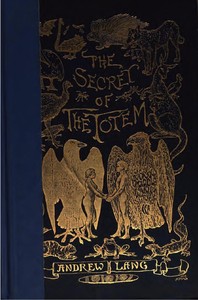
The Secret of the Totem by Andrew Lang
Andrew Lang, the man who brought us those beautiful Fairy Books in every color of the rainbow, takes a sharp turn here. In The Secret of the Totem, he's not collecting stories; he's trying to solve a historical mystery. The book is his attempt to explain the widespread practice of totemism—where groups of people believe they are descended from or spiritually linked to an animal, like a bear, wolf, or eagle.
The Story
There isn't a traditional plot with characters. Instead, Lang presents his case like a lawyer or a detective. He gathers evidence from all over the world: accounts from Native American tribes, Aboriginal Australians, ancient Egyptian customs, and even old Scottish clan traditions. He lays out these examples to show how common this belief in animal kinship really is. His central argument, his 'secret,' is that it might have all begun with a case of mistaken identity. He suggests that long ago, people were given nicknames based on animals (like 'the swift deer' or 'the wise owl'). Over generations, the literal meaning was lost, and later descendants took the name seriously, believing they were actually related to that animal. The book follows Lang as he tests this idea against the evidence, seeing if this simple explanation can unlock a complex global phenomenon.
Why You Should Read It
What makes this book special is Lang's voice. He's not a cold, distant scholar. You can feel his curiosity and his excitement when he finds a piece of folklore that fits his puzzle. Reading it feels like following a very enthusiastic, well-read friend down a rabbit hole of history and myth. He connects dots you'd never think to connect, asking why the same patterns show up in places that had no contact with each other. It makes you look at old stories and symbols in a new light. You start seeing potential 'totems' everywhere—in national flags, company logos, and sports team mascots. It’s a book that stretches your imagination about human thought.
Final Verdict
This is a perfect book for curious minds who enjoy historical detective work and big ideas. It's for readers of popular science or history who like Jared Diamond's broad theories, but in a shorter, literary package. Fans of Lang's fairy tales will get a kick out of seeing the mind behind the collections at work on a different problem. Be warned: some of his 1900s-era attitudes and terms are outdated, so read it as a product of its time. But if you can look past that, you'll find a genuinely engaging and provocative little book that tackles the huge question of why humans tell the stories they do.
This digital edition is based on a public domain text. It is now common property for all to enjoy.
Jennifer Johnson
11 months agoI was particularly interested in the case studies mentioned here, the objective evaluation of the pros and cons is very refreshing. Well worth the time invested in reading it.
Richard Hernandez
3 months agoThe methodology used in this work is academically sound.
Joseph Garcia
11 months agoExactly what I was looking for, thanks!
Jennifer Wilson
6 months agoI was particularly interested in the case studies mentioned here, the emphasis on ethics and sustainability within the topic is commendable. Finally, a source that prioritizes accuracy over hype.



James Martinez
1 month agoComparing this to other titles in the same genre, the emphasis on ethics and sustainability within the topic is commendable. It’s hard to find this much value in a single source these days.